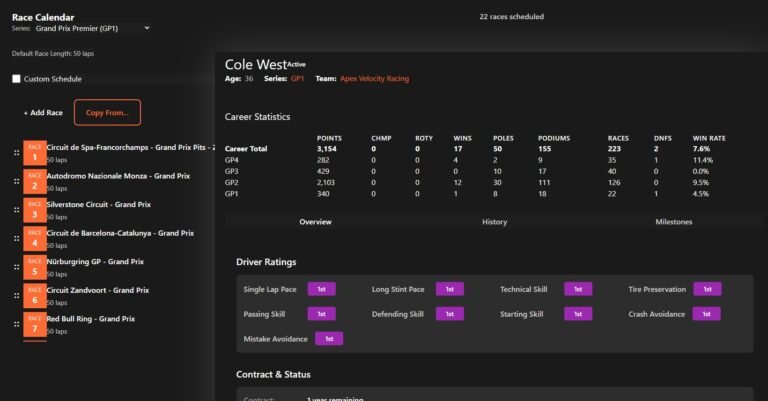
Career Mode progression works nothing like official iRacing racing. Instead, it borrows its structure from real world driver development. There are no license classes or safety ratings inside careers. Objectives decide whether you climb, stall, or fall back down.
Also See
➡️ Career Mode ladders explained, all seven paths
🏁 iRacing development update, August 2026
Each season, meanwhile, hands you predetermined targets through the objective system. Hit the required performance level and you advance a level. The main target usually centers on your championship standing position.
Bonus objectives also sit beside the main target every season too. Examples include leading 75 laps across a season campaign. Winning a race or averaging top five finishes also appear.
Those bonuses matter because they feed your career points total. Career points drive the global leaderboards unique to this mode. Strong seasons therefore count twice, once for advancement and once globally.
Failure, however, carries real consequences inside a career, by design. Miss your advancement target and you spend a re-do opportunity. The game calls those second chances mulligans, and they are limited.
Run out of mulligans and the career can demote you. In the worst case, you start that career over entirely. That risk gives late season races genuine pressure and weight.
Mulligans also interact with your leaderboard score in another way. Every re-do you take lowers your overall leaderboard score. Clean first attempts are worth more than rescued seasons overall.
Difficulty settings therefore let players tune how harsh this feels. Raise the difficulty and the AI fights harder each week. Lower it and the same ladder becomes a relaxed cruise.
Race length and schedule depth scale with your level too. Early steps run shorter races on tighter seasonal schedules. Higher levels stretch both, mirroring real world career demands better.
Players can adjust those settings directly for each season. A busy driver can shorten schedules without abandoning a ladder. A hardcore driver can stretch everything toward full realism instead.
Advancement criteria stay performance based rather than participation based throughout. Simply showing up does not move you up the ladder. The system expects results, just like a real team owner would.
That structure separates Career Mode from official series racing clearly. Online racing rewards consistency across a whole community season instead. Career Mode judges you against targets set for your level.
It also creates natural storylines inside a single player save. A blown engine or one bad week can threaten promotion. Protecting a mulligan becomes part of your season long strategy.
The designers behind this system bring real paddock experience. Sim racers, internal designers, a former team manager, and professional drivers contributed. That mix shows in how unforgiving the structure can feel.
Career Mode progression also respects how real careers actually bend. One bad season rarely ends a real driver story outright. Mulligans mirror those second chances that real teams sometimes grant.
Still, the score penalty keeps those rescues honest for everyone. A rescued season should never outscore a clean one overall. That balance keeps Career Mode progression credible on the leaderboards.
Tell us in the comments whether demotion belongs in a single player career.