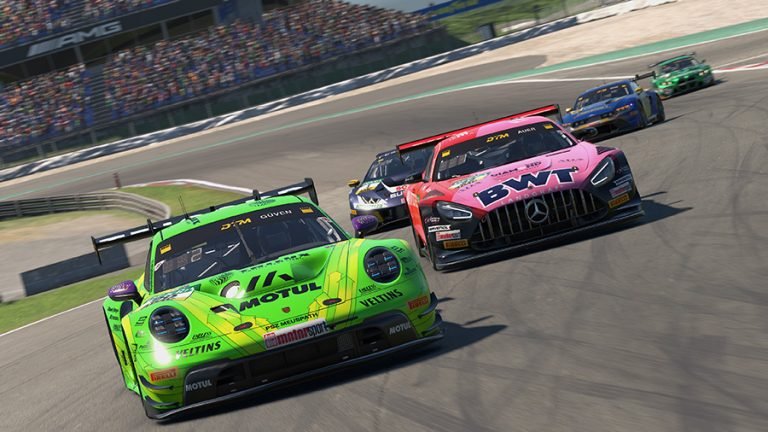
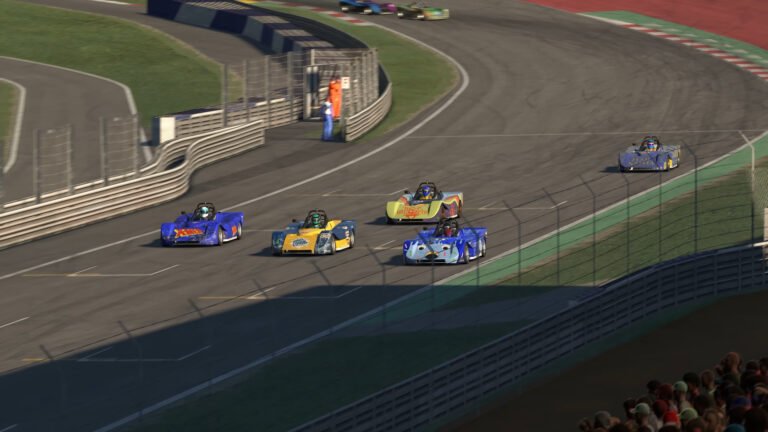
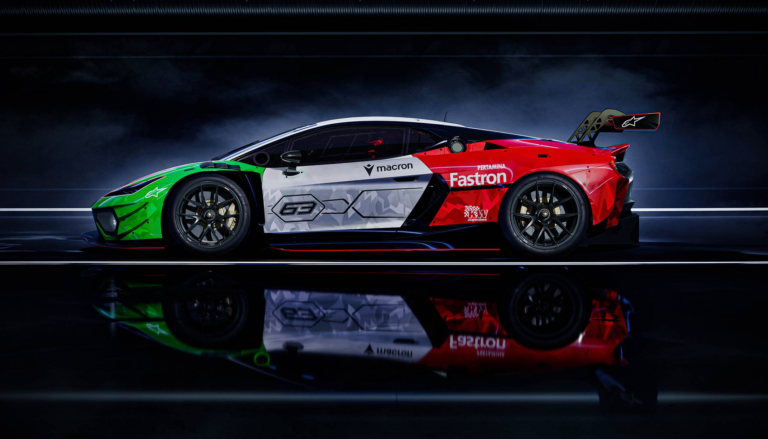
iRacing realism is the platform’s founding promise. Laser-scanned tracks, manufacturer-licensed physics, a tire model built over years of iteration. If you want to know what real racing actually feels like, iRacing is the closest accessible alternative to being in the car itself.
That promise holds almost everywhere. Plate racing is where it breaks down, and the breakdown is worth discussing because the problem is not a bug. It is a philosophy.
iRacing built its identity on accuracy. The iRacing realism pitch is straightforward: if you want to know what it actually feels like to race, iRacing is your closest option short of an actual car. Professional drivers train in it. Broadcasters reference it as a legitimate benchmark. The realism is the product.
That promise holds across most of the content library. Road courses respond to driver inputs in ways that make sense. Ovals with mechanical grip reward setup work and consistent lines. The feedback loop functions: input, response, consequence, improvement.
Plate Racing Breaks the Loop
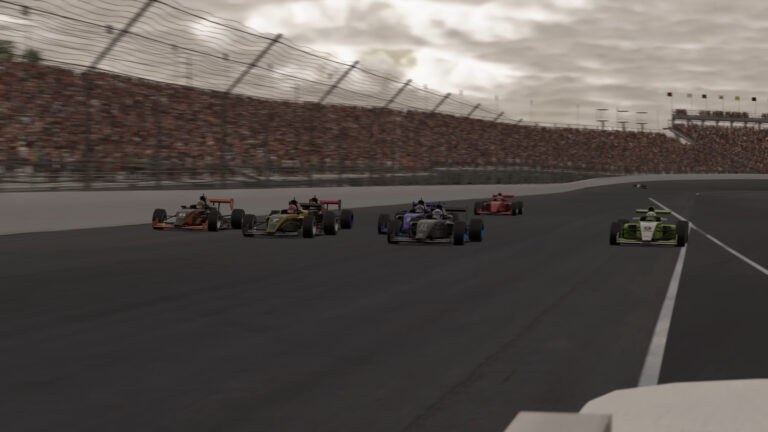
The structural problem is this: superspeedway racing in real life is chaotic by design. Forty cars at 200 miles per hour, equalized by restrictor plates, racing inches apart in a pack where one wrong move triggers a chain reaction. Real Cup drivers describe these events as the most mentally draining races of the year. Not because the skill ceiling is higher, but because control is partially surrendered to the group.
iRacing models that accurately. The chaos is intentional. The drafting physics reflect genuine superspeedway dynamics. From a technical standpoint, the simulation is doing its job.
The problem is that real-world chaos is navigable in an actual car because the driver’s body is processing information the eyes cannot catch alone. G-forces, seat vibration, the sound of the engine under aero load. All of it communicates what is happening at the edge of grip and the limit of the draft. Sim racers get none of that. The chaos remains, but the physical anchors that make it readable are gone. What should feel tense feels random instead.
What Updates Have Fixed (and What They Have Not)
iRacing has made changes to the superspeedway package in recent seasons. Some have helped. The community reaction has been cautiously positive in places and skeptical in others, because the adjustments targeted specific physical variables without addressing the wider translation problem: some real-world dynamics become friction in a sim environment precisely because the body is not present to interpret them.
This is not a unique iRacing realism failure. Every high-fidelity simulator faces the same ceiling. The physics can be right, and the experience can still miss. Plate racing is just where the gap is most visible and most discussed.
iRacing Realism and the Question for 2026
None of this is an argument for abandoning accuracy. iRacing’s standards are what justify the investment. The argument is that iRacing realism and a good sim experience are not always the same goal, and that at the superspeedway, the platform has prioritized one at the expense of the other.
The target for 2026 should not only be a more accurate plate racing model. It should be a plate racing model that a driver can actually feel, learn from, and improve at. Because right now, too much of what happens in the draft feels like it is happening to the driver rather than because of them.
iRacing gets the experience right everywhere else. iRacing realism, at its best, is what makes the sim worth the investment. Plate racing remains the clearest area where that promise still needs work. For drivers looking to add more data and feedback to their sim sessions in the meantime, our look at Digital Race Engineer covers one of the more capable tools available for iRacing.