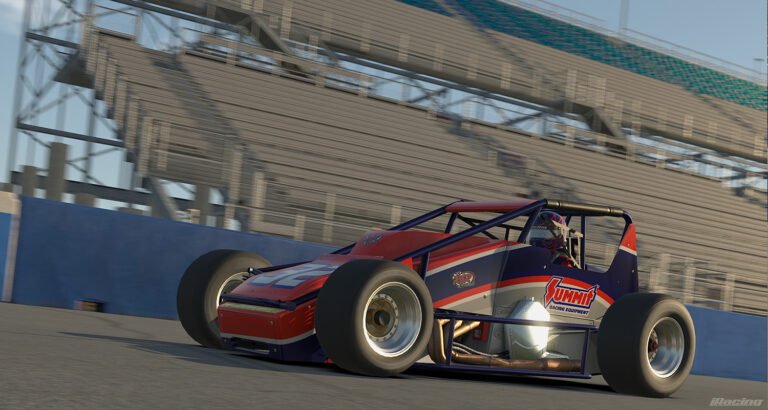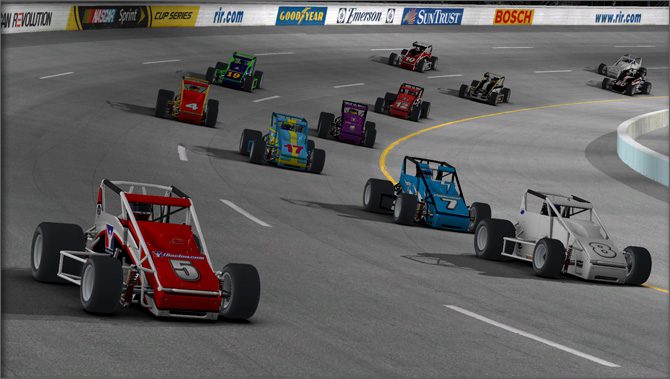
Mastering the iRacing Sprint Car guide requires a fundamental shift in how you approach oval racing. This isn’t a stock car with soft springs and a heavy chassis; this is an 800-horsepower “roller skate” that demands the precision of a formula car with the bravery of a bullring specialist. Driving a pavement sprint car is a balancing act of extreme power and minimal weight. To find speed, you must respect the direct drive system and learn to manage a car that features four unique tire sizes. This guide covers the essential techniques to keep the 410 cubic inch beast pointing in the right direction.
The Direct Drive Dilemma: Throttle over Brakes
The first rule of any iRacing Sprint Car guide is understanding the direct drive system. Because there is no clutch or transmission to soak up the energy, the connection between your right foot and the rear wheels is instantaneous. At 650 lb-ft of torque, “stabbing” the throttle will not just spin the tires—it will likely swap the front of the car for the rear. You must learn to “roll” into the throttle with extreme finesse. Think of an egg sitting under your pedal; you want to squeeze the power out without ever breaking the shell.
[Image showing a comparison of throttle telemetry: smooth “rolling” vs. jagged “stabbing” inputs]
Braking in the sprint car is equally unique. While you have strong brakes, using them too aggressively can “shock” the direct drive system and stall the engine or upset the chassis. Many pro drivers use the brake primarily to set the “attitude” of the car on entry, using a light touch to pin the nose down before letting the engine’s torque pull the car through the apex. In this car, the throttle is your primary steering tool. If the car isn’t turning, a slight lift or a tiny squeeze of gas will rotate the car far more effectively than cranking the steering wheel.
Asymmetrical Handling: The Power of Stagger
A critical technical aspect of the iRacing Sprint Car guide is managing tire stagger. Unlike almost any other car on the service, every tire on a sprint car is a different size and compound. “Stagger” is the difference in circumference between the right-rear and left-rear tires. Because the axle is locked, a larger right-rear tire naturally wants to push the car to the left. This is what allows a sprint car to “hook” into a corner at 140 MPH.
However, stagger is a double-edged sword. Too much stagger will make the car “loose” (oversteer) under power, while too little will cause it to “push” (understeer) toward the outside wall on exit. As the race progresses and your right-rear tire heats up and expands, your effective stagger changes. You must monitor your tire temperatures and adjust your driving line accordingly. If the car starts getting loose late in a run, you may need to “straighten” your corner exits to save the right-rear rubber from shredding under the 800-horsepower load.
Finesse in the Bullring: Managing 800 HP
In a 25-mile feature, the iRacing Sprint Car guide emphasizes conservation. It is incredibly tempting to use all 800 horses on every straightaway, but doing so will heat the tires to a point where they lose all grip. The fastest drivers are often the ones who look the “slowest”—they are the ones who aren’t sliding, aren’t counter-steering constantly, and aren’t spinning the wheels. Smoothness is the only way to make the tires last until the checkered flag.
Advanced Setup: Torsion Bars and Cross Weight
While the car is brutish, the setup options are surprisingly delicate. Instead of traditional coil springs, the sprint car uses torsion bars. These bars act as the “springs” of the car, and changing their diameter drastically alters how weight transfers during cornering. A stiffer right-rear bar will help the car drive off the corner but can make it “skatty” over bumps. Most top-split setups focus on “cross weight” to ensure the car stays balanced under the massive torque of the 410 engine. Small adjustments to the torsion bar stops can be the difference between a podium finish and a trip into the catch fence.
Summary: The Ultimate Car Control Teacher
To conclude this iRacing Sprint Car guide, remember that this car is the ultimate teacher of car control. There are no electronic aids, no downshift blips, and no second chances. It forces you to develop a “feel” for the limit that applies to every other car on the service. Once you can tame the pavement sprint car at a bullring like Irwindale or Winchester, you will find that almost every other car feels like it’s moving in slow motion. Respect the power, manage your stagger, and keep your foot out of the radiator.