Neck and shoulder pain from sim racing is a fixable problem. The soreness usually shows up hours after a session, or the next morning. Without addressing the root cause, it compounds as you add time in the rig. The r/simracing community has worked through this in detail, and the answers consistently point to a few specific things.
Why Sim Racing Causes Neck and Shoulder Pain
The primary cause is static load. When you hold the same position for a long time, the muscles supporting your head and shoulders work continuously without rest. Sim racing adds to that because you grip the wheel, resist force feedback, and react throughout the session.
Posture that feels fine for 30 minutes becomes a problem at the two-hour mark. Forward head position is the most common culprit. When your head sits in front of your shoulders instead of directly above them, the load your neck muscles carry increases significantly. Most sim racers with chronic neck pain sit too far from the wheel and push their heads forward to stay on screen.
Shoulder tension from force feedback is the other main contributor. High FFB levels require sustained muscle engagement to hold through corners. That tension builds across a session and concentrates around the base of the neck and the upper trapezius.
Fix Your Seat Position First
The fix that most sim racers land on is moving the seat closer to the wheel. When your arms have a slight bend at the elbow in your natural grip position, you no longer have to lean forward. As a result, your spine stays neutral, your head stays over your shoulders, and the static load on your neck drops considerably.
Seat angle matters as well. Most sim rigs allow for some recline. A few degrees of recline changes how your spine stacks and takes sustained load off your upper back and shoulders. However, too much recline creates reach problems. Find the point where your back is supported and your arms reach the wheel without your shoulders pulling forward.
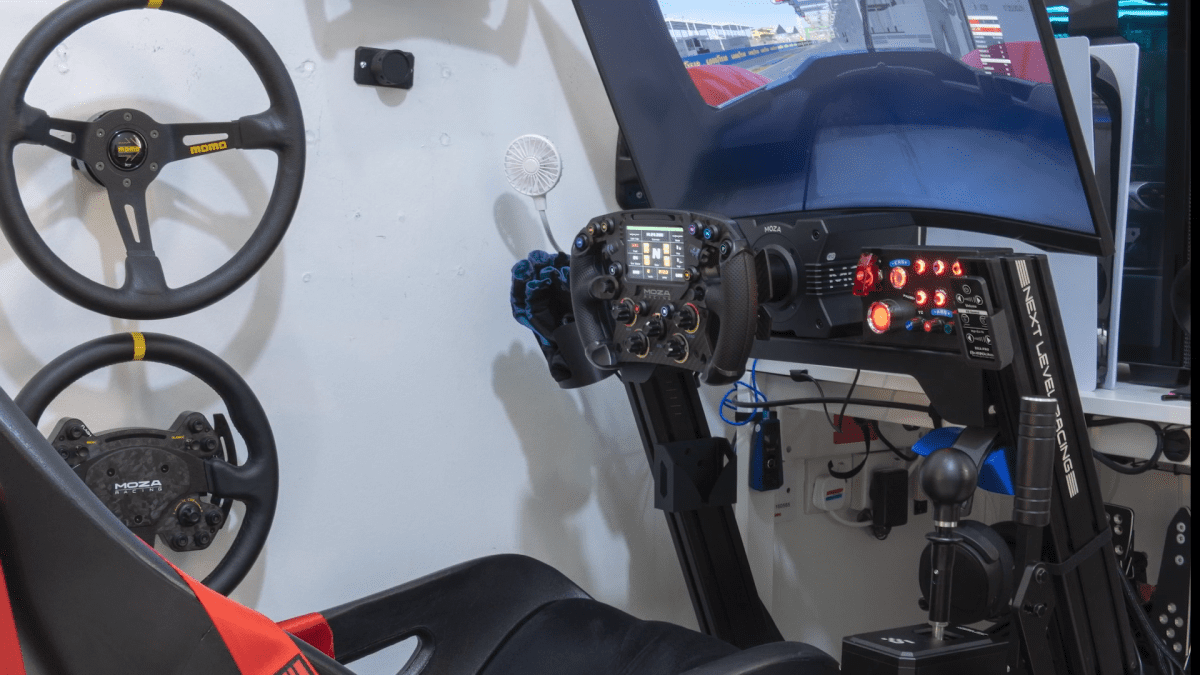
Some sim racers with persistent issues have moved to bucket seats with proper side bolsters. The bolsters remove the tendency to shift around during long stints. That sideways movement puts repeated lateral stress on the neck and adds up over time.
Wheel Height and Distance
Wheel position is the second most important variable. If the wheel sits too low, your shoulders roll forward to reach it. If it sits too high, you elevate your arms and load the tops of your shoulders throughout the session.
The position that works for most sim racers places the wheel center at roughly elbow height when your arms are relaxed at your sides. That keeps your arms in a natural position and reduces the sustained shoulder elevation needed to hold the wheel.
Reach causes more pain than most people expect. When you extend your arms further than a relaxed bend to grip the wheel, the muscles running from your shoulder blades to your neck tighten to stabilize the joint. That tightness compounds over a session. Pulling the seat forward even a few centimeters can make the difference.
Lower Your Force Feedback
High FFB strength requires sustained effort from your hands, wrists, and the muscles running up your forearm into the shoulder. Some sim racers run FFB levels much higher than needed for useful feedback, and their upper bodies pay for it over a full race session.
A more conservative FFB level that still gives you clear feel through corners reduces the sustained load. Start by lowering overall strength by 10 to 15 percent and run a full session. If you lose useful information from the car, bring it back up incrementally. Most drivers find a setting that gives them good feel at a fraction of the physical load they were running before.
Steering ratio also plays a role. A quicker steering ratio means shorter rotations through corners, fewer inputs per lap, and less accumulated work on your shoulders over a full race.
Take Breaks Between Sessions
Static posture for more than an hour causes muscle tension to build, regardless of how good your rig setup is. Sim racers who avoid chronic pain tend to take breaks at natural points. Between races is the obvious time. Even a few minutes of movement resets the muscles and prevents the cumulative tightening that becomes soreness the next morning.
Neck rolls, shoulder shrugs, and chest openers address the specific areas that load up during sim racing. The chest opener counteracts the rounded shoulder position that time in a rig promotes: clasp your hands behind your back, lift gently, and open your chest forward. Some sim racers do these between every race as a habit, rather than waiting until something hurts.
What the Community Has Found
The community consensus is consistent: seat position changes matter more than any recovery routine. Fixing the root cause, which is sustained load from poor rig setup, is more effective than managing symptoms afterward.
Some sim racers have run sessions at lower FFB intensity specifically to test how much discomfort went away. For many, the answer was most of it. Recalibrating FFB and pulling the seat forward solved the problem without anything else changing.
Recovery tools like massage guns and foam rollers focused on the upper back and trapezius help with soreness that has already developed. They are not a replacement for fixing the setup, but they are a useful bridge while you are still dialing things in.