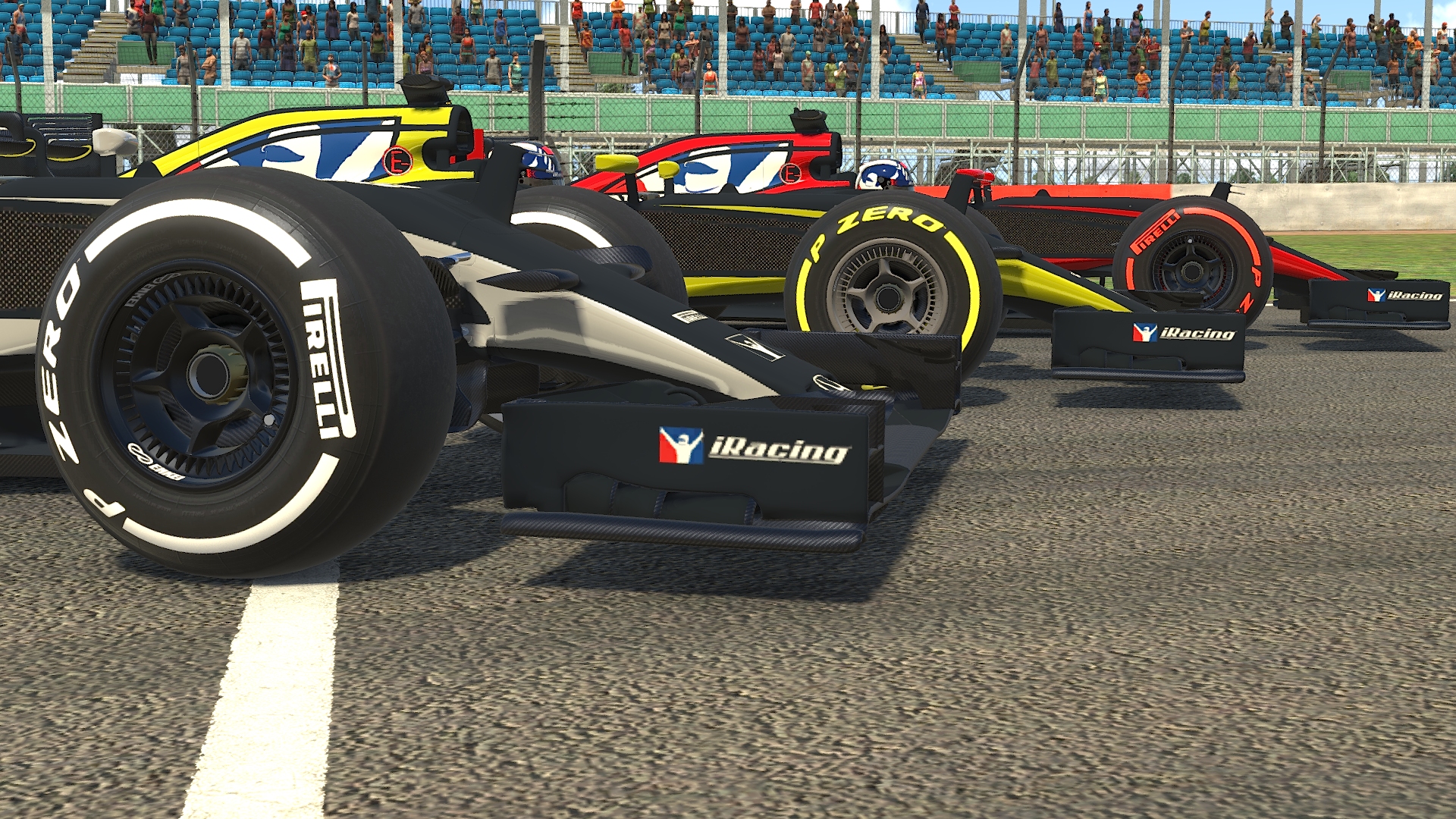
iRacing flat spotting is the feature the sim is missing. Lock a brake into Turn 1 at Monza in real life and you’ve got a problem that follows you for the rest of the race. That flat spot on your tire vibrates through the steering wheel, shakes the car at speed, and gets progressively worse as the rubber wears unevenly. You can’t fix it without a pit stop. It punishes the mistake for as long as you’re on that set of tires.
In iRacing, you lock a brake, the tires smoke for a second, and then you carry on like nothing happened. That’s a problem.
What Flat Spotting Actually Does
In real-world racing, a flat spot occurs when a tire stops rotating while the car is still moving. The locked wheel drags across the pavement, grinding a flat section into the rubber. The severity depends on how long the lockup lasts and how fast you were going when it happened.
The consequences are immediate and lasting. A flat-spotted tire creates vibrations that increase with speed. At best, it’s distracting. At worst, it compromises your ability to brake consistently, unsettles the car in high-speed corners, and accelerates wear on suspension components. Drivers have to make a strategic call: pit early and lose track position, or try to nurse the damaged tire to the planned window.
That decision, that consequence, is entirely missing from iRacing.
Why iRacing Flat Spotting Would Make Racing Better
Sim racing’s whole value proposition is consequence-based competition. The reason iRacing works is that actions have outcomes. You crash, you lose iRating. You overshoot your pit box, you lose time. Every second of a race involves risk-reward calculations.
Flat spotting fits perfectly into that framework. It would add a real penalty for sloppy braking without requiring a full-contact incident. Right now, you can mash the brake pedal into a corner, lock up for half a second, and the only cost is a slightly compromised entry. There’s no lingering punishment. No strategic ripple effect.
With flat spotting, that same lockup could cost you the race. Not immediately, but through accumulated tire damage that forces an early stop or makes the car undriveable in the closing laps. It would reward smooth, precise braking, and it would make trail braking a genuine skill differentiator rather than just a speed tool.
For endurance racing especially, flat spotting would add a layer of strategic depth that’s currently absent. Drivers would have to weigh aggressive braking against the long-term health of their tires. Crew chiefs (in team events) would need to monitor tire condition and adjust strategy on the fly.
The Counter-Argument: Frustration Factor
The pushback against adding flat spotting usually comes down to accessibility. iRacing already has a steep learning curve. Adding another way for a race to go wrong, especially one tied to a skill that newer drivers struggle with, could push casual players away.
There’s some merit to that concern. A new driver who locks up three times in the first stint and then has to limp around on a vibrating tire for 20 minutes isn’t having fun. And iRacing needs its casual players to keep the participation numbers healthy.
But the same argument could be made against tire wear itself, or fuel consumption, or any of the other systems that create consequences. The solution isn’t to remove consequences. It’s to scale them appropriately and give drivers the tools to understand what’s happening.
How Other Sims Handle It
Assetto Corsa Competizione models flat spotting with meaningful fidelity. Lock a tire in ACC and you’ll feel it for the rest of the stint. The vibration is persistent, it affects handling, and it forces you to make pit strategy decisions around damaged rubber. It works, and it makes brake management a core part of the racing experience.
rFactor2 has also implemented flat spotting in its tire model, with varying degrees of severity depending on the surface, speed, and duration of the lockup. It’s been part of that sim’s DNA for years, and it’s one of the reasons rF2 enthusiasts consider it the benchmark for tire physics.
iRacing’s tire model has come a long way with NTMv7 and beyond, but the absence of iRacing flat spotting remains one of the most noticeable gaps compared to its competitors.
Where It Sits on the Priority List
Let’s be realistic about iRacing’s development roadmap. The team is working on the next generation tire model, the Spark graphics engine, Career Mode, and a long list of car and track updates. Flat spotting, while desirable, probably isn’t near the top of that list.
And that’s understandable. The tire model improvements they’re already pursuing will lay the groundwork for features like flat spotting to be implemented properly. You can’t model tire damage well if the base tire physics aren’t there yet. If you want to see what iRacing actually has confirmed in the pipeline, check the Build Tracker for the latest updates.
The case for iRacing flat spotting is clear. iRacing prides itself on being the most realistic online racing simulation. And in most areas, it earns that title. But every time you lock a brake and drive away with zero consequences, the immersion takes a hit. Flat spotting wouldn’t just add realism. It would add depth, strategy, and a meaningful skill gap between drivers who manage their brakes and those who don’t. It’s a feature the sim needs, and one that would make every race just a little more honest.