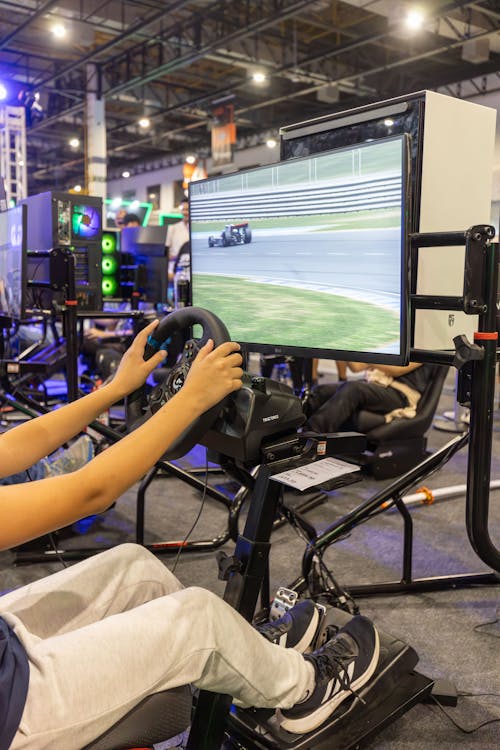
Pedals are the most underrated upgrade in sim racing. Most new iRacers spend the bulk of their budget on a wheel and treat pedals as an afterthought, but experienced drivers will tell you the opposite: good pedals make a bigger difference to your lap times than a good wheel. Consistent braking is the foundation of fast, clean racing, and the right pedals make consistent braking possible.
This guide covers the best sim racing pedals for iRacing in 2026, organized by price tier. We explain the key technology differences, recommend specific products at each level, and help you figure out when and where to upgrade.
Why Pedals Matter More Than You Think
In iRacing, braking is where most time is won and lost. Hitting the same braking point with the same pressure on every lap is what separates consistent racers from inconsistent ones. Your pedals directly determine how accurately and repeatedly you can apply brake pressure, which makes them arguably the most performance-critical piece of hardware in your rig.
The throttle pedal matters too, especially for rear-wheel-drive cars where progressive throttle application prevents wheelspin on corner exit. But the brake is where the biggest gains live, and that is why the brake pedal technology in your pedal set is the single most important spec to evaluate.
Potentiometer vs Load Cell: The Core Difference
Budget pedals use potentiometers. These sensors measure how far the pedal travels. Push the brake halfway down, and the game registers 50% brake input. The problem is that humans are not great at judging pedal distance consistently. You might push the brake 48% one lap and 53% the next, and that 5% variation translates directly to inconsistent braking performance in the sim.
Load cell pedals measure how hard you push, not how far. This is how real race car brakes work. Your leg muscles are far better at reproducing a specific force than a specific distance, so load cell pedals let you hit the same brake pressure lap after lap with much less effort. The difference is immediate and dramatic. Most racers who switch from potentiometer to load cell brakes report more consistent lap times within their first session.
If you take one thing from this guide, let it be this: upgrading to a load cell brake is the single best hardware investment you can make for iRacing performance. It matters more than wheel torque, more than screen size, and more than rig stiffness.
Budget Tier: Under $200
Thrustmaster T-LCM Pedals
The Thrustmaster T-LCM pedals are the most affordable load cell pedals worth buying. Priced around $170-200, they include a load cell brake, a Hall effect throttle, and a potentiometer clutch. The load cell brake is the key feature here, and it performs well above its price point. You get adjustable brake stiffness through interchangeable rubber inserts, and the overall build quality is solid metal construction.
For iRacing, the T-LCM delivers the consistency advantage of load cell braking without requiring a major investment. If you are running a Logitech or Thrustmaster wheel and want the biggest performance upgrade available, these pedals should be your first purchase. They connect via USB, so they work with any wheel base regardless of brand.
Logitech G923 Pedals (Bundled)
If you bought a G923 bundle, you already have these pedals. They use potentiometers for all three pedals and include Logitech’s TrueForce braking system, which adds some resistance to the brake pedal. They are functional and fine for getting started, but upgrading to load cell pedals is the most impactful change you can make to this setup. Keep the G923 pedals until you have budget for T-LCM or better.
Mid Tier: $200 to $500
Moza CRP2 Pedals
The Moza CRP2 pedals are priced around $400 and represent a significant step up from the T-LCM. They feature a 200 kg load cell brake with adjustable stiffness and travel, Hall effect sensors on all pedals, and a sturdy aluminum construction. The brake feel is excellent, with a progressive resistance curve that closely mimics the hydraulic brakes found in real race cars.
In iRacing, the CRP2 delivers precise and repeatable brake modulation that helps you carry more speed into corners and hit your marks consistently. The adjustable stiffness lets you tune the brake feel to match your preference, from a soft and progressive feel to a firm and responsive one. If you are running Moza wheels, these pedals integrate seamlessly into the Moza ecosystem.
Fanatec CSL Pedals with Load Cell Kit
The Fanatec CSL Pedals start as a basic potentiometer set around $80, but adding the Load Cell Kit ($150) transforms the brake into a legitimate load cell pedal. The total package comes in around $230 for a two-pedal set, making it one of the most affordable load cell options if you buy into the Fanatec ecosystem. Build quality is adequate for the price, and the load cell brake performs well in iRacing.
High Tier: $500 to $800
Heusinkveld Sprint Pedals
The Heusinkveld Sprint pedals are the benchmark that every other pedal set in this price range is measured against. Priced around $520-580 depending on configuration (two or three pedals), they feature a 120 kg load cell with up to 65 kg of usable braking force, all-metal construction, and exceptionally precise sensors.
The brake feel on the Sprints is outstanding. The resistance is firm, progressive, and consistent in a way that cheaper load cells simply cannot match. In iRacing, this translates to the ability to modulate braking pressure with surgical precision. Trail braking into a corner becomes intuitive because the pedal gives you clear tactile feedback about how much force you are applying. Many competitive iRacers consider the Sprints the last set of pedals they will ever need to buy.
Fanatec ClubSport V3 Pedals
The Fanatec ClubSport V3 pedals are priced around $360 and offer a strong alternative to the Sprints at a lower price. They feature a load cell brake with vibration motors that simulate ABS feedback, Hall effect sensors on the throttle and clutch, and damper kits for adjustable pedal feel. The ABS vibration is a unique feature that provides an additional tactile cue when braking at the limit in cars with ABS systems.
For iRacing, the V3s are excellent. The load cell brake is precise and responsive, and the vibration feedback adds a layer of immersion that helps with brake modulation in GT3 and other ABS-equipped cars. If you value the ABS vibration feature and want a complete three-pedal solution at a competitive price, the V3s are a strong choice.
The Upgrade Path That Makes Sense
If you are starting from scratch on a budget, buy the cheapest wheel bundle you can find and plan to upgrade the pedals first. A Logitech G923 bundle with a T-LCM pedal upgrade gives you a load cell brake for roughly $450 total, and the braking consistency improvement is transformational.
If you are already running potentiometer pedals and want the best single upgrade, jump straight to the Heusinkveld Sprints if your budget allows. They are a buy-once product that will outlast multiple wheel upgrades. If the Sprints stretch your budget too far, the Moza CRP2 or Fanatec V3 are excellent alternatives that deliver load cell precision at a lower price.
The key principle is this: do not overspend on a wheel while running cheap pedals. A $300 direct drive base with $500 pedals will make you faster than a $800 base with the pedals that came in the box. Prioritize the brake, because that is where lap time lives.