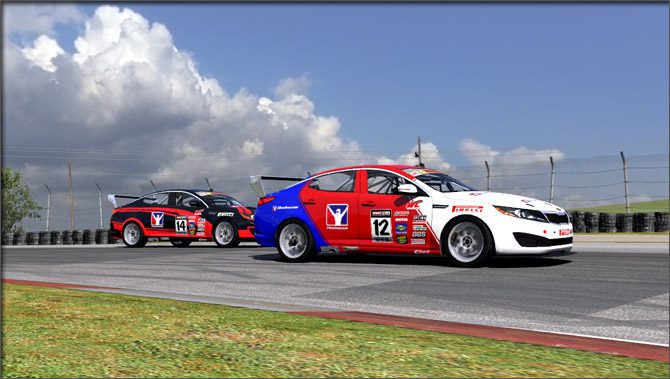
The Kia Optima GX iRacing launch in August 2012 was a watershed moment for the sim racing road community. As the build went live, the “Optima” immediately became a polarizing but popular addition. It was the first time iRacing members were forced to deal with “torque steer” and the unique weight transfer of a FWD racing platform. The launch successfully proved that FWD racing wasn’t just “easy” or “slow”—it was a technical discipline that required a completely different set of skills to master.
The Reality of Turbo Scrub
On the Kia Optima GX iRacing launch day, drivers were quick to realize that “mashing” the throttle was a recipe for disaster. With 310hp going through the front wheels, the car is prone to massive understeer if you aren’t smooth with your inputs. The launch showcased a machine that rewards “throttle steering.” By lifting off the gas mid-corner, the weight shifts forward, allowing the rear of the car to rotate. This “pendulum” style of driving was a revelation for many, leading to some of the most exciting and unconventional racing seen in the Global Challenge series to date.
Setting the FWD Standard
The Kia Optima GX iRacing launch saw the car dominate the participation charts in its debut week. Drivers praised the visceral turbo whistle and the “growl” of the 2.0L engine, noting that the car felt significantly more modern than the legacy roadster options. The launch also highlighted the car’s “dive” under braking; because so much weight is at the front, the Optima rewards a very specific braking technique to prevent rear-locking. It was a successful debut that solidified Kia’s place in sim racing history and provided a permanent home for touring car enthusiasts on the platform.