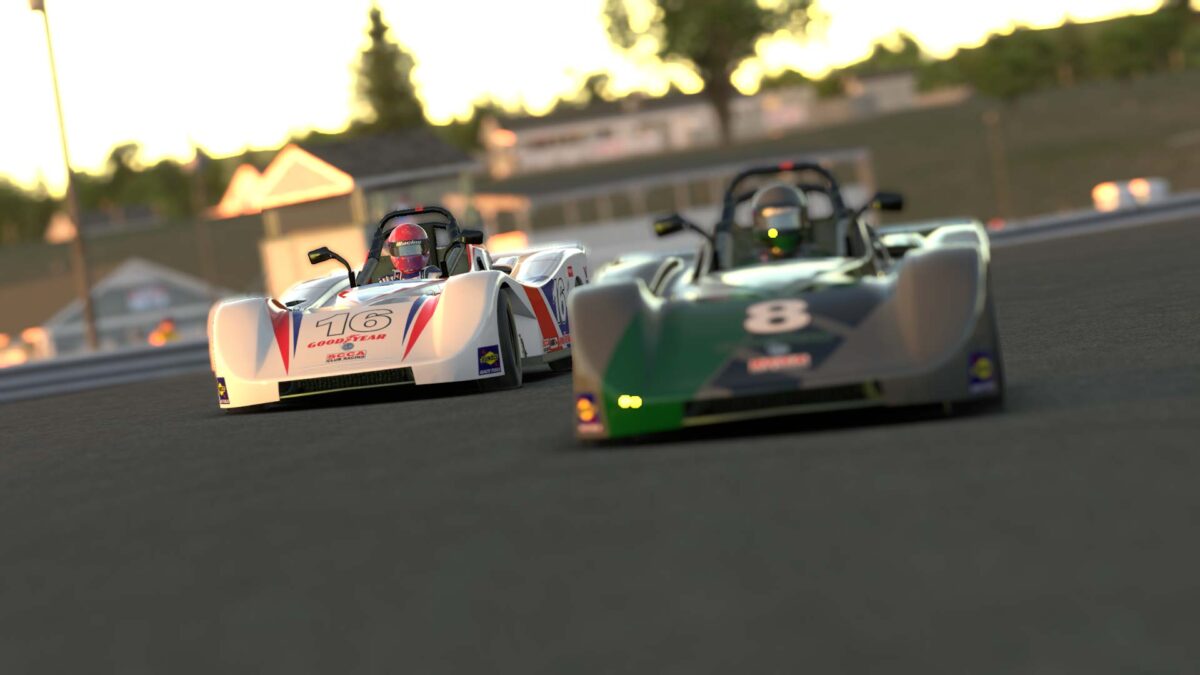
If you grew up driving the original 1.9L Spec Racer Ford, the Spec Racer Ford MKII iRacing update (Gen3) will feel like a completely different animal. While the fiberglass body and tube frame look familiar, the soul of the car has been transformed. The shift from the low-revving 1.9L engine to the 1.6L Ford Sigma unit, combined with a 6-speed sequential gearbox, requires a total overhaul of your driving style. This driving school article focuses on the key differences and teaching you how to adapt to the new “Gen3” era of SCCA racing.
From Lugging to Screaming: The Engine Revolution
The biggest hurdle for veterans of the original car is the shift points. In the 1.9L Spec Racer Ford iRacing model, the power band peaked early, and “lugging” the engine in a higher gear was often the fastest way through a corner. In the Spec Racer Ford MKII iRacing version, the rules have changed. The 1.6L Sigma engine loves to rev. You now have 135 horsepower at your disposal, and you need to keep the engine singing at the top of its range to find speed. If you shift too early like you did in the old car, you will be left behind on the straights.
[Image showing the RPM gauge comparison between the 1.9L and 1.6L dash displays]
The sequential gearbox is the other game-changer. You no longer have to worry about the H-pattern dance or heel-and-toe downshifting to keep the car stable. The Spec Racer Ford MKII iRacing model allows for clutchless upshifts, meaning you can keep your foot pinned to the floor during gear changes. However, downshifting requires more finesse. You still need to rev-match or “blip” the throttle during downshifts to prevent the rear tires from locking up and sending you into a spin. The car is faster, but it demands more precision from your right foot.
Handling the Weight Loss: More Agile, Less Predictable
The Spec Racer Ford MKII iRacing update shaved nearly 100 pounds off the total weight of the car. While this makes the car more agile in chicanes, it also makes it more reactive to weight transfer. The original 1.9L car was famous for its “lift-off oversteer,” but its heavier weight made that rotation feel somewhat slower and more predictable. The MKII is much “sharper.” When you lift the throttle now, the nose tucks in instantly. This is a powerful tool for rotating the car, but if you aren’t ready for it, the rear will step out much faster than it used to.
To master the Spec Racer Ford MKII iRacing handling, you must be “liquid-smooth” with your brake release. The new radial tires offer more peak grip than the old bias-ply tires, but they have a sharper drop-off point. Once you exceed the limit of the radials, the car is harder to catch. Practice trail-braking deep into the corner to keep the nose pinned, then transition smoothly to the throttle. The extra 30 horsepower means you can now use the gas to “settle” the rear end much more effectively than in the 1.9L car.
Braking and Bias Adjustments
In the original car, braking was a delicate balancing act to avoid the “death spin.” In the Spec Racer Ford MKII iRacing model, the brakes feel more robust, but the increased top speed means you are arriving at corners much faster. You will need to move your braking markers back significantly. Many drivers find that a slightly more forward brake bias (around 54-56%) helps stabilize the car under heavy deceleration. As you get more comfortable with the MKII’s agility, you can move the bias rearward to help the car rotate during turn-in.
Summary: Relearning the Momentum Monster
Transitioning to the Spec Racer Ford MKII iRacing is about embracing modern performance while respecting the car’s roots. You still need to preserve momentum, but you now have the tools to be much more aggressive. Use the sequential box to your advantage, keep the 1.6L engine in its power band, and respect the increased agility of the lightened chassis. Whether you missed the old 1.9L or are just starting your SRF journey, the MKII represents the ultimate evolution of SCCA club racing. See you on the grid for the next official session.