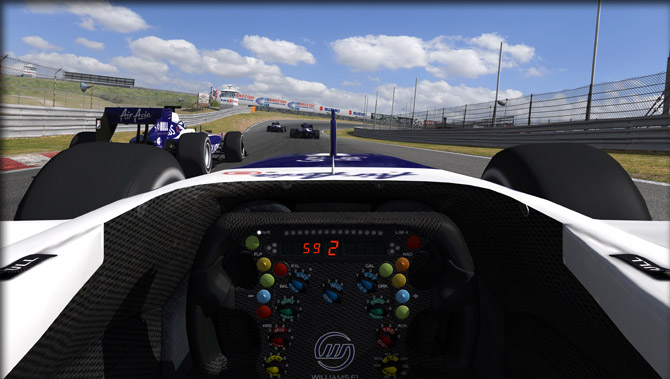
This Williams-Toyota FW31 iRacing guide explores the technical mastery required to drive a modern Formula 1 car. The FW31 is not just a fast vehicle; it is a complex engineering marvel. To find speed, you must understand how aerodynamic downforce and mechanical grip interact. This guide covers the essential physics, setup theories, and driving techniques needed to tame the 740-horsepower beast. Whether you are a veteran or a newcomer, mastering the Williams FW31 will elevate your sim racing skills to a professional level.
The Aerodynamic Philosophy of the FW31
The core of any Williams-Toyota FW31 iRacing guide must begin with aerodynamics. Unlike lower-tier open-wheelers, the FW31 produces thousands of pounds of downforce. This air pressure “glues” the car to the track, allowing for cornering speeds that seem impossible. However, this downforce is incredibly sensitive to the car’s “attitude” or rake. Rake refers to the difference between the front and rear ride heights. Typically, a slightly higher rear ride height (positive rake) improves front-end turn-in but can make the rear unstable in high-speed sections.
You must balance drag and downforce for every circuit. On tracks like Monza, you want low wing angles to maximize top speed. On technical tracks like Suzuka, you need high wing angles to maintain grip through the “S” Curves. Finding the “sweet spot” requires testing different wing configurations in the iRacing garage. Remember that increasing downforce always increases aerodynamic drag. This trade-off is the most important decision you will make before a race starts.
Mastering the 18,000 RPM Toyota V8 Engine
The Williams-Toyota FW31 iRacing guide would be incomplete without discussing the 2.4L Toyota RVX-09 engine. This naturally aspirated V8 is a masterpiece of high-revving performance. It produces its peak power near the 18,000 RPM redline. You must keep the engine in this narrow power band to stay competitive. The seven-speed seamless-shift transmission allows for lightning-fast gear changes without losing momentum. Mastering your upshift timing is vital for maximizing acceleration onto long straights.
Throttle application is equally critical. With over 700 horsepower, the rear tires will spin instantly if you are too aggressive. You must roll into the throttle smoothly, especially when coming out of low-speed hairpins. Practice “short-shifting” in lower gears to maintain traction on slippery surfaces. This technique involves shifting to the next gear earlier than usual to prevent the tires from breaking loose. Proper engine management ensures you have the power you need without destroying your rear tires.
Advanced Setup: Heave Springs and Dampers
The Williams-Toyota FW31 iRacing guide gets highly technical when discussing suspension. The FW31 utilizes “heave” springs (also known as third springs) in both the front and rear. These springs only engage during vertical movement, such as when aerodynamic load pushes the car down. This allows you to run softer corner springs for better mechanical grip over bumps while using stiff heave springs to keep the car from bottoming out at high speeds. Balancing these two systems is the secret to a stable aerodynamic platform.
Your damper settings also play a major role in handling. Rebound and compression adjustments allow you to control how the car reacts to weight transfer. If the car feels nervous over curbs, softening the compression can help the suspension absorb the impact. If the car feels “lazy” during direction changes, increasing the rebound can sharpen the response. Always make small adjustments—one click at a time—to see how each change affects your lap times. A stable car is a fast car, especially in the high-stakes world of Grand Prix racing.
Mechanical Grip and Tire Management
While aerodynamics provide the bulk of your grip, mechanical balance is what helps you in low-speed corners. The Williams-Toyota FW31 iRacing guide recommends focusing on tire pressures and camber angles. Optimal hot pressures typically range between 17 and 20 psi. Keeping your tires in this window ensures you have a consistent contact patch. Camber angles between -2.5 and -4.0 degrees on the front help the car “bite” into the corners. However, excessive camber will increase tire wear on the inside edge during long stints.
Tire management is a game of patience. Overheating the tires will cause the grip levels to drop significantly. Monitor your tire temperatures through the iRacing telemetry or the on-screen display. If you see the temperatures spiking, you are likely sliding the car too much or overdriving the entry. Backing off your pace by just one percent can often save the tires and allow you to finish the race without an extra pit stop. Strategy is just as important as raw speed in an F1 car.
Summary: The Path to Professionalism
To conclude this Williams-Toyota FW31 iRacing guide, remember that smoothness is your best friend. Jerky steering or sudden pedal movements will upset the aerodynamic balance and lead to a spin. Treat the car with respect, but do not be afraid to push the limits once you feel comfortable. The FW31 is the ultimate test of a sim racer’s skill. Once you master the complexity of its systems and the violence of its speed, you will be ready for any challenge iRacing has to offer. Keep practicing, analyze your data, and we will see you on the podium.