Most iRacers begin their careers entirely focused on lap time. That is the right priority early on, because without reasonable pace you cannot compete for positions and racecraft becomes academic. However, there comes a point where chasing lap time is no longer the fastest route to improvement, and shifting focus to racecraft becomes the higher-value work. Knowing when that transition happens is one of the things experienced coaches consistently flag as a turning point for developing drivers.
Also See
➡️ Speed & Strategy
🎮 iRacing License System Explained
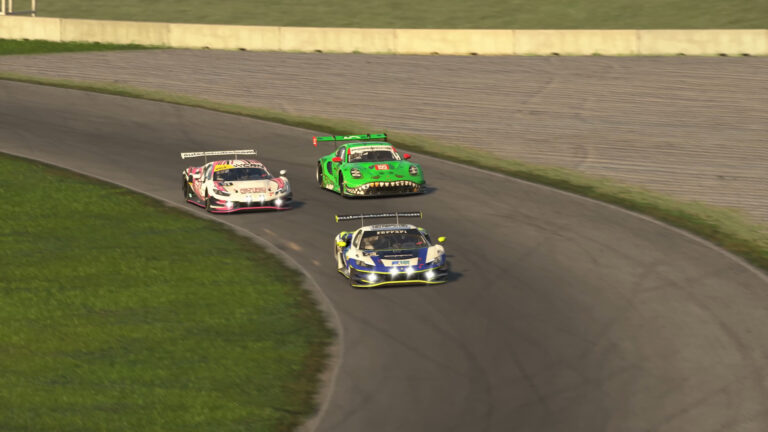
Racecraft, in this context, means the skills that are specific to racing, not just driving. It includes defending and attacking positions, managing gaps, reading competitors, timing overtakes, protecting your tyres in traffic, and making decisions at race speed that have nothing to do with your theoretical one-lap pace. These skills require racing situations to develop. They cannot be practiced in time trial or solo hot laps.
The Pace Threshold: When Are You Ready?
A useful rule of thumb from the coaching community is to shift your focus to racecraft when your lap time is consistently within about two percent of the split-fastest lap on circuits you have practiced. At that point, pure pace is no longer the main variable determining where you finish. Racecraft decisions, including when to attack, when to defend, and when to manage tyres, begin to outweigh lap time as a determinant of your race position.
Another indicator is when your iRating is moving upward despite not setting fast laps. This often means your racecraft instincts are already developing even if you have not consciously directed attention toward them. In those cases, deliberately focusing on racecraft skills can accelerate what is already happening naturally.
What Racecraft Looks Like at Each License Level
In Class D and C, racecraft primarily means incident avoidance and positional awareness. The most common mistake at this level is overcommitting to an overtake that the gap does not support, resulting in contact and an incident point that cancels out the position gained. Racecraft at Class D means learning to read when a gap is genuinely there and when it is going to close before you arrive.
In Class B and A, racecraft becomes more sophisticated. Drivers at this level can defend lines effectively, use traffic strategically to pull away from a chasing car, and manage pit timing relative to competitors. The gaps between drivers are smaller, so small racecraft advantages compound into meaningful position gains over a race distance.
At the higher iRating bands, roughly 3,000 and above, racecraft becomes as important as outright pace. The fastest driver in the field does not always win because the fastest driver is not always in the best position at the critical moments of the race. Drivers who have invested in their racecraft skills tend to produce more consistent points results even when their absolute pace is not the best in the field.
Practical Ways to Build Racecraft in iRacing
One of the most effective practices is replaying your own races and reviewing decisions rather than just crash moments. Look at lap 8 when you tried to pass into the hairpin and got the door closed. Look at lap 14 when you got overtaken. The questions to ask are not what went wrong mechanically but what information you acted on and what you missed. Racecraft is largely an information-processing skill, and reviewing the data improves it faster than racing more laps without reflection.
Racing in tight, multi-class sessions also builds racecraft more quickly than single-class racing. Managing lapped traffic, dealing with different pace cars, and adapting your defensive approach to cars that are significantly slower or faster develops situational awareness that carries directly into your primary class racing.
Additionally, race consistently in the same series for a period of time rather than jumping between tracks and car classes frequently. Familiarity with the typical defending lines, braking reference points for overtakes, and common race situations at specific circuits accelerates racecraft development in ways that variety does not.
The Overlap Between Pace and Racecraft
Pace and racecraft are not separate tracks. The shift is a shift in emphasis, not an either-or decision. Drivers who begin focusing on racecraft often find that their pace improves as a side effect, because racecraft forces cleaner driving and better tyre management. Furthermore, the mental focus required for sustained racecraft awareness tends to produce more consistent lap times than the mental state of purely chasing fast laps.
Balancing Racecraft Work With Ongoing Pace Development
Shifting focus toward racecraft does not mean abandoning pace work. The most effective development approach involves dedicating the majority of effort to racecraft skills while keeping pace work deliberate and structured. This balance ensures racecraft continues to improve without pace regressing from neglect.
A practical structure is to spend the first portion of any practice session running consistent hot laps, focusing entirely on lap time and technique. Then switch into race scenarios for the remainder: traffic management, overtaking practice, defensive positioning, and responding to unexpected situations. Keeping both elements active in the same session prevents the two skill areas from pulling your training in opposite directions.
Another effective habit is setting one specific racecraft objective per race before the session starts. Rather than entering an event with a general intention to drive cleanly, decide in advance what you are practising. It might be completing the first two laps without incident, defending a position cleanly for five consecutive corners, or identifying exactly when and why you lost places mid-race. Specific objectives produce evaluable results regardless of your finishing position, and they shift your measure of a successful race from position alone to skill development, which is a more reliable motivator over a full season.
The goal is to become a complete iRacer, one who is quick enough to compete but smart enough to convert that pace into results. Getting the balance right between these two areas of development is one of the most consistently impactful changes drivers report when reflecting on what moved their iRating from plateau to growth.