Most sim racers focus their upgrade budget on wheels, pedals, and displays. Bass shakers rarely make the shortlist. When they do come up in discussion, people treat them as a luxury accessory rather than a functional tool. That framing undersells them significantly. Bass shakers are one of the highest-value upgrades available to mid-level sim racing rigs. Drivers who add them consistently report that the experience of driving changes in ways that other hardware upgrades do not match.
Also See
➡️ Sim Racing Gear
This article covers what bass shakers are, how they work in a sim racing context, and what they actually add to the driving experience. It also covers what a basic setup looks like for someone who wants to try them without committing to an expensive system.
What Bass Shakers Actually Are
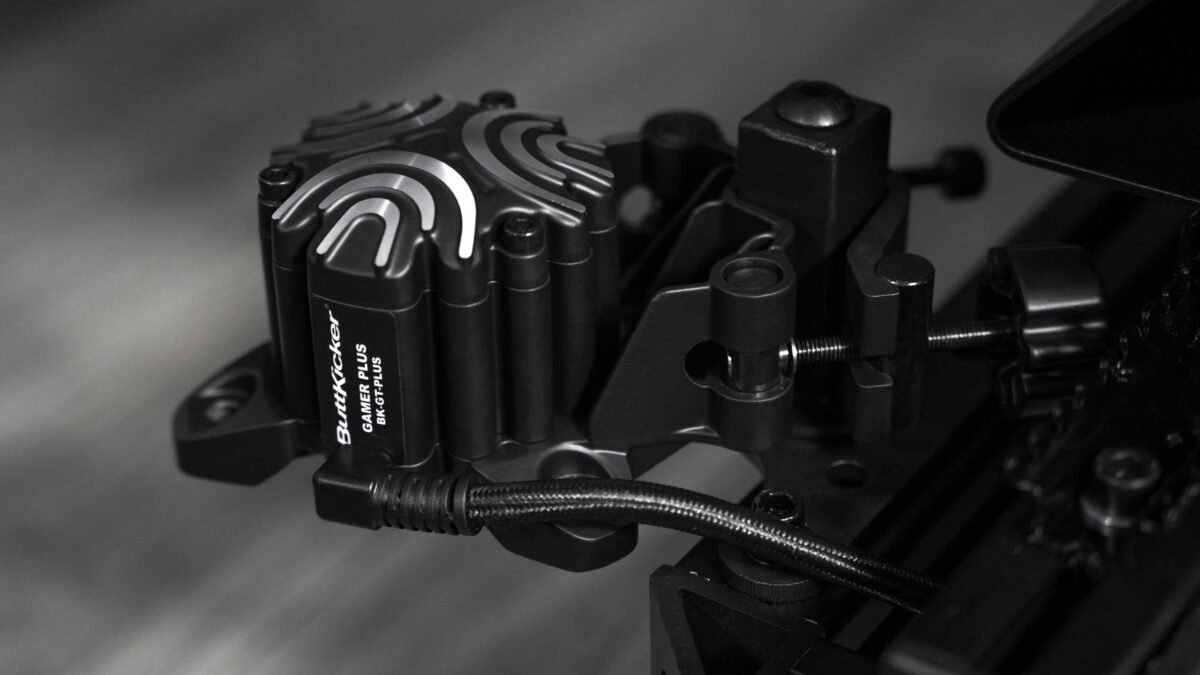
A bass shaker, sometimes called a tactile transducer, is a device that converts audio signals into physical vibration. Unlike a speaker, it does not produce meaningful airborne sound. Instead, it transfers vibration directly into whatever surface it is mounted to. In a sim racing context, that means attaching them to your seat, rig frame, or floor platform. The vibrations then pass through your body rather than through the air.
The most commonly used units in sim racing are the Dayton Audio BST series and the Clark Synthesis tactile transducers. The Dayton BST-1 is the entry-level choice and costs around $30 to $40 per unit. One under the seat is the minimum to start. Additional units under the pedal plate and in the seat back provide a more complete picture. A basic two-unit setup with a small amplifier can be assembled for $100 to $150.
How They Work With iRacing
Bass shakers are driven by audio output, which means the simplest way to run them is to feed them the audio from your sim. iRacing produces a rich audio mix that includes tyre noise, engine vibration, kerb strikes, and surface changes. All of this translates into useful tactile feedback through a bass shaker. You do not need dedicated software to run a basic setup.
For more advanced users, software like SimHub allows you to drive tactile transducers from telemetry data rather than audio. This gives you direct control over exactly which forces are represented and at what intensity. Wheel slip, engine RPM, suspension compression, and ABS activation can all be mapped to specific vibration patterns. The SimHub approach requires more configuration time but produces a more accurate and controllable result.
What They Add to the Driving Experience
The most immediately noticeable effect is tyre feedback. In iRacing, the transition from grip to slip at the limit of traction is communicated primarily through the wheel. Bass shakers add a physical sensation through your seat that represents what the tyres are doing at the contact patch. Many drivers report that this makes it easier to feel the car sliding before it reaches the point of no return. The sensation is not the same as a real car. But it provides an additional channel of information that the wheel alone does not carry.
Kerb strikes are another strong use case. In iRacing, running over a kerb produces an audio cue but nothing physical. With a bass shaker under the seat, kerb strikes become physical events. You feel the rumble of the sausage kerb, the impact of a high kerb exit, or the vibration of a rumble strip. That physical feedback changes how you interact with those elements on track. Drivers who use bass shakers often report naturally adjusting their kerb usage without consciously thinking about it. The physical feedback makes overuse feel uncomfortable in a way that audio alone does not.
Engine vibration and gear changes add to the sensation of driving at speed. The combination of road surface texture, engine note, and tyre behaviour coming through the seat frame creates an immersive driving environment. It is meaningfully different from a rig without tactile feedback. The cumulative effect after an hour of driving is significant. Many drivers describe their first session with bass shakers as a turning point. Sim racing started to feel like a connected physical experience rather than a screen-based game.
Does Tactile Feedback Actually Make You Faster?
This is the question that matters most to serious iRacers. The honest answer: it depends on where your development gaps are. If you are losing time because you cannot feel the car at the limit of traction, adding tactile feedback can provide information that directly helps. If your gaps are in braking points, racecraft, or setup, bass shakers will not address those.
Where bass shakers tend to have the clearest impact is in consistency. Drivers who can feel their tyre feedback through the seat catch slides earlier. They also maintain more consistent lap times over a run. Whether that translates to raw lap time improvement varies by driver, but the consistency benefit is real.
Getting Started Without Spending a Lot
A single Dayton Audio BST-1 mounted under the seat and driven by a basic plate amplifier such as the Fosi Audio BT20A is a solid entry-level starting point. Total cost runs around $100 to $130. Running it from iRacing’s audio output via a standard 3.5mm split is enough to get started. You do not need SimHub or a dedicated controller for a first experience, though both are worth adding if you decide to expand the system.
If you want to try before committing, place any existing subwoofer under your seat. It gives a rough approximation of what bass shakers do. The effect is less precise and the vibration character is different, but it is enough to understand the basic concept before spending money on dedicated hardware.
Bass shakers are not the most talked-about upgrade in sim racing communities, but the drivers who use them rarely remove them. That is the clearest signal available that they deliver on the experience they promise. If your rig is already at a reasonable hardware level and you are looking for the next meaningful upgrade, tactile feedback is the answer. It is what most drivers have overlooked.