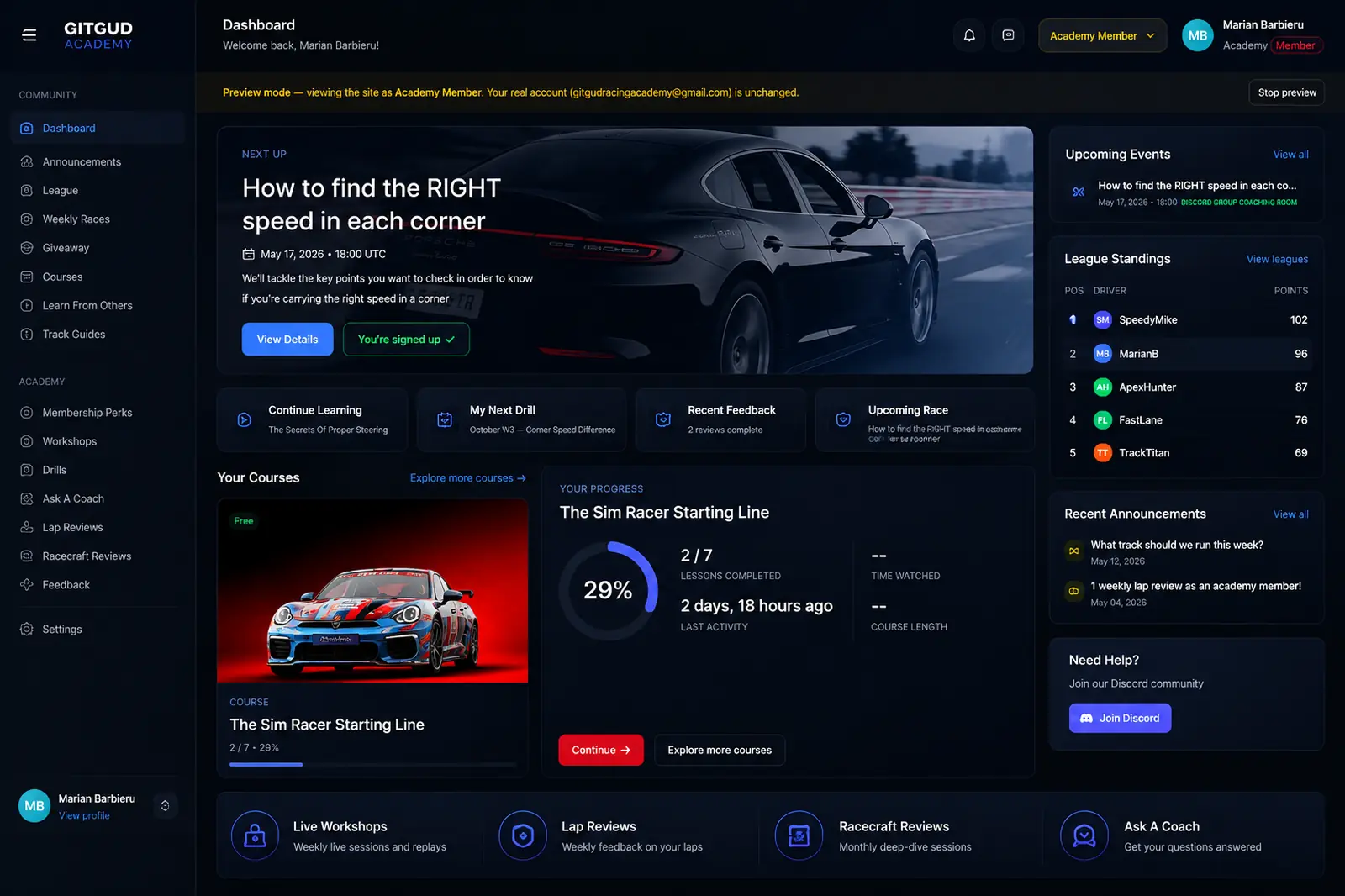
GitGud Racing Academy released version 2.0 after gathering feedback from the sim racing community. The update moved everything onto a dedicated platform at gitgudracingacademy.com, combining 10 structured courses, weekly lap reviews from professional coaches, a consistency analyzer, and a full tools suite under one monthly subscription. The service has been building since Marian Barbieru started coaching iRacing drivers through YouTube and 1-on-1 sessions. Version 2.0 turns that foundation into a formal training platform.
What GitGud Racing Academy Is
GitGud Racing was built by Marian Barbieru, a top 1% iRating driver with 25 million YouTube views covering driving technique, track guides, and coaching breakdowns. The original offering was standalone paid courses and 1-on-1 coaching sessions sold separately. Version 2.0 bundles all of it into a single subscription called the Academy.
The Academy now serves as the central hub for everything GitGud produces. Courses that previously required separate purchases are all included. The weekly coaching review system, the team of professional coaches, the tools, and the community all live in one place. The subscription also covers Assetto Corsa Competizione, Le Mans Ultimate, and Automobilista 2, not just iRacing.
The Course Library: 10 Courses and 450 Lessons
The Academy includes 10 courses and over 450 lessons, structured as a three-stage progression designed to build technique before specialization.
Stage 1 is the foundation course: Complete Driving Technique Foundations. It runs 68 lessons and 12 hours 40 minutes, covering braking, trail-braking, rotation, throttle application, vision, and reference points. Barbieru calls this the prerequisite before anything else.
Stage 2 is specialization. Drivers choose between the Complete GT3 Masterclass (56 lessons, 10 hours 15 minutes) or the Complete Formula Masterclass (55 lessons, 10 hours 5 minutes). Both unlock Stage 3.
Stage 3 goes car-specific: Ferrari 296 GT3, Porsche 992 Cup, Mazda MX-5, Toyota GR86, Formula 4, and Super Formula Lights. Each course runs 23 to 24 lessons and 4 to 5 hours. The structure forces drivers to build a proper technique base before diving into the specifics of a particular car. That sequencing is intentional, and it separates this from a collection of general tips videos.

Weekly Lap Reviews: The Core Feature
The most significant addition in version 2.0 is the weekly lap review system. Members submit a YouTube link or replay file of a lap. A coach picks it up and returns written notes plus an annotated video of that exact lap, covering braking zones, racing lines, and throttle application. Average turnaround is 12 hours.
This is the feature that separates a coaching subscription from a YouTube playlist. A general video teaches the common case. A lap review tells you specifically where you are losing time. The coaching team behind those reviews includes Marian Barbieru plus four professional coaches: Leo Ovtcharov (8.5k iRating in Formula cars, Delta Esports driver, multiple world-record laps), Matteo Kuenzner (10.1k iRating, Williams Esports GT3 driver, real-world racing driver), Adrian Kulleseid (8.5k iRating, coaches both real and sim drivers), and Bradley Leenards (9.6k iRating, Formula and GTP driver for BS+ Competition).
Members also get Ask-a-Coach access: up to five text questions every 30 days on setup, racecraft, mental approach, or race procedure. Replies come back within 24 hours. This is useful for the specific questions that a YouTube search will not answer. You can ask about a corner at a specific circuit, a car behavior you cannot explain, or a race situation that cost you positions.
The Tools: Consistency Analyzer and More
Beyond courses and coaching, the Academy includes several tools built around the same goal: turning data into actionable feedback.
The Consistency Analyzer reads a screenshot of any iRacing (or ACC, AMS2, or Gran Turismo) timing screen and breaks down the stint automatically. It returns a consistency score out of 100, a per-lap chart identifying where pace dropped, the reclaimable time across the stint, and the specific fixes that recover it. According to the site, a typical output includes a race-cost estimate, for example, a single off-lap identified as costing three positions.
The Academy also includes an FFB tuning tool, an FOV calculator, and a Driver’s Log for tracking session notes and progress across weeks. The Sim Racer’s Training Manual, an 80-page technique guide, is included in full as a digital read. Members can also submit drill videos for coach review, so the practice is verified rather than self-assessed.
What Changed in Version 2.0
The 2.0 update rebuilt the delivery platform into a dedicated app, separate from the original gitgudracing.com courses site. The changes came from user feedback collected through the Discord community and direct coaching interactions.
The practical changes in 2.0: the course library and coaching features moved into one app rather than being spread across separate purchases. The weekly lap review system became a formal, structured process with average turnaround tracking. The Consistency Analyzer and the Driver’s Log are new additions that were not in the previous version. The drills library now updates weekly. The community Discord continues alongside the platform for broader discussion and community races.
Marian’s YouTube channel continues to post free content covering track guides and technique breakdowns. The Academy is the paid tier of a larger ecosystem that starts free on YouTube and scales through the subscription.
Pricing, Trial, and Who It’s For
The Academy costs $30.24 per month including tax. A 3-day free trial is available with no charge on day one. A 30-day money-back guarantee covers the first full paid month.
For context: a single 1-on-1 coaching session with a GitGud coach costs $100 for one session. The Academy subscription includes a weekly lap review plus all courses, tools, and Ask-a-Coach access for roughly the same price as three sessions per year.
GitGud Academy works best for drivers who have hit a plateau they cannot diagnose themselves. Watching general technique videos is useful up to a point. After that point, the gap between your current pace and your potential comes from specific, individual habits that a coach can identify from your actual laps. That is the problem the weekly review system is designed to solve.
Newer drivers also benefit from the structured course progression. Starting with the Foundation course and working through the stages gives a clearer improvement path than self-directing through YouTube content. The 3-day free trial makes it easy to test whether the coaching style and platform fit your needs before committing.