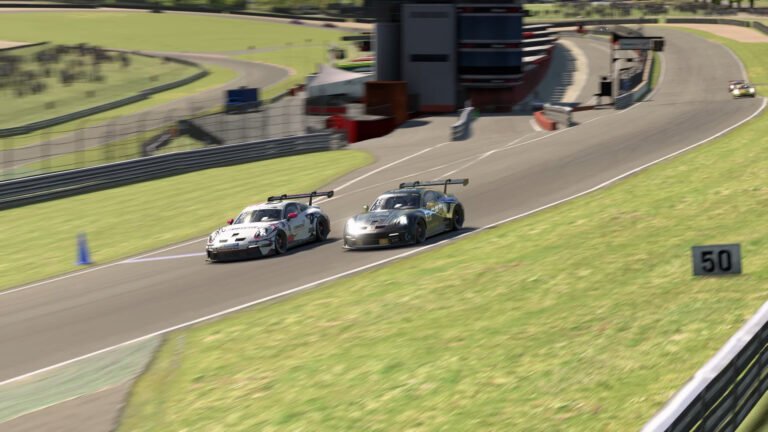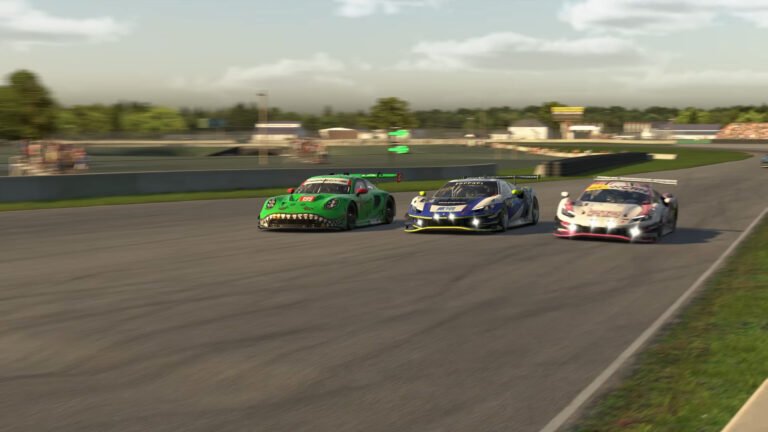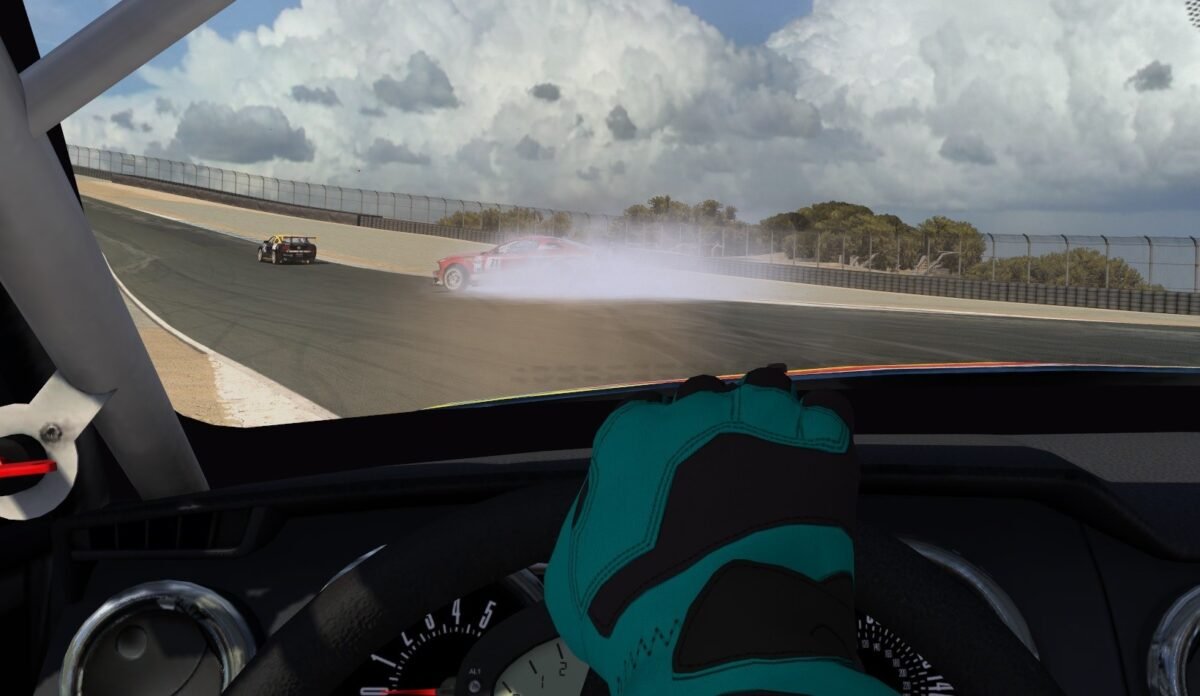
Spinning in iRacing has a cause. It is almost never random and it is almost never just “I pushed too hard.” Every spin comes down to a specific input at a specific point in the corner. Entry, mid-corner, and exit each produce different problems with different fixes. Once you can identify which phase is triggering your spinning in iRacing, you stop correcting the wrong thing and start working on the right one.
Also See
➡️ iRacing GT4 Trail Braking Guide: How to Get the Car to Rotate
Understanding Weight Transfer
Everything in car control comes back to load. When you brake, weight moves forward, loading the front tires and reducing grip at the rear. When you accelerate, weight shifts back. Through a corner, lateral force pushes load to the outside tires. The rear tires can only hold as much as the load on them allows. Remove that load abruptly and the rear loses grip before you have time to react.
Weight transfer is not inherently bad. Racing relies on it. The front needs to be loaded for turn-in grip, and the rear needs load for traction on exit. The problem is the rate at which that load shifts. Tires lose grip much faster than a driver can consciously react, which is why inputs have to be smoother than they feel natural at first.
Abrupt inputs are the common thread in almost every spin. A sharp steer, a snap lift off the throttle, or a hard stomp on the brakes mid-corner all cause rapid weight shifts the tires cannot absorb. Smooth and progressive inputs give the tires time to respond.
Entry Spins: How Spinning in iRacing Starts
Entry spins happen in two main ways. The first is braking too deep and arriving at the turn-in point with too much speed. When you add steering angle to compensate for excess entry speed, the front tires overload, the rear unloads, and the back steps out.
The second way is subtler: releasing the brakes too suddenly at turn-in. Many drivers treat the turn-in point as the moment to jump off the brake pedal. The problem is that snapping brake pressure to zero throws weight forward immediately, reduces rear load, and can pitch the car into oversteer right as the corner starts. This is sometimes called trail-off oversteer. It is caused by the brake release, not the braking itself.
The fix for entry spins is consistent braking discipline. Brake earlier than feels necessary, and release the pedal progressively through the turn-in zone rather than snapping off. The goal is a smooth, controlled transition. A small amount of brake pressure at turn-in keeps the front loaded and the rear planted, even if it costs a bit of entry speed.
Mid-Corner Spins: The Patience Problem
Mid-corner spins are almost always caused by getting on the throttle before the car is ready. At the apex, the car is still rotating. The rear tires are already loaded with lateral force. Add throttle there and you are asking them to handle longitudinal acceleration on top of the lateral load they are already carrying. One of those demands gives first.
Steering corrections mid-corner also destabilize the car. If the entry was slightly off and you adjust the wheel at the apex, that micro-input causes a weight shift. String a few of those together and the rear finds its limit.
The fix is patience. Wait until the car has passed the apex and the rotation is settling before touching the throttle. A stable arc through the middle of the corner sets up a clean exit. Rushing the throttle in turns that small gain into a spin that costs far more time.
Why Throttle Causes Spinning in iRacing at Exit
Exit spins are the most common for drivers who have found a pace limit and are pushing through it. The car has made it through the corner, and now you want more drive off the final apex. So the throttle goes down harder and earlier.
At that moment, the rear tires are still handling some lateral load from the corner. The throttle adds longitudinal load on top of it. The outside rear reaches its limit first. The car rotates and the exit becomes a spin.
The fix is progressive throttle application. Start the throttle earlier but lighter, and increase it as you unwind the steering. Throttle and steering should move in opposite directions together: more throttle as less steering angle is needed. Do not open the throttle fully while the wheel is still turned. That balance is what separates a fast exit from a spin.
Why Sudden Lifts Make Everything Worse
Lifting suddenly mid-corner when the car feels loose is a natural reaction, but it often makes the situation worse. A sharp lift throws weight forward instantly. If the rear was close to its limit before the lift, that sudden load reduction will cause it to step out.
Cars with significant rear engine weight or aero balance are particularly sensitive to this. In cars like the Porsche GT3 or the Cayman, a sharp mid-corner lift can be more destabilizing than staying on the throttle.
The correct response when the rear feels light is to reduce throttle gradually while holding a steady steering angle. Let the car find its balance. If you have already started to slide, the goal is to smooth out the weight transfer rather than create another sudden shift. Snap inputs in a recovery moment almost always extend the problem instead of fixing it.
Grass and Curb Contact
Grass is immediate. One rear wheel on the grass means that corner of the car has significantly less grip than the other three. On corner exit with throttle applied, a rear wheel on the grass causes an instant spin because the grip asymmetry is severe. Many tracks in iRacing have grass that behaves closer to ice than dirt, so there is almost no room to recover once a rear wheel goes off.
Curbs vary by track and car. Some curbs in iRacing are flat and have minimal effect. Others bounce the suspension or upset the aero balance enough to cause a spin. A curb that works fine in a GT4 can be a launch pad in a prototype. Treat unfamiliar curbs the same way you treat grass: learn the limit in practice before relying on them in a race.
Using Replays to Diagnose Spinning in iRacing
After a spin, the instinct is to restart and go again. A better use of three minutes is to watch the replay and find the actual cause. The visible spin, the car rotating, is the result. The cause happened one or two seconds earlier.
Watch the replay from directly behind the car. Look for the moment when the rear first starts to move. Once you find that moment, check what the inputs were: was the brake still on when you turned in? Did you apply throttle too early? Did a rear wheel touch the grass on exit?
Telemetry tells the full story. Tools like Forseti pull your brake, throttle, and steering data from iRacing session files and display them as overlaid traces. You can see exactly when each input was made relative to when the tire slip started. Because the gap between cause and effect is often less than a second, the traces make the problem obvious in a way the replay alone cannot.
Practice Drill: Find Your Limit Deliberately
The most effective way to stop spinning unpredictably is to create spins on purpose. Take a low-powered, forgiving car and pick a track you already know reasonably well. The Mazda MX-5 and the GR86 both work well for this. If you have been struggling with spins in higher-powered cars, dropping down temporarily to reset your technique is a proven approach that many fast iRacers use.
Spend 20 minutes at one corner. Run it consistently at your normal pace, then push one variable at a time. Carry slightly more speed into the entry. Apply the throttle a fraction earlier. Trail the brakes a little longer. Push until the car starts to rotate. Let it move, catch it if you can, and notice exactly which input caused it.
You are not trying to go fast. You are trying to feel what causes the rear to step out before the snap happens. Once you can feel the slip angle building before the full slide, you can start catching problems in a race instead of just reacting to them. That instinct does not develop in races. It develops in low-stakes deliberate practice where you are specifically hunting for the limit.
Identifying which phase of the corner is causing your spins takes time. However, once it clicks, the laps get more consistent and the car feels more predictable. The spin rate drops because you understand what is happening instead of just hoping for a clean lap. Understanding what the car is telling you, and giving it the right answer at the right moment, is what separates an iRacer who spins from one who does not.