Getting fast in iRacing is a different problem than most racers expect. You can drive a car cleanly for months without meaningfully improving your lap times, and the more you study what high-level drivers actually do, the clearer it becomes that speed comes from a set of repeatable habits rather than raw talent.
Also See
➡️ How Long Does It Take to Learn the Nürburgring in iRacing?
🔗 iRacing Competition Center
Drivers who consistently race at 5000 and 6000 iRating in sportscar classes have solved specific problems that most lower-rated drivers haven’t thought to address yet. Some of those solutions are technical. Some are about mindset. All of them take deliberate practice to make permanent. This guide walks through what separates mid-pack drivers from the front of the field — drawn from coaching patterns seen across hundreds of hours of sportscar sessions.
Consistency Beats Heroics
The biggest separator between mid-pack and front-of-the-pack iRacers isn’t corner speed. It’s variance. A driver who posts consistent 2:05.3s throughout a race will beat someone who runs a 2:04.8 every few laps and a 2:06.1 the rest of the time. Tire wear, fuel loads, and incident points compound over a race, and the driver who manages all of them without dramatic swings is almost always the one with results at the end.
The practical implication of this is uncomfortable: many drivers are better served by slowing down slightly and stabilising their lap times than by chasing their theoretical maximum on every lap. A consistent 103% lap is worth far more over a 45-minute race than a pace that swings between 100% and 107%. If your best lap and your average lap are more than a second apart, fixing the floor of your pace is more important than raising the ceiling.
Brake Release Is Where Most Time Goes
Newer drivers focus on braking points. Experienced drivers focus on brake release. The transition zone between peak braking and turn-in is where the car is most loaded and where you have the most influence over the front end. A choppy, abrupt release throws the balance off and kills rotation. A smooth, trailing release keeps the car planted through the corner entry and creates grip exactly when you need it. Watch your steering inputs through this zone in replay. If you’re making corrections mid-corner, the brake release is usually the root cause.
This is especially true in GT3-class sportscar racing. The combination of downforce, ABS, and relatively high-grip tyres means drivers can get away with a lot — until they can’t. At lower iRating the car tolerates a rough entry. At higher iRating, where every driver is extracting more from the same tyre, that extra half-second of tyre life you trade for a sloppy entry starts costing you in the final stint.
Use the Data, Even Briefly
You don’t need to be a data analyst to use iRacing’s replay tools effectively. Overlay your fastest lap against a fast driver in the same car and track combination. Look at two things: where they start braking and what their minimum speed is at the apex. If your minimum speed is lower in two or three corners, that’s where the lap time is going. Pick one corner per session and work it deliberately. Don’t try to fix everything at once.
If you have access to iRacing’s black box or a third-party telemetry tool, the most useful channel to watch is throttle application. Specifically, look at how early a faster driver gets to full throttle after the apex compared to you. Early, progressive throttle from apex to exit is the single clearest marker of a driver who is managing the rear of the car confidently. If they’re on throttle two car lengths before you are, the lap time difference is explainable right there.
How to Approach Qualifying
Qualifying deserves its own section because most drivers approach it wrong. The goal of a qualifying lap is not to drive the fastest lap you are capable of — it is to drive a lap where nothing goes wrong. That distinction matters. Pushing for maximum pace in qualifying often means carrying more risk into each corner than you would in race trim. The better approach is to qualify at roughly 98% of your peak pace, driving a clean lap you can repeat rather than a perfect lap you might only hit once in five attempts.
Grid position matters in sportscar racing, but it matters less than most drivers think below the top split. What matters far more is the first three laps, when traffic is unpredictable and incident risk is highest. Starting P8 on a clean lap is worth more than starting P4 after a ragged run that leaves your tyres worse off than the field around you.
Managing Tires and Fuel Strategically
Tyre management in sportscar iRacing is often discussed but rarely practiced with precision. The most effective approach is to decide on your pit strategy before the race starts — not in the middle of a stint when emotion and race pressure cloud the decision. If you know you need to make two stops in a 90-minute race, your lap pace target in stint one is different than if you can run long on one stop. Drivers who arrive at pit entry with a clear plan almost always come out ahead of drivers who react in the moment.
Fuel saving is a separate skill that high-rated sportscar drivers use routinely. Lifting and coasting on long straights before a low-speed corner can recover two to three laps of fuel in a long race without a meaningful pace penalty. The fuel you save in the first half of the race is the fuel that keeps you from stopping a lap before the competition in the final stint.
Sportscar Racecraft Is Its Own Skill
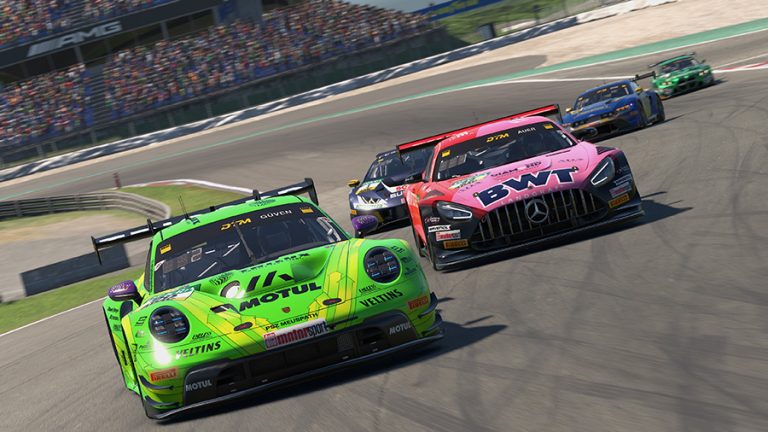
In multiclass racing, managing traffic across class lines is a skill as important as raw pace. High-rated GTP, LMP2, and GT3 drivers are constantly aware of what’s behind and ahead across all classes. They give space generously when needed, not because they lack pace, but because a clean race with points is more valuable than a fast race that ends in contact. Incident management is part of the sport in sportscar racing in a way that single-class oval events simply don’t require.
The specific skill to develop is predicting where prototype traffic will be when you reach a braking zone, not where it is now. A GTP bearing down on a GT4 car two corners ahead of you will reach that car just as you arrive at the next braking zone. Building that awareness takes time, but it is what separates the drivers who race cleanly from those who accumulate incidents through situations that were technically avoidable.
The Recovery Lap
Most drivers know how to run a good lap. Fewer know how to run a good lap immediately after a bad one. The lap after an incident — whether a spin, a contact penalty, or a trip through the grass — is where iRating is disproportionately won and lost. Drivers who settle quickly after an incident and return to clean race pace lose far less than drivers who carry frustration into the next lap and compound the problem.
The most practical technique is to use the out-lap from an incident like a mini qualifying lap. Keep pace low, get your tyres back up to temperature, and confirm the car is behaving normally before you start pushing again. One deliberate reset lap costs you almost nothing in time and prevents the second incident that usually does the real damage.
The Ceiling Moves When You Stop Chasing It
Drivers who reach the high end of the iRating range typically stopped caring about the number at some point. They started focusing on specific skills, specific corners, specific sessions, and the rating followed. If your goal each session is to improve one defined thing, you’ll learn faster than if your only target is to run faster laps.
The skills described in this guide — brake release, data use, qualifying approach, tyre management, multiclass awareness, the recovery lap — are not the most exciting parts of going fast in iRacing. They are also not the fastest to develop. But drivers who build them into habits consistently outpace drivers with more natural speed who never addressed the fundamentals underneath it.
Getting faster takes longer than most racers want. The path is clearer than it looks from the bottom.