iRacing assigns every driver a division ranking from 1 to 10, based on their iRating relative to the rest of the active field. Division 1 represents the top 10 percent of drivers, Division 2 the next tier, and so on. In theory, the iRacing division system creates a framework for understanding where they rank in the broader competitive field. In practice, many experienced iRacing drivers have questioned whether divisions carry enough meaning. That skepticism is worth taking seriously.
How the Division System Currently Works
Divisions in iRacing are a static display of your iRating percentile. They do not affect which races you can enter or which series you have access to. They also do not change how your iRating and safety rating move from race to race. The division number appears on your profile and on the results page. It does not gate any content, unlock any rewards, or create any competitive structure. Nothing about it operates independently of iRating itself. In functional terms, it is a label. It describes where your iRating sits relative to other active drivers at the time of measurement.
The system updates over time as the overall iRating distribution shifts. However, there are no milestone events tied to division changes. Moving from Division 4 to Division 3 happens quietly and without ceremony. The division number is also not prominently featured in most parts of the iRacing interface. Many drivers who have been on the platform for years are aware of their division in a general sense. Few track it actively or regard it as a meaningful competitive target.
What Would Make Divisions More Meaningful
The debate about what makes a division meaningful tends to cluster around two related ideas. The first is that divisions should carry more weight. Scheduled championship structures with prize pools, recognition, or progression stakes could make the division ranking matter. LeMans Ultimate has implemented scheduled online championships organized around competitive tiers. Some iRacing drivers have pointed to that system as a model. In that structure, the tier creates genuine competitive stakes rather than existing only as a passive descriptor.
The second idea is that divisions could be restructured around specific series or disciplines. A global iRating ranking would no longer be the sole basis. A driver who is Division 1 in iRating might race primarily in sports cars. Their oval car skills could be underdeveloped. A discipline-specific division system would give a more accurate picture of competitive standing. It could also create targeted progression tracks for drivers who want to specialize. This would also make the division number more meaningful as a signal to other drivers in a specific series context.
What Division Rankings Mean Day-to-Day
For most active iRacing members, the division number surfaces occasionally on profile views or results screens. Otherwise, it is set aside in favor of iRating. The reason is practical: iRating is the number that directly determines your race splits, while division is not. When drivers talk about progress on the platform, they talk in iRating points rather than division brackets. Division 3 at 2,100 iRating and Division 3 at 2,800 iRating describe very different competitive situations. This highlights the core limitation of the division label as a standalone metric.
The progression that dedicated drivers want involves ranked advancement, milestone recognition, and competitive standing. iRating partially provides this, but without ceremony. When a driver crosses 2,000, 3,000, or 4,000 iRating, the platform offers no acknowledgment. The number just changes. A better-integrated division system could anchor those milestones more visibly. A structured progression from Division 5 to Division 4 that triggers recognition could help. So could unlocking exclusive community access or visible status in the race lobby. These mechanics build the kind of progression loop that keeps competitive drivers engaged longer.
The gap between what divisions could mean and what they currently do is not a criticism of iRacing’s racing product. The split system, the safety rating framework, and the iRating engine are well-regarded. They generally do what they are designed to do. The question is whether a dedicated progression metric adds real value. Or whether it simply occupies space on top of systems that already work. That question has a different answer for different types of iRacing members. The platform is large enough that both positions represent significant constituencies.
The Other Side: What Divisions Do Right
Not everyone agrees that the division system needs significant changes. The existing structure is simple, transparent, and tied to a metric iRacing already calculates accurately. That metric is iRating. Adding structured championships around divisions would introduce complexity. It also creates potential for gaming. Drivers might deliberately manage their iRating to stay in a favorable bracket for a championship season rather than racing at their true level.
There is also an argument that iRating and safety rating already do most of the work. A more complex division structure would attempt to replicate what those systems already handle. The split system in official races groups drivers by iRating automatically. This produces competitive fields without requiring drivers to manage a division rank. Adding a parallel championship layer on top means maintenance overhead for iRacing. It does not necessarily improve the racing experience for most drivers.
Where This Fits in iRacing’s Current Direction
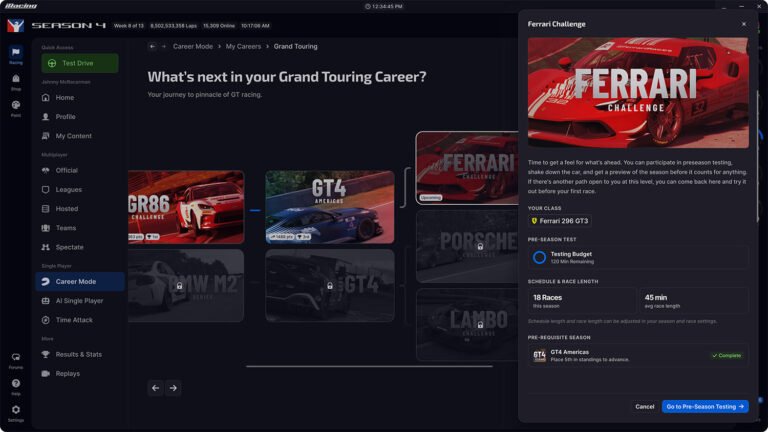
The conversation about divisions sits within a broader discussion about progression and competitive structure. It also encompasses the Career Mode announcement in the Season 3 2026 developer update. Career Mode is confirmed as in active development, with a feature preview promised in the next developer blog. Whether Career Mode integrates with or replaces the existing division framework is an open question. The timing of both discussions suggests that iRacing is thinking about progression and competitive identity more seriously than it has in recent years. The division debate reflects a real appetite among iRacing drivers for a competitive layer that means something tangible. For now, iRating remains the most actionable measure of where you stand on the platform. Drivers looking for more structure can find it in licensed series and multi-week schedules, where field splits create natural competitive tiers regardless of which division label appears on your profile.