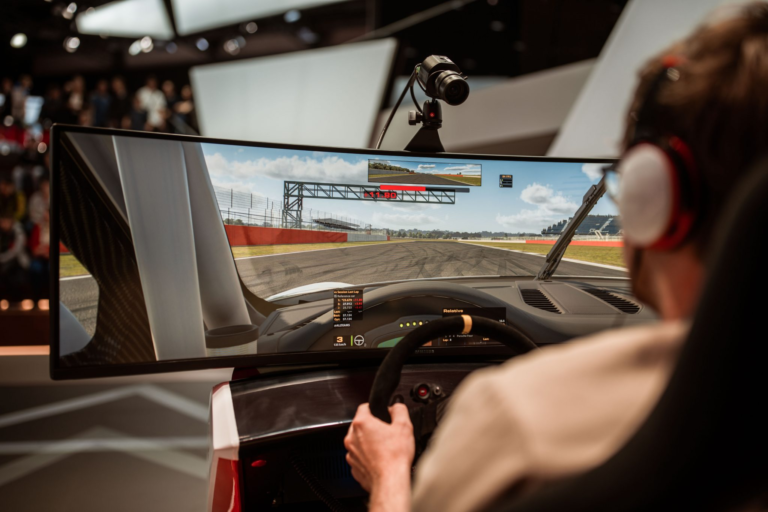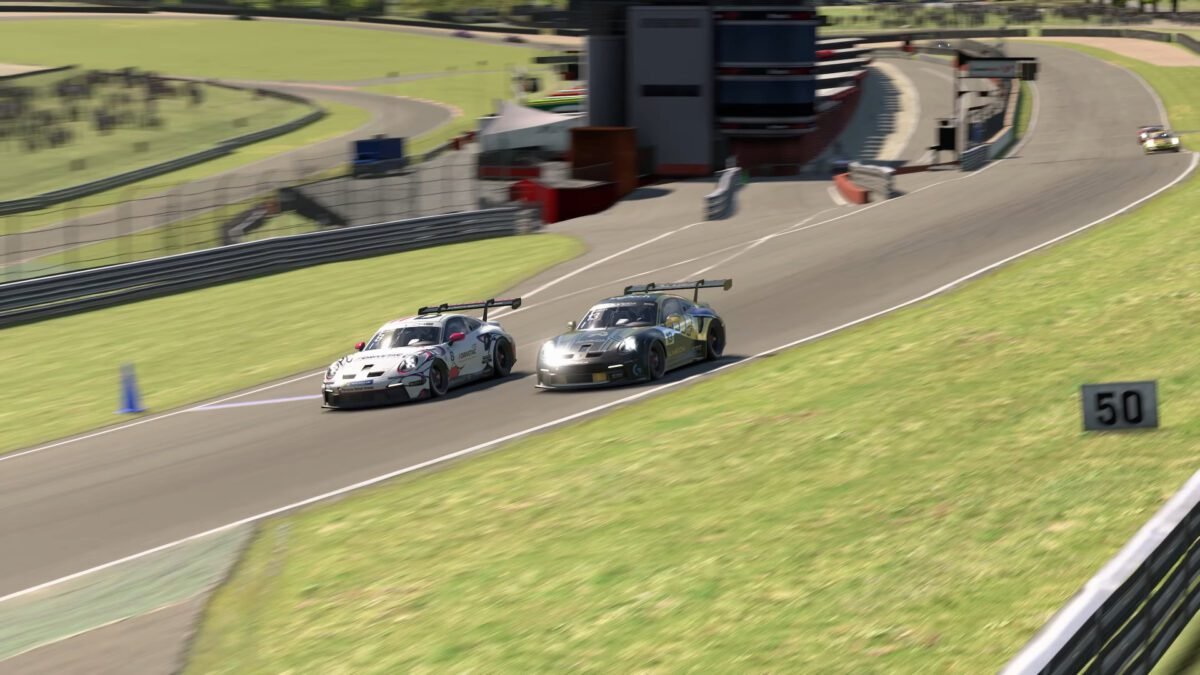
Advanced iRacing racecraft separates drivers who consistently gain positions from those who force moves and cause incidents. Speed alone does not explain the gap. The difference is positioning, timing, and a clear plan two corners before the passing zone. This guide covers the specific tools: reading mirrors, using feints correctly, and knowing when to abort. Each skill is easier to develop in practice than in a race, but the payoff shows up in both.
Also See
➡️ How to Pass Cars in iRacing Without Causing Incidents
➡️ How to Defend Fairly in iRacing
🎮 Virtual Racing School: Racecraft Fundamentals
Surprise Without Dive-Bombing
A surprise move and a dive-bomb look the same from outside the car. Both involve a late commitment to the inside line. The difference is whether the attacking car can reach the apex without the defending driver yielding ground.
A surprise works when the defending driver has not yet committed to a line. Track is still available, and the attacker carries enough speed to reach the apex cleanly. A dive-bomb happens after the defender has committed. At that point, the move only works if someone takes contact or runs wide.
Experienced iRacing drivers recognize this gap from both sides. On attack, the goal is to find the commitment window before the defender closes it. That window most often appears on long braking zones. It opens when a car protects the inside too early and leaves the outside open. It also appears when a trailing car carries more speed through a section. The defending driver in that case is managing tires or avoiding marbles.
Finding these windows requires pattern recognition. Most drivers in iRacing repeat their braking references and line choices in similar situations. Watch two to three laps before committing to an attack. The pattern is usually there.
Advanced iRacing Racecraft in Lap 1 Conditions
Lap 1 in iRacing produces poor racecraft decisions because grip is still building. Nobody wants to lose positions, so the instinct is to push early and claim space. The better approach is patience backed by a specific read of track conditions.
Advanced iRacing racecraft on cold tires means knowing which sections reward patience over aggression. Tight infield sections punish early dives because understeer is worse below optimal tire temperature. Long sweeping braking zones reward slight trail-braking variations. Defending drivers in those zones brake conservatively to avoid locking up on a cold surface.
Work the sector before the passing zone rather than the zone itself. On tracks with a progressive grip build, the Lap 2 passing window is consistently cleaner than the same window at the start. Sebring and Daytona road course both show this clearly. A driver who holds position cleanly in Lap 1 and moves in Lap 2 often comes out further ahead. Forcing the move in Lap 1 and exiting off the ideal line gives back more than it gains. Drivers newer to wheel-to-wheel pressure can start with the guide to your first online race in iRacing before adding these tools.
How to Use a Feint Without Getting a Penalty
A feint is a directional change before the braking zone that causes a defending driver to react and abandon their preferred line. Done correctly, it is legal and effective. Done wrong, it earns a blocking or weaving warning in iRacing’s protest system.
The rule is clear: one direction change per braking approach is legal. Moving left to initiate a pass is legal. Moving right to draw the defender’s coverage, then immediately moving left to attack, is two changes. Stewards do not weigh how small the second movement was. Two changes is the line, and the penalty follows.
The feint works because defending drivers instinctively mirror early positioning moves. A move left on the approach often draws the defending car rightward to protect the inside, which opens the outside. The movement needs to come before the 200-meter board on most tracks. After that point, a direction change is either a committed overtake or it is a blocking move. Timing matters more than the size of the movement. The defending side of this exchange is covered in the iRacerHub guide to defending in iRacing.
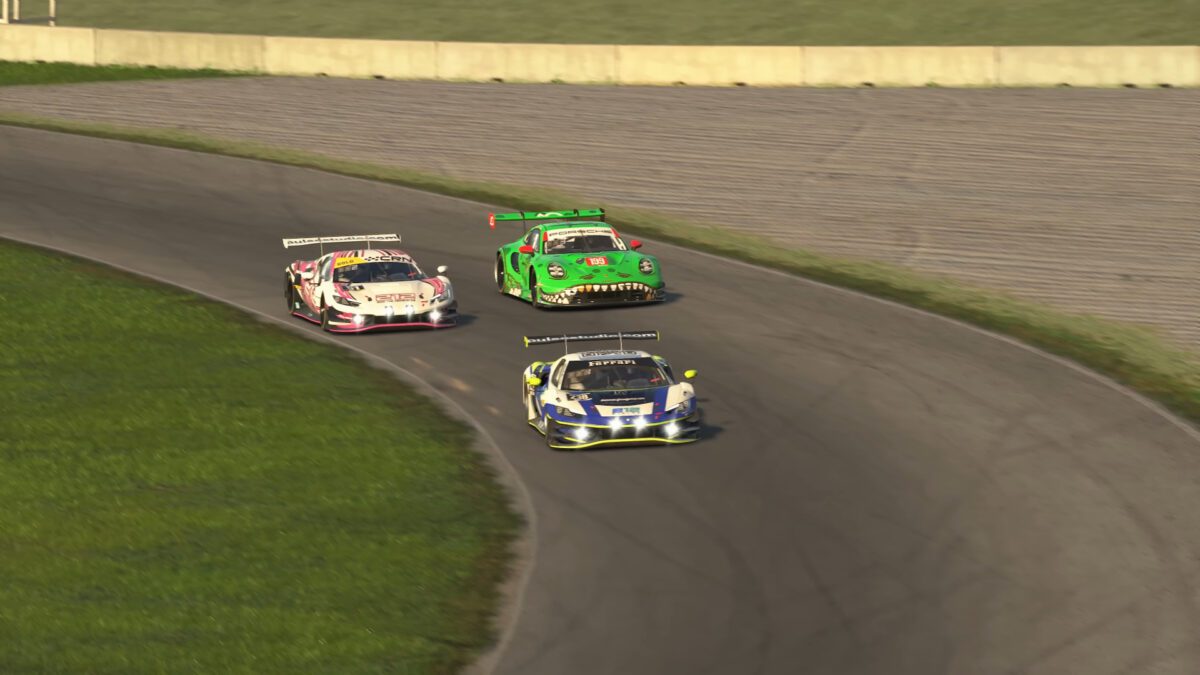
Reading Opponents in Advanced iRacing Racecraft
Drivers in iRacing communicate through their movement, even without voice chat. A car that checks its mirrors frequently shows as small steering corrections and subtle speed variation on corner approaches. A car that stops checking is more vulnerable than its pace suggests.
The moment to attack is not always the fastest entry window. Often it is the moment after an attacker backs off and appears to concede a position. That pullback shifts the defender’s attention forward, which creates a different opening on the next sequence. Patience here is deliberate, not passive.
Pair mirror-reading with exit analysis. If a defending driver takes a protective line into a corner, check whether that line costs them on the following straight or the next entry. Advanced iRacing racecraft uses the next corner as the real target. A clean exit from a corner where the defender goes protective often sets up a clean move at the next braking zone with significantly less resistance.
When to Abort a Move
Aborting a passing attempt is not losing a corner. It is the skill that keeps the car in the race and out of the stewards’ notes.
Most incidents in iRacing do not start with deliberate aggression. They start when a driver recognizes too late that the move will not work and commits anyway because backing out felt like conceding. The abort window is specific: the moment the attacking car can no longer reach the apex without the defending car yielding, the move is over. Recognizing that moment at 60 percent through the braking zone, rather than 90 percent, is the skill.
Drivers who develop this read accumulate more positions across a season than drivers who win every contested fight but cause incidents in the process. Two clean positional gains per race outperform one aggressive pass followed by a drive-through penalty. Consistent advanced iRacing racecraft builds a safety rating and a reputation that opens up more racing room. Opponents who know you will not overcook a move give more space from the start.
Advanced iRacing Racecraft Builds Repeatable Judgment
The goal is not the single pass that gets clipped on a stream. The goal is the race where every wheel-to-wheel sequence ends cleanly, positions change, and neither driver leaves the session filing a protest.
Repeatable judgment is a measurable standard. After each wheel-to-wheel sequence, ask whether the same move would work from a fresh attempt. If the answer requires the defending driver to cooperate or back off early, the move was fortunate rather than repeatable. Advanced iRacing racecraft builds a library of move patterns that transfer across cars, tracks, and opponent styles.
A feint approach that works in GT3 at Sebring transfers to Prototype racing at Spa with adjustments, not a full restart. That transfer happens when you understand what created the opening. Study replays after competitive races. Look for the sequences that resolved cleanly and identify the specific decision that produced the clean outcome. That decision is the repeatable part, not the car position itself.
The Practice Drill
Set up an AI race at a track with two to three natural overtaking zones. Pick one zone as the target. Over the course of the race, create two separate attack approaches in that zone: one that commits one car length earlier and one that holds off by one car length. Compare the results for each timing.
The goal is to find which timing creates space without requiring the AI car to yield. AI opponents in iRacing do not give ground under pressure. Any space you find is space you created through positioning. Run this drill on a track where braking zones change with fuel load, such as Daytona road course or Watkins Glen. Adjust the timing across stints and note which sessions produce cleaner corner exits. Carry the successful timing into a license race and check whether the result holds under real pressure.