If you’ve mastered GT4 racing and finally jumped into GT3s expecting a smoother ride, surprise — it’s often a humbling experience.
Everything feels faster, louder, grippier, and somehow less forgiving.
This guide breaks down the critical differences between GT4 and GT3 racing — braking behavior, aerodynamics, assists, and traffic — and gives you practical iRacing GT4 to GT3 tips to adapt faster without tanking your iRating or confidence.
1. The GT3 Illusion: Faster Doesn’t Mean Easier
On paper, GT3 cars look like a natural upgrade: more downforce, more power, and full electronic assists like traction control (TC) and ABS.
But in iRacing, those assists are not a safety net — they’re precision tools that punish sloppy inputs.
What shocks most GT4 veterans:
- Braking distances are shorter, but the penalty for braking too late is harsher.
- Corner speeds are higher, but aero grip disappears instantly when disturbed.
- Race traffic behaves differently — GT3s are faster everywhere except when packed together.
Moving up means re-learning the fundamentals you thought you’d mastered.
2. Braking: From Patience to Precision
GT4 braking is mechanical. GT3 braking is aerodynamic.
In GT4s, your stopping power depends mostly on tires and weight transfer. In GT3s, the car’s aero load does much of the work — but only at high speed.
That means braking technique must change completely:
GT3 Braking Tips
- Brake hard early while aero is active, then bleed pressure smoothly as downforce fades.
- Trail brake less aggressively — GT3s snap under load loss faster.
- Calibrate brake bias for each track. Too far forward, and you lock; too far rear, and ABS overheats.
- Use ABS as insurance, not as a crutch. Overuse overheats brakes and lengthens stops.
Practice each new car’s braking signature using AI sessions — repeat 5-lap drills focusing solely on entry stability.
3. Aerodynamics: Your New Best Friend and Worst Enemy
In GT3s, downforce turns grip into a conditional ally.
When airflow is clean, the car feels glued to the track. But in traffic, dirty air reduces front-end bite dramatically.
How to Manage Aero Loss
- Lift earlier behind another car — braking zones extend by 15–30 meters in slipstream.
- Avoid tight following mid-corner; run slightly offset to regain front-end air.
- Respect curbs. GT3 underbodies are lower; aggressive curb use causes aero stall and spins.
GT4 cars forgive aggression — GT3s reward finesse.
4. Power Delivery and Traction Control
In GT4, throttle application is mostly linear — you can mash the pedal and survive.
In GT3, power and torque spike harder, and traction control becomes your gatekeeper.
But TC doesn’t fix poor throttle timing — it hides it until your lap times suffer.
Best Practices for GT3 Throttle Control
- Treat TC as a limit indicator. If it flashes, you’re losing time.
- Experiment with TC settings per corner — tighter turns may need higher TC.
- Keep steering angle minimal before applying throttle; TC hates simultaneous inputs.
Think of TC as telemetry: if it’s triggering constantly, your technique is inefficient.
5. ABS: Precision, Not Permission
GT3 ABS systems are advanced but not omnipotent.
They allow threshold braking closer to the limit, but extended activation overheats tires and flattens grip.
ABS Optimization
- Set brake bias to allow minor ABS activity — not constant pulsing.
- Feel for vibration or audio cues (some cars have distinct “ABS chatter”).
- On long stints, increase bias slightly forward to compensate for fuel weight loss.
In short: use ABS to save your race, not to run it.
6. Traffic Etiquette: Multiclass Reality
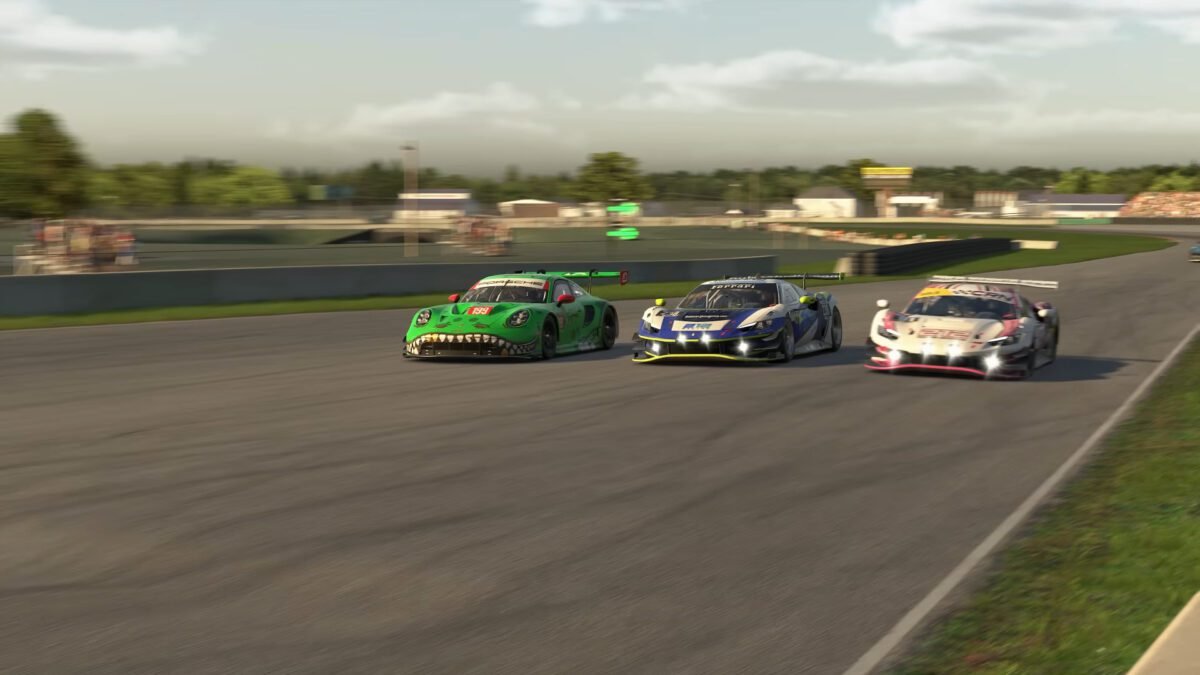
If you’re entering IMSA or endurance races, GT3s often sit mid-pack between prototypes and GT4s.
That means you’re both overtaking slower cars and being overtaken by faster ones — sometimes simultaneously.
Key Rules for GT3 Traffic
- Predictable lines > defensive lines. Let faster cars read you.
- Communicate through consistency. Hold line; don’t weave.
- Time overtakes smartly. Don’t dive on GT4s mid-corner; pass on exit straights.
Building patience here saves your SR — and your sanity.
7. Setup and Ride Height: Don’t Copy GT4 Habits
GT4 setups are stable and forgiving — GT3 setups live on a razor’s edge.
Key Differences
| Component | GT4 Behavior | GT3 Behavior |
|---|---|---|
| Ride Height | Stable, moderate sensitivity | Heavily affects aero balance |
| Dampers | Primarily comfort | Key to traction and stability |
| Anti-Roll Bars | Mild influence | Drastic effect on rotation |
| Brake Bias | Broadly tolerant | Requires per-track fine tuning |
If you’re running fixed setup GT3 races, use practice sessions to understand how the default setup feels, not to fight it.
If you run open setups, start conservative — small changes produce massive behavior shifts.
8. Learning Schedule: A 3-Week Transition Plan
Adaptation takes reps. Here’s a structured three-week block to speed it up.
| Week | Focus | Drill | Goal |
|---|---|---|---|
| Week 1 | Braking and Balance | 20-lap AI runs at Road Atlanta | Smooth, consistent trail braking |
| Week 2 | Aero and Traffic | Draft sessions at Spa or Monza | Maintain pace in dirty air |
| Week 3 | Racecraft and Recovery | Full 40-minute online races | No off-tracks, no spins |
After that, you’ll be ready for official GT3 endurance or fixed races without fear.
9. Common Mistakes When Moving Up
- Overconfidence: Expecting GT3 assists to save mistakes.
- Late braking everywhere: Forgetting aero falls off at low speed.
- Setup obsession: Copying alien setups without context.
- Ignoring fatigue: GT3s demand focus; schedule shorter stints early on.
- Skipping review: Failing to analyze mistakes across both cars.
GT3s reward data-driven learning — even simple delta tools can highlight bad habits early.
10. Comparing GT4 vs GT3 Data: Find the Real Delta
A great exercise is comparing your lap telemetry between GT4 and GT3 at the same track.
Notice where you’re gaining time — and where you’re losing it.
Look for:
- Brake point entry speed difference.
- Minimum corner speed stability.
- Throttle application timing.
- Lateral G load vs throttle curve.
You’ll see that GT3 lap time comes from higher corner exit velocity — the product of smooth weight transfer, not aggression.
11. Mental Reset: Embrace the “Rookie Again” Phase
The hardest part of the GT4 → GT3 jump isn’t technique — it’s ego.
You’ll suddenly be mid-pack again after months of front-running. That’s normal.
The mindset shift is to treat the move as a new discipline, not a new car.
GT4 teaches stability; GT3 teaches precision.
Every lap you survive teaches more than any leaderboard finish.
12. Future Path: GT3 as a Gateway
Once you’re confident in GT3, you unlock nearly every major endurance and league format in iRacing:
- IMSA Series (multi-class with prototypes)
- VRS Sprint/Endurance
- Special events like Daytona 24h, Spa 24h, and Nürburgring 24h
GT3 mastery is the foundation of modern sim racing.
It’s not about raw speed — it’s about control at chaos.
Moving from GT4 to GT3 is both a technical and mental transformation.
You’ll relearn braking, re-feel grip, and rebuild confidence lap by lap.
These iRacing GT4 to GT3 tips aren’t shortcuts — they’re checkpoints for smart growth.
Embrace the discomfort, study your data, and practice with purpose.
Soon, that “humbling jump” will become your proudest leap.