iRacing racecraft begins with a question that most drivers never stop to answer clearly: how assertive should I actually be? The drivers who go too passive get walked over at every corner. Drivers who go too aggressive collect incidents, burn their Safety Rating, and cycle through protest reviews. The answer isn’t a fixed setting. It’s a calibration, not a fixed default. Specifically, the right level shifts based on your license class, the series you’re running, the phase of the race, and the driver you’re racing against right now.
Also See
➡️ How to Defend the Inside Line Without Ruining Your Corner
What Assertiveness Actually Means in iRacing Racecraft
Assertiveness in racing means taking the space that is yours and not giving up space that you’re entitled to defend. It’s distinct from aggression, which involves taking space that belongs to another car. The line between them is real. Crossing it in iRacing produces incident points, protests, and the kind of reputation that follows you across series.
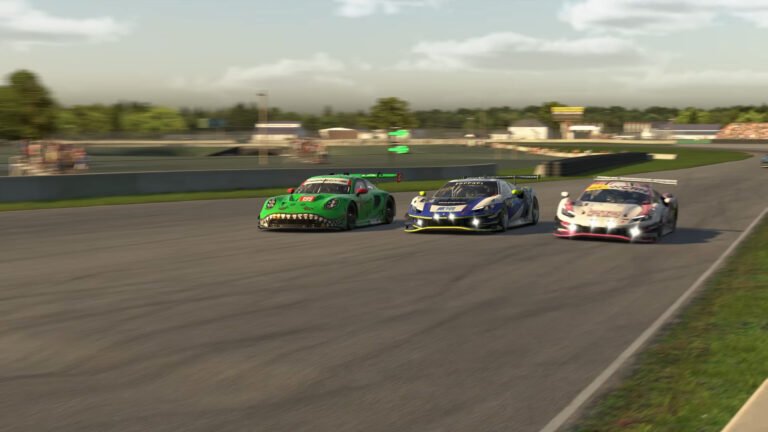
Assertive drivers hold their line through corners even when another car is challenging. They make their position clear early by placing their car where it needs to be before the braking zone. They accelerate out of corners without hesitating when they have track position. None of those things require contact or deliberate blocking. They require, in short, commitment to the line you’ve chosen and the willingness to trust that the other driver will respect it.
Passive drivers, by contrast, give ground they don’t need to give. They brake early when a car is close behind them. They lift off throttle at corner exit when a challenger is alongside even though they have the inside. As a result, they second-guess their position under pressure and end up creating the contact they were trying to avoid.
The Spectrum From Passive to Reckless
It helps to think of driving assertiveness as a spectrum with four rough zones. Passive is the far left. Specifically, it means giving up positions that don’t need to be given, flinching under pressure, and running inconsistent lines when challenged. Assertive is the next zone: holding entitled space, making clear defensive moves, committing to wheel-to-wheel battles with proper technique. Aggressive is beyond that: initiating contact, moving on cars that are already alongside, applying pressure that creates incidents. Reckless is the far right: deliberate wrecking, brake-checking, and the behavior that gets drivers suspended.
The goal, therefore, is to sit firmly in the assertive zone. That means being able to recognize when you’re drifting toward aggressive. That recognition is hard to do in the moment. Consequently, pre-race decisions about your tolerance are more reliable than in-lap judgment calls. Additionally, decide before you get in the car what you’re willing to do to hold a position. Decisions made in advance hold up better under race pressure than ones made at 120 mph.

When to Attack and When to Wait
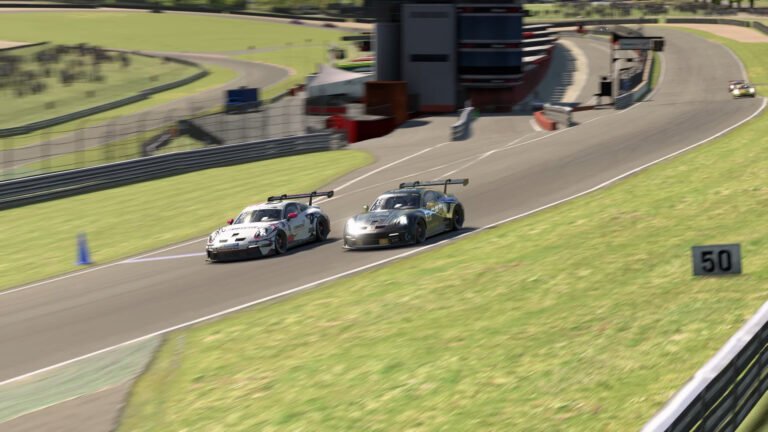
The best overtaking opportunities in sim racing are the ones that don’t require the other driver to do anything. If you carry more momentum through a corner and come out alongside, you’ve created an opening. Similarly, if you time your braking to arrive at the apex with a clear advantage, you’ve set up a move the other driver can complete without contact. These are the moves worth taking. The difference between patience and passivity is that patience waits for a real opportunity. Passivity, by contrast, settles for no opportunity at all.
Forced moves are the ones that go wrong. Sending it down the inside when you’re a full car length back at the braking point puts the outcome in the other driver’s hands. The same is true when diving across someone who is already committed to the apex. If they hold their line as they’re entitled to do, you either hit them or lose the corner anyway. In both cases, the move needs to already be working when you commit to it, not by the time you hope the other driver notices you.
A practical rule: if the overtake requires the car ahead to brake earlier or widen their line, it’s too early to commit. Wait for the lap where your entry pace is genuinely better. Alternatively, use the pressure of following closely to induce a mistake that creates real space.
The Moving Obstacle Principle in Defense
iRacing’s sporting code and the broader motorsport consensus both use something close to a moving obstacle principle for defensive driving. You get one defensive move per straight. You can close a door once per braking zone. After that, you must maintain a consistent line through the corner. Moving twice is the kind of defending that generates protests and incident reports. So is moving late to close a door you already left open.
The most effective defensive driving in iRacing isn’t blocking. It’s positioning. When you come off a corner with a gap behind you, your line on the following straight matters. That line determines how easy you’ve made the challenger’s job. For example, if you apex late and track out toward their attack side, you’ve made the draft less useful. You achieve this without moving at all under braking. That’s positional defense. It’s available to any driver who thinks about where they want to be on track 200 meters before the decision point.
Reading Your Opponents to Calibrate Your iRacing Racecraft
Your assertiveness level should vary based on who you’re racing. A driver who has been consistent and clean through the early laps earns a higher level of trust. Conversely, a driver who has already made two avoidable mistakes gets a wider margin. Against a clean driver, you can race closely because both of you are working within the understood conventions. Against an unpredictable one, giving an extra car-width of margin isn’t passive, it’s damage control.
Over time, you’ll also build a read on the type of moves that tend to work in each license class. Specifically, lower-license racing has more chaos, more late-braking that overshoots corners, and more drivers who don’t hold consistent lines under pressure. In those series, patience pays off more than it does at higher license levels. The drivers around you will create opportunities through their own mistakes without you needing to force anything.
The drivers who develop consistently strong iRacing racecraft across multiple classes share one habit. Specifically, they spend time after races reviewing their battles. Not just the ones that went wrong, but the ones that went well. What made that overtake work? Where did that gap open? What defensive position kept the car behind from getting a run? The answers to those questions, accumulated across sessions, are what moves a driver from reactive to deliberate.