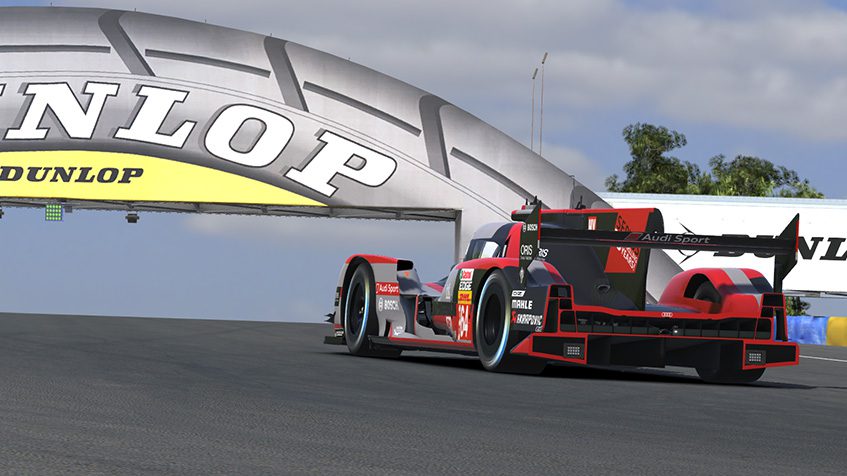
Mastering the Audi R18 iRacing prototype is a journey into the world of high-efficiency endurance racing. Unlike traditional internal combustion cars, the Audi R18 e-tron quattro requires you to be as much of a systems engineer as you are a driver. To find the ultimate pace, you must look beyond the racing line and master the flow of energy between the V6 TDI engine and the flywheel hybrid system. This guide focuses on the technical nuances of diesel torque, energy recovery, and hybrid deployment strategies.
Understanding the V6 TDI Torque Curve
The first rule of the Audi R18 iRacing guide is to respect the diesel powerplant. The 4.0L V6 TDI produces peak torque at a much lower RPM range than gasoline prototypes. If you try to drive the R18 like a high-revving formula car, you will be slow. Short-shifting is often the fastest way around the track, as it keeps the engine in its most efficient power band. Additionally, the diesel engine has significant compression braking, which can help stabilize the car during corner entry if managed correctly.
The KERS Hybrid System: Harvesting and Deployment
The Audi R18 iRacing model utilizes a Kinetic Energy Recovery System (KERS) that captures energy from the front axle during braking. This energy is stored in a high-speed flywheel and can be deployed back through the front wheels. Understanding your state of charge (SoC) is vital. You should monitor your hybrid gauge constantly to ensure you have enough “boost” for critical sections of the track. Deployment is most effective when used to overcome the car’s initial inertia on corner exit, essentially pulling the car out of the turn with four-wheel-drive grip.
There are two primary ways to manage your hybrid energy in the Audi R18 iRacing cockpit:
- Automatic Deployment: The car’s onboard computer handles the boost based on your throttle position. This is ideal for consistency and long endurance stints where mental fatigue is a factor.
- Manual Deployment: You control the boost button. This allows for tactical “push-to-pass” maneuvers or defending your position on a long straight. It requires high concentration but offers a significant strategic advantage.
Managing the “Quattro” Transition
One of the most complex aspects of the Audi R18 iRacing physics is the transition between rear-wheel drive and four-wheel drive. When the e-tron system engages, the car’s handling balance shifts toward understeer as the front wheels begin to pull. You must anticipate this change in balance. The fastest drivers slightly open the steering wheel as they engage the boost, allowing the front-axle torque to pull the car straight without scrubbing the front tires.
Energy Strategy for Multi-Class Traffic
In a multi-class race, the Audi R18 iRacing hybrid boost is your greatest weapon for navigating traffic. The staggering acceleration allows you to make passes in “short chutes” between corners that would be impossible in a non-hybrid car. However, every manual boost consumes energy that you might need for the main straightaway. Learn to time your energy recovery (harvesting) behind slower GTE cars so that you have a full “tank” of electric power the moment you see a gap in the pack.
Summary: The Thinking Man’s Prototype
To conclude this Audi R18 iRacing guide, success comes to those who can balance raw speed with energy efficiency. By short-shifting the V6 TDI, maximizing your harvesting under braking, and strategically deploying your hybrid boost, you can maintain a pace that gasoline-only cars simply cannot match. The Audi R18 e-tron quattro is a masterclass in modern racing technology; master the systems, and you will master the track.