iRacing standing starts look simple from the menu screen. Once the lights go out, the field compresses into the first braking zone and the car beside you does not always behave predictably. Getting iRacing standing starts right requires treating the launch, the initial positioning, and the first corner as three separate skills rather than one combined reflex.
Also See
➡️ Your First iRacing Race: A Practical Plan
The good news is that most launch mistakes happen in the first 50 meters. Drivers who develop a repeatable launch procedure arrive at Turn 1 in roughly the position they started. That gives the rest of the race a neutral baseline instead of a recovery deficit created before the first corner arrives.
What iRacing Standing Starts Actually Test
Unlike rolling starts, iRacing standing starts demand full torque control before the car has momentum or heat in the tires. The wheels can break traction immediately from rest, and correcting mid-launch takes more time than most drivers expect when they first encounter it in a live race.
Furthermore, every car around you is doing the same thing simultaneously. Your slip and recovery affects the drivers directly behind you. A clean start is 30 to 40 meters of advantage over a messy one, and that gap compounds because you carry cleaner air into Turn 1.
The three problems that cause most first-start failures are: not knowing the car’s specific launch procedure, inconsistent clutch release from one attempt to the next, and treating the first corner as an overtaking opportunity before the tires have temperature. Each of these has a specific practice fix.
Know Your Car’s Start Procedure
Each iRacing car has different torque delivery, clutch behavior, and rev response. The MX-5 Miata launches cleanly with modest throttle and an early clutch engagement. A Formula Vee or Super Formula Lights wants a higher rev hold and a faster clutch release. A Dallara Formula 3 can stall if you feed too little throttle before releasing the clutch. Before entering a session, understand where your specific car makes usable torque and what the engagement window feels like.
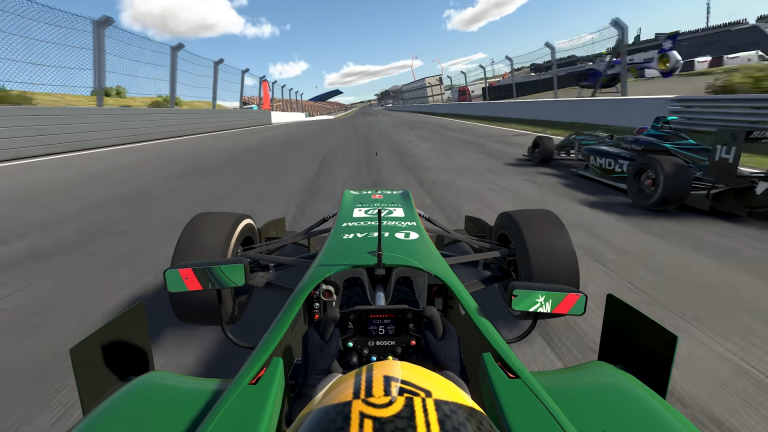
Before entering a race session, also check whether your car has a launch control mode in the options. Formula cars in iRacing often include an automatic clutch slip setting that manages the engagement window on your behalf. If your car has that option, practice the exact engagement sequence in a test session before using it under race conditions. An untested launch mode under pressure produces more inconsistency, not less.
Additionally, iRacing models clutch slip. The clutch pedal is not a binary switch. Slipping the clutch through the engagement window smooths torque delivery and reduces wheelspin, particularly on cold tires or a low-grip surface. If your pedal set includes a clutch axis, assigning and calibrating it correctly before your first standing start weekend is worth the setup time.
Clutch, Throttle, and Wheelspin in iRacing Standing Starts
The core skill is balancing torque against available grip. Hold the engine at a rev point where the car pulls without surging. For most road cars, that range sits between 3,500 and 5,000 rpm. For formula cars, the range is typically higher. The fastest way to find the right hold point is to run test launches and note exactly where wheelspin starts.
Release the clutch progressively through the engagement window rather than dumping it. A fast dump loads the tire instantly and almost always produces wheelspin. Letting the clutch out gradually across 0.2 to 0.4 seconds gives the tire a chance to build traction before it faces peak engine torque. You will feel the car pull forward cleanly rather than spinning and hunting for grip.
If wheelspin occurs, a small throttle lift followed by immediate re-application recovers the launch more cleanly than holding throttle and waiting for grip to return. Furthermore, a simultaneous small lift on the clutch pedal can stop a sliding rear without killing the launch entirely. The goal is staying at the edge of traction, not eliminating slip. A small amount of slip is normal and does not mean the launch has failed.
What to Practice When Your Launch Feels Inconsistent
Inconsistency in iRacing standing starts usually comes from one of three places: a variable rev hold before clutch release, inconsistent clutch speed through the engagement window, or different throttle timing across attempts. Identifying the cause means keeping two inputs constant while changing one.
Therefore, run ten launches with the same rev hold, the same clutch speed, and the same throttle application. Watch the replay after each run and observe the car’s attitude in the first 20 meters. A consistent nose dip followed by straight acceleration means the input is working. A tail slide in the first 10 meters means the throttle or clutch is too aggressive. A flat bog means the rev hold is too low.
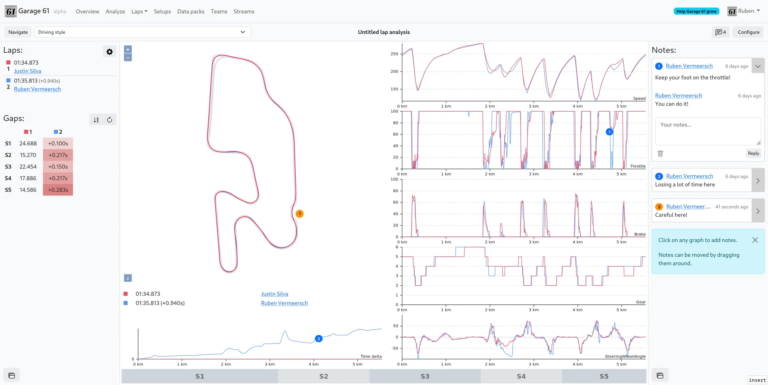
Additionally, run launches from both warm and cold tire states. A launch procedure that works cleanly after a warm-up lap may produce wheelspin from a cold grid stop because the tires have cooled significantly. Telemetry review tools like Virtual Racing School can show you exactly where your inputs diverge across attempts if you want to close the gap between warm and cold launch consistency.
Consequently, knowing both cold and warm launch characteristics gives you a concrete reference point for what to expect on race day rather than discovering the difference at the start of Lap 1.
Positioning Before Turn 1 in iRacing Standing Starts
Your grid position shapes your options in the first corner. If you are on the inside line into a right-hander, you have priority through the apex but also face the risk of a faster car arriving alongside you if you are slow off the line. Know your Turn 1 approach before the lights go out, not after the field has already moved.
On the outside line into the first corner, give the car ahead an extra half car length of margin in the braking zone. Cars on the inside line often brake later in the opening lap because they are actively defending position. If you match their brake marker from the outside, you will arrive at the apex with too much speed for your line on track.
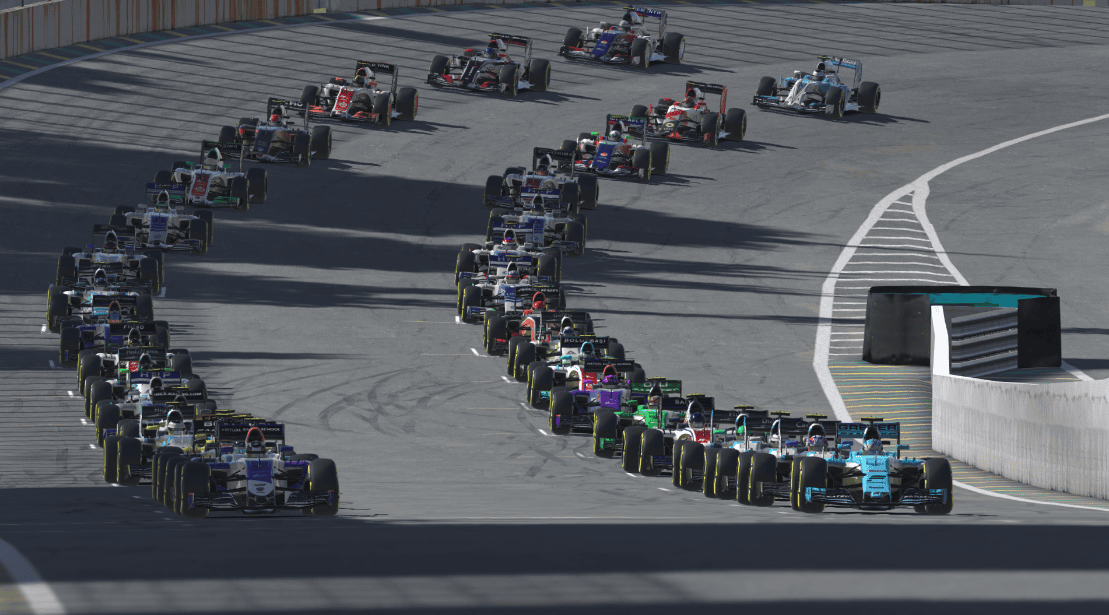
Also, the distance to Turn 1 shapes the risk level. Tracks with a long straight before the first corner give the field time to spread before the braking zone, which significantly reduces first-corner contact risk. Tracks with a short run to Turn 1 mean the braking zone arrives while the field is still bunched together. Adjust your caution level accordingly. A clean exit from a conservative Turn 1 is faster over a full race distance than a collision caused by misjudging the gap on Lap 1.

Cold Tires and Cold Brakes
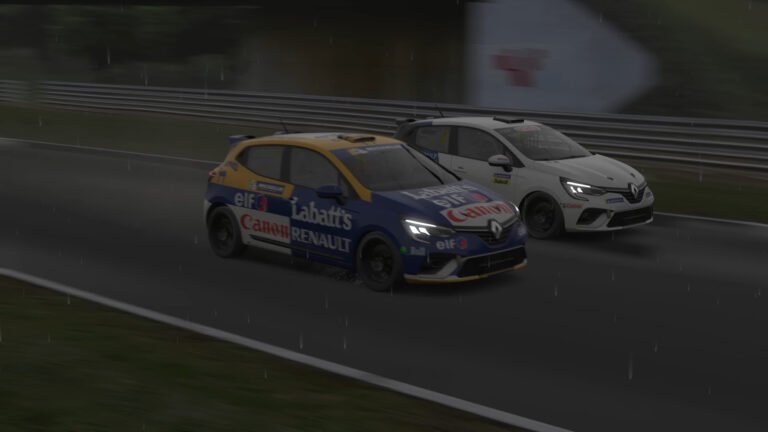
iRacing models tire and brake temperature. At the start of a race, both are below working temperature, which means grip and braking efficiency are lower than they will be after the first few laps. A braking marker that feels comfortable in mid-race practice may produce a lock-up or significant understeer in iRacing standing starts because the tires have not reached working temperature yet.
Therefore, add five to ten percent more braking distance in the first two laps compared to your regular practice markers. Also, trail-braking into corners on cold tires requires less rotation entry than it will once the tires have built temperature. Trusting your mid-race braking technique on Lap 1 is one of the more common causes of first-corner incidents in iRacing races.
In rear-wheel drive cars, the rear tires take longer to reach working temperature than the fronts because front brakes carry more of the braking load. Consequently, oversteer at corner exit in the first two laps is a normal tire temperature effect and not a sign of a setup problem. Reduce your throttle application angle at corner exit during the first lap and let the rears build temperature before you push the exit grip limit.
When Gaining a Position Is Not Worth the Risk
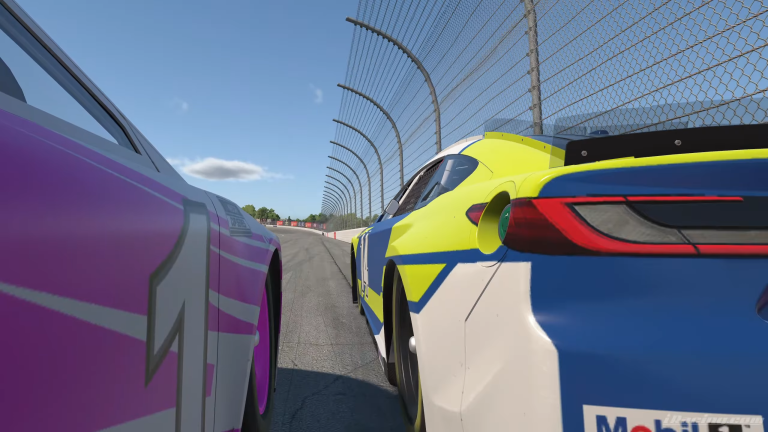
The most common mistake in a standing start is treating the first corner as the primary overtaking opportunity. In lower-split racing, the drivers around you are not yet confident in their braking distances, which makes Turn 1 the highest-risk part of the race rather than the lowest.
If you are alongside another car into Turn 1 and the other driver does not clearly give way, hold your line rather than forcing the issue. Furthermore, a car that spins into your side or pushes you into the wall costs you far more positions than the one you were trying to take. The position is recoverable with clean laps. A retirement caused by first-corner contact is not.
Also, if you run wide at Turn 1, let the car go to the edge of the track rather than over-correcting across a car beside you. A smooth exit from a wide line recovers the position within a few corners once the field has spread. A panic correction that makes contact with the car on your left is an incident point and potentially a damaged front wing. How you handle the recovery from any first-corner mistake matters as much as the mistake itself, a point covered in depth in this piece on what high iRating drivers do after incidents in iRacing.
The Practice Drill for iRacing Standing Starts
Set up a test session at the same track where the race will run. Choose a standing start in the session options rather than a rolling start. Complete ten launches using the same inputs without changing anything. Watch the replay after the session and note which launches produce wheelspin and which run clean.
For the next five launches, change one variable by a small margin: the rev hold by 200 to 300 rpm, or the clutch release speed by a fraction of a second. Run five more identical attempts. If the launch improves, adopt the change. If it gets worse, revert and try a different variable. Therefore, by the end of the session you will have a launch procedure that is consistent enough to use under race pressure.
Furthermore, finish the practice session with an AI race at the same track. Set the AI difficulty between 60 and 70 percent. The AI race applies your launch procedure in a consequence-free traffic environment. When you complete the opening lap with clean positioning and no contact, your iRacing standing starts preparation is solid enough to carry into a live session.
The goal at the start of any iRacing race is to arrive at the first braking zone in roughly the position you qualified, with clean tires and a working car. Everything that comes after is easier from that baseline. The broader first-race context that standing start preparation feeds into is covered in this guide to surviving your first online race in iRacing.