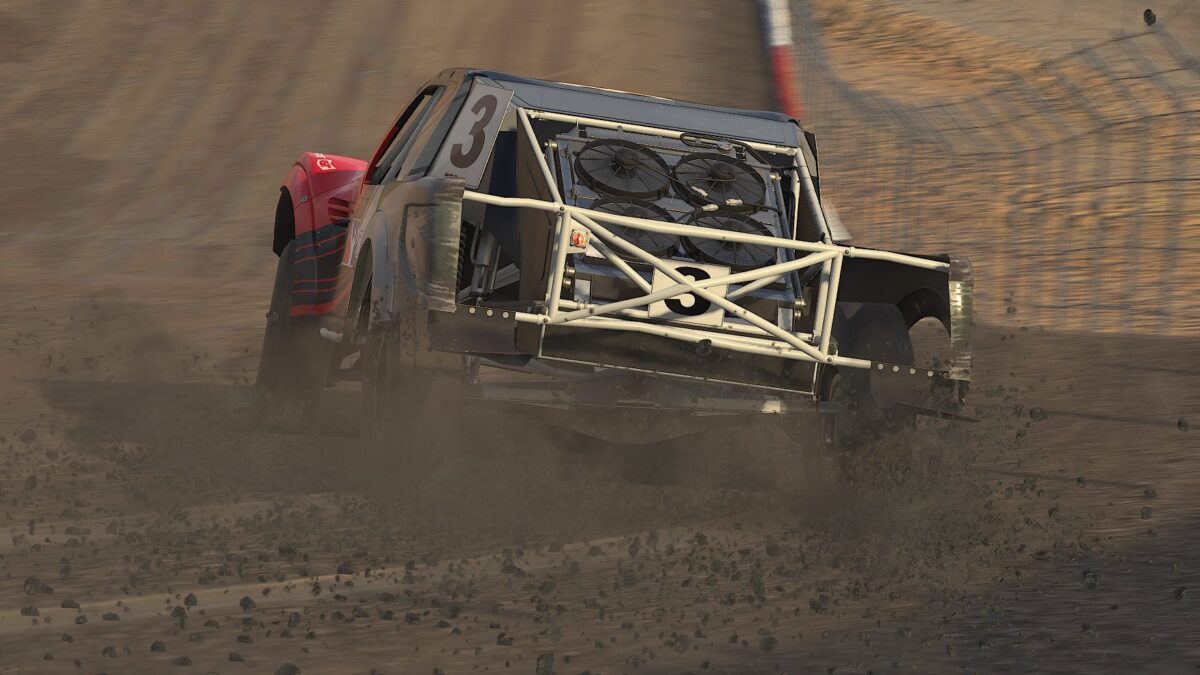
This is your comprehensive guide to the Lucas Oil Off Road Truck family in iRacing—the Pro 2, Pro 4, and Pro 2 Lite. All three share common bodywork and visual DNA, but each variant teaches a different lesson in traction, rotation, and jump management. Use this piece to learn what changes between them and how to translate that into lap time.
Pro 2 is rear‑wheel drive with stout power. It rewards classic dirt technique: brake in a straight line, ease off the pedal to help the rear rotate, and pick up throttle smoothly so the truck squats rather than snaps. Because the front tires are unloaded over crests and lips, you must square the steering wheel before takeoff. In the air, a brief lift will tip the nose down; a small throttle blip can bring it back up. The rhythm is brake‑rotate‑settle‑go.
Pro 4 layers AWD grip on top of that foundation. You can hustle into entries harder and stand on the throttle sooner, but the extra traction hides momentum. If you over‑drive, the truck will push wide and chew up the next landing. The trick is to brake a touch earlier than your instincts suggest and keep the platform flat over the lip—big steering corrections in the air are a recipe for crossed‑up landings. Driven correctly, Pro 4 is devastating in traffic thanks to its drive off the corner.
Pro 2 Lite is the on‑ramp. With less power and a spec philosophy, it forgives poor timing and rewards tidy lines. The suspension still demands respect: land straight, wait half a beat for the compression to finish, then roll into throttle. If you’re new to short course, start here until your lap times stabilize and you can consistently hit the same braking markers lap after lap.
Baseline specs (approximate): Pro 2 ~700 hp, RWD, ~4,000 lb. Pro 4 ~900 hp, AWD, ~4,000 lb. Pro 2 Lite ~450 hp, RWD spec, ~3,800 lb. Gearboxes are geared for punch and control rather than top speed; most venues emphasize acceleration and jump stability over terminal velocity.
Cornering & rotation. The fastest laps come from using weight transfer instead of steering lock. Trail the brake just past turn‑in to point the nose; then open your hands and feed in throttle to plant the rear. On dirt, the slip angle you want is visible—you’re looking for a controlled drift that stays inside the cushion and lines you up square for the exit berm.
Jumps & landings. Treat every jump like a mini‑straight. Prioritize a clean approach line, neutral steering at the lip, and a stable landing. If the nose is high, a brief lift mid‑air will bring it down; if the nose dives, a quick throttle blip can rescue the attitude. Aim to minimize airtime—distance without drive on the ground is rarely faster.
Racecraft. Passes are built before the jump, not in the air. Set up exits that put you alongside into braking zones, and defend by forcing rivals to take the long way around the cushion. Light contact is common, but clean lines save incident points and keep the truck aligned for the next rhythm section.
Why it’s fun. Short laps, constant decision‑making, and huge skill expression make these trucks perfect for bite‑sized sessions and league nights alike. Once you learn to read the suspension, the track opens up—suddenly there are three viable lines where you used to see one.
New here? After you’ve skimmed these fundamentals, scan the official release recap for historical context and baseline expectations for setups and series placement.