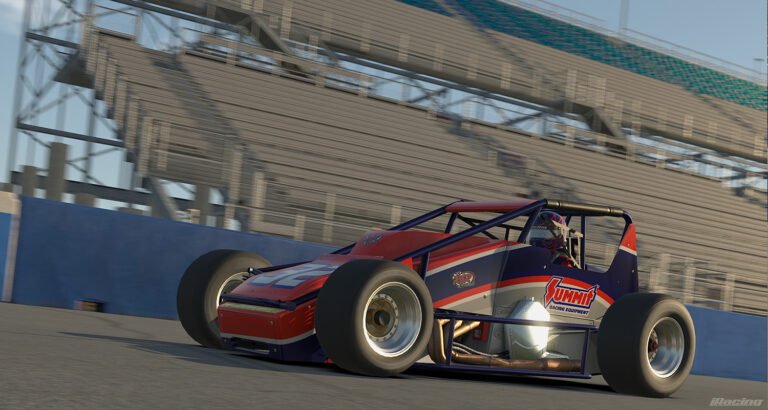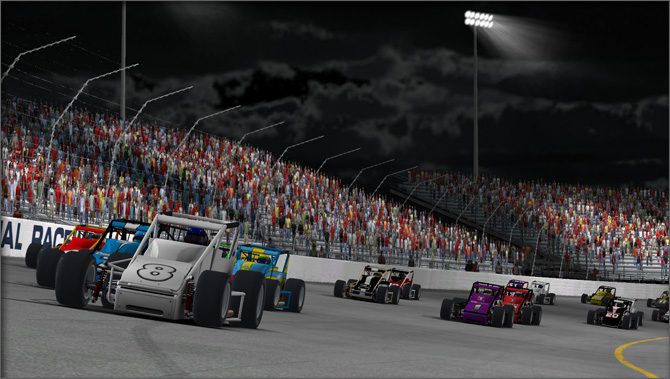
The iRacing Sprint Car is more than just a challenging short-track machine; it is a digital tribute to the “Golden Age” of American open-wheel racing. Nothing better epitomizes American grassroots racing than the sprint car. Its iconic “roller skate” shape hearkens back to a time when the likes of Bill Vukovich, Jimmy Bryan, and Parnelli Jones scratched and clawed their way from the dusty bullrings of America to a front-row seat in the Indianapolis 500. While the career paths have changed, the sprint car remains the top of the short-track pyramid, serving as a vital stepping stone for modern legends like Jeff Gordon and Tony Stewart.
The E-Ticket to the Indy 500
In the mid-20th century, a sprint car feature win at a legendary track like Terre Haute was effectively an E-ticket to the Indianapolis 500. The iRacing Sprint Car captures the raw, mechanical essence of that era. Before the advent of rear-engined “spec” cars, the path to the Brickyard was paved with 410 cubic inch pushrod engines and direct-drive systems. These cars were the “Big Cars” of their day, and mastering them was the only way to prove you had the iron will and technical finesse required to handle a Champ Car at 150 MPH. When you climb into the cockpit in iRacing, you are stepping into a lineage of bravery that defined American motorsport.
The iRacing Sprint Car maintains this historical accuracy by preserving the “brutish” nature of the vehicle. Lacking a clutch, flywheel, and transmission, these cars are a world apart from their modern Formula One counterparts. Yet, they share a similar power-to-weight ratio that makes them equally dangerous and exhilarating. Muscling a sprint car around a bullring for 20 or 30 laps is not for the faint of heart. It is a physical battle that requires a delicate touch with the steering wheel and the throttle—a skill set that made drivers like Kasey Kahne and Tony Stewart stand out when they finally made the jump to NASCAR and IndyCar.
The Modern Stepping Stone: Gordon and Stewart
While the direct link to an Indy 500 seat has faded, the iRacing Sprint Car continues to play a vital role in driver development. Jeff Gordon famously moved to Indiana specifically to pursue a sprint car career, recognizing that the Midwest was the hub for open-wheel talent. Similarly, Tony Stewart used the USAC Sprint Car series to hone the car-control skills that would eventually lead him to three NASCAR Cup championships and an IndyCar title. The ability to manage 800-plus horsepower in a lightweight, short-wheelbase chassis creates a “sixth sense” for grip that stays with a driver for their entire career.
A Global Phenomenon
The influence of the iRacing Sprint Car extends far beyond the United States. This style of racing remains a massive draw in Australia, Canada, New Zealand, and South Africa. Whether it’s a Saturday night feature in Sydney or a high-stakes race in Indiana, the formula remains the same: a compact wheelbase, massive torque, and an asymmetrical tire setup that rewards the bold. iRacing’s inclusion of the pavement sprint car ensures that this unique form of motorsport is preserved and accessible to fans worldwide, regardless of their local track’s surface.
Summary: Preserving the Heart of Grassroots Racing
To conclude the iRacing Sprint Car collection, we look at the car as a bridge between the past and the future. It represents the rawest form of competition, where mechanics and drivers must work in perfect harmony to make a right-rear tire last for 25 grueling miles. It is a car that demands respect and offers no second chances. As you take the green flag in your next iRacing session, remember the legends who came before you. You aren’t just driving a “roller skate”—you are driving the heart and soul of American racing history.