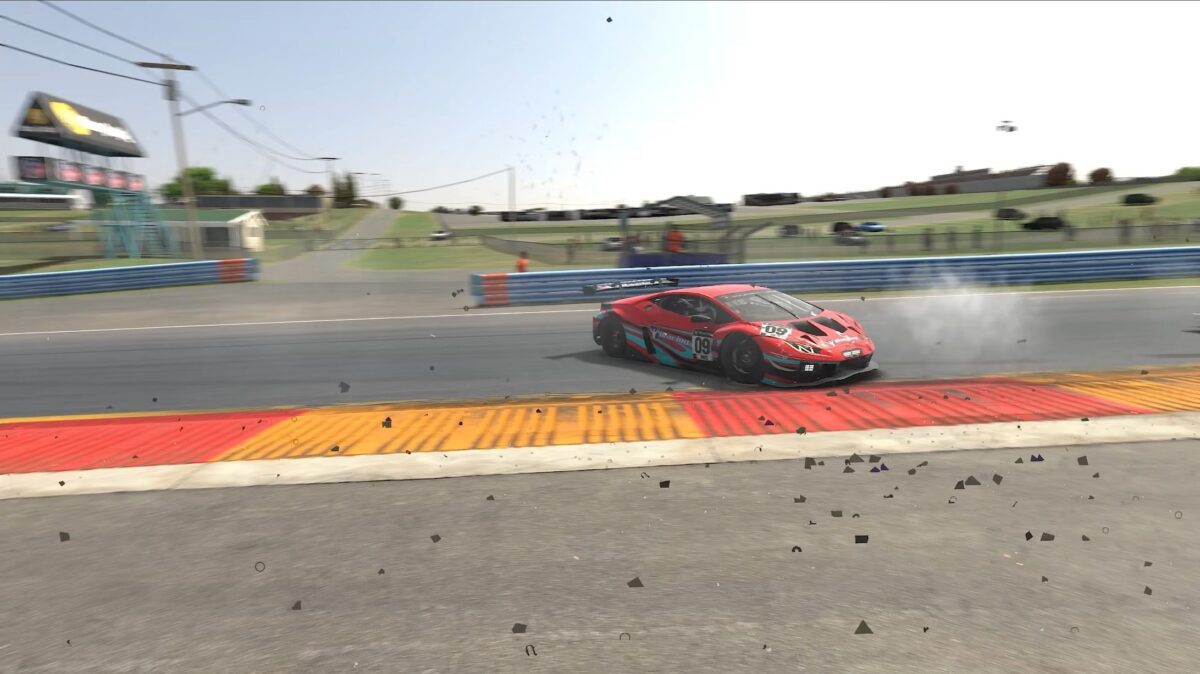
Aerodynamic damage is one of the most misunderstood parts of iRacing. When your car slows down after contact, it’s easy to notice. Understanding why it behaves differently is the tricky part. Aero damage in iRacing is modeled in a detailed, car-specific way. Even small changes to bodywork can drastically change how your car performs.
How Aero Damage Works
Almost all damage, except for complete part loss in rare cases, will increase drag. That makes your car less efficient through the air and hurts straight-line speed. The bigger effect often comes from how downforce balance changes when specific parts are damaged.
- Front-end damage reduces downforce at the nose. This causes understeer as the front tires lose grip in fast corners.
- Rear-end damage reduces downforce over the back of the car. That leads to oversteer and instability under acceleration or while turning.
- Losing a major aero part like a wing or diffuser can wreck handling and speed. The car often becomes nearly undriveable at full race pace.
Location Matters
Damage to aero-critical areas such as the splitter, undertray, diffuser, or wings has a much larger effect than dents on non-aero panels. In open-wheel cars, bodywork plays a huge aerodynamic role. Losing a sidepod or part of the floor can ruin performance.
For instance, a missing sidepod on a Lotus 79 removes a major source of ground-effect downforce. On the other hand, a dented door on a GT4 car is mostly cosmetic and rarely changes lap times.
Car-Specific Tuning
iRacing does not use a single aero damage formula for all cars. Each vehicle is individually tuned to match its real-world aero traits and community feedback. The general rules apply to all cars, but the impact varies. A touring car reacts differently to aero loss than a prototype or an open-wheel car.
Aerodynamic damage means more drag and a shift in downforce balance. The effect depends on where the damage is and what you drive. Front-end damage makes the car push. Rear-end damage makes it loose. Losing major parts usually ends any hope of matching your previous pace.
If you feel slower after contact, it’s not just “damage.” It’s airflow — broken, turbulent, and holding you back.