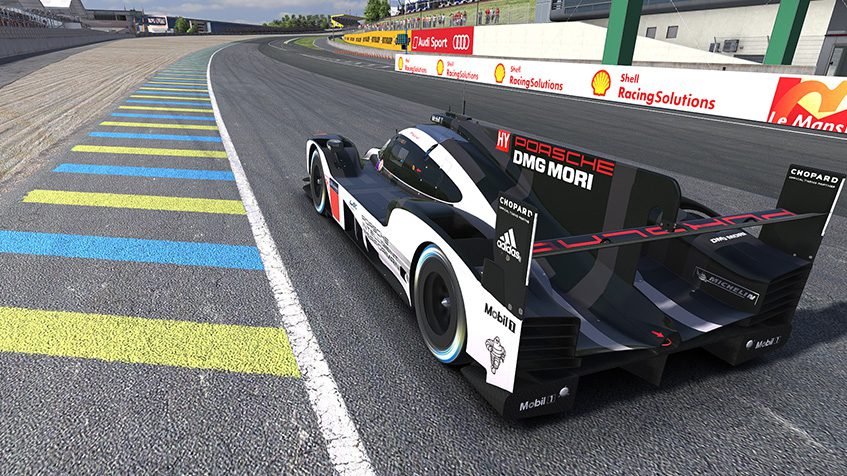
Mastering the Porsche 919 Hybrid iRacing machine requires a fundamental shift in how you approach endurance racing. Unlike traditional combustion cars, the 919 Hybrid is a dual-energy recovery vehicle that balances a turbocharged V4 engine with two distinct hybrid systems. To extract the maximum pace from this 900-horsepower legend, you must learn to manage your energy budget lap by lap, ensuring you have the “boost” available when it matters most while maintaining the delicate aerodynamic balance of an LMP1 titan.
The Heart of the 8MJ Class: V4 and Dual ERS
The Porsche 919 Hybrid iRacing guide begins with the powertrain. The car features a mid-mounted 2.0L V4 engine that produces roughly 500 horsepower. However, it is the 8-Megajoule (8MJ) hybrid system that defines the car’s performance. The 919 utilizes a Motor Generator Unit (MGU) on the front axle for kinetic energy recovery (KERS) and a second MGU in the exhaust (MGU-H) to harvest thermal energy. This unique combination allows the car to charge its lithium-ion battery not just under braking, but also under full acceleration, creating a relentless cycle of power.
Managing Deployment: Automatic vs. Manual
In the Porsche 919 Hybrid iRacing cockpit, you have two primary methods for deploying your stored energy. In “Automatic” mode, the car’s onboard computer “learns” the track over a few laps and manages the boost to optimize your average speed. This is highly effective for long endurance stints where mental fatigue is a factor. For more advanced drivers, “Manual” mode—often toggled via the MGU-K Deploy Mode—allows you to set a fixed trim level. This dictates how aggressively the car boosts out of corners, allowing you to save energy for specific tactical moves or defending your position on a long straight.
Successful energy management involves monitoring your State of Charge (SoC). If you find your “deployment” bar (the blue bar on the dash) emptying before the end of a lap, you are “clipping” and losing significant time. Adjust your deployment trim to a more conservative setting (higher numbers in manual mode typically use less energy) to ensure you have power for the final sector. Conversely, if you finish a lap with 30% battery remaining, you are leaving speed on the table and should move to a more aggressive map.
Tactical Boosting and Overtaking
One of the most powerful tools in the Porsche 919 Hybrid iRacing arsenal is the “HYS Boost” button. This is your “Push-to-Pass” weapon. When held, it overrides your current map to deliver maximum hybrid power to the front wheels. This is best used to complete a pass on a slower GT3 car or to pull alongside a rival LMP1 before a braking zone. However, be warned: the boost button drains the battery at an alarming rate. Overusing it early in a stint can lead to “derating,” where the car’s top speed is severely limited for several laps while the battery recovers.
- Harvesting Tip: Maximize your MGU-K Re-gen Gain (set to 9 or 10) to ensure your battery stays topped up during braking. The 919 is incredibly efficient at recovery, so there is rarely a reason to lower this setting.
- AWD Traction: Remember that hybrid deployment turns the car into a 4WD machine. This adds stability out of slow corners but can induce understeer if you boost too early while still carrying significant steering angle.
- Fuel Management: Use the hybrid system to your advantage during long runs. By relying more on electric boost and lifting early before braking zones (Lift-and-Coast), you can stretch your fuel window, potentially skipping a pit stop in shorter races.
The Precision of the 900HP Prototype
To conclude this Porsche 919 Hybrid iRacing guide, remember that the 919 rewards precision over aggression. The car’s complex systems are designed to work in harmony, and forcing the car beyond its aerodynamic or energy limits will only result in slower lap times. By mastering the balance between the V4 engine and the dual-hybrid systems, you aren’t just driving a car—you are conducting a high-speed symphony of engineering. Treat the battery as a resource, the boost as a weapon, and the track as a puzzle to be solved through technical excellence.