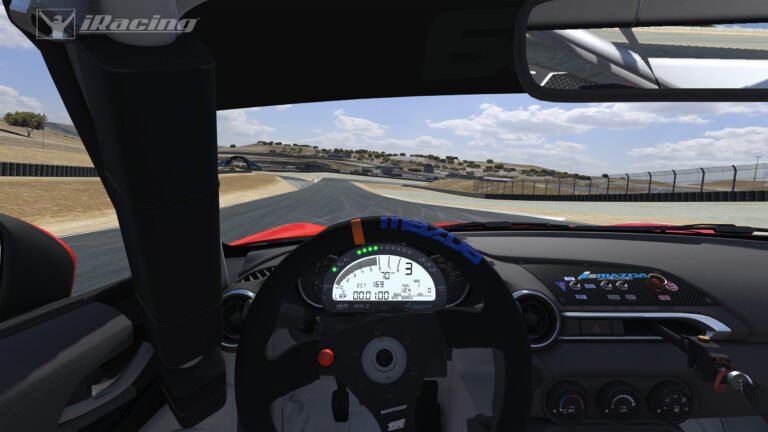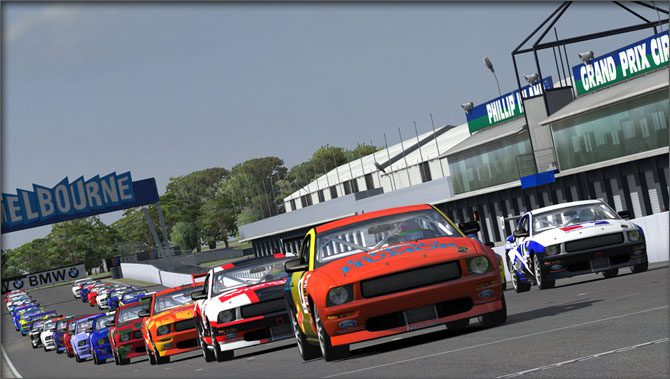
Mastering the Ford Mustang FR500S iRacing experience is a masterclass in managing momentum and weight transfer. Unlike the lightweight Mazda MX-5, the Mustang is a 3,160-pound “heavyweight” that relies on its 4.6L V8 torque and mechanical grip. To excel in the Mustang Challenge or the Production Car Challenge, you must move beyond aggressive driving and focus on the fundamentals of early braking, trail braking for rotation, and the delicate art of the H-pattern shift.
The “Slow In, Fast Out” Philosophy
The golden rule for the Ford Mustang FR500S iRacing machine is “slow in, fast out.” Because the car is heavy and features a live-axle rear suspension, it is prone to understeer if you carry too much speed into a corner. The fastest drivers brake early and in a straight line, ensuring the car is settled before turn-in. Over-taxing the front tires by combined braking and steering will only result in a “plowing” sensation that kills your exit speed. By being conservative on the way in, you can square off the corner and use the 325-horsepower V8 to rocket down the following straightaway.
Trail Braking: The Secret to Rotation
While early braking is essential, mastering trail braking is what separates the mid-pack from the podium. As you release the brake pedal and begin your turn-in, keeping a tiny amount of pressure (roughly 5-10%) on the brakes helps keep the nose pinned. This shifts the weight forward, giving the front tires the bite they need to rotate the 3,000lb chassis. If you release the brakes completely before turning, the weight shifts back, and the Mustang will naturally want to push wide. Think of the brake pedal as a tool for steering just as much as for slowing down.
- H-Pattern Discipline: The FR500S rewards smooth, deliberate shifting. Avoid “slamming” gears; the iRacing transmission model requires a moment for the gear to engage. Rev-matching on downshifts is vital to prevent “axle hop,” where the rear wheels lock and cause the car to spin.
- Live-Axle Awareness: The solid rear axle makes the Mustang sensitive to curbs. While you can “clip” some flat curbs, hitting a large “sausage” curb will unsettle the entire rear end, often resulting in a snap-spin.
- Throttle Modulation: With 325HP and massive torque, “mashing” the throttle on exit will induce wheelspin. Roll onto the power gradually, feeling for the point where the rear tires have enough load to handle the V8’s grunt.
Managing Weight Transfer and Engine Braking
One of the unique challenges of the Ford Mustang FR500S iRacing model is its significant engine braking. Lifting off the throttle suddenly in a high-speed corner can cause “lift-off oversteer,” as the weight shifts forward and the engine drag slows the rear wheels. To keep the car balanced, try to maintain a “maintenance throttle” (around 5-10%) through high-speed sweeps. This keeps the weight distributed evenly across all four tires, preventing the “squirrelly” rear-end behavior that often catches out newer drivers.
Precision Over Aggression
Ultimately, the Ford Mustang FR500S iRacing car rewards the clinical driver. It is a car that punishes over-driving with overheating front tires and lost momentum. By perfecting your trail braking, being disciplined with your H-pattern shifts, and respecting the car’s mass, you can turn this “pony car” into a precision instrument. Momentum is your best friend—keep the car balanced, exit with power, and the lap times will follow.