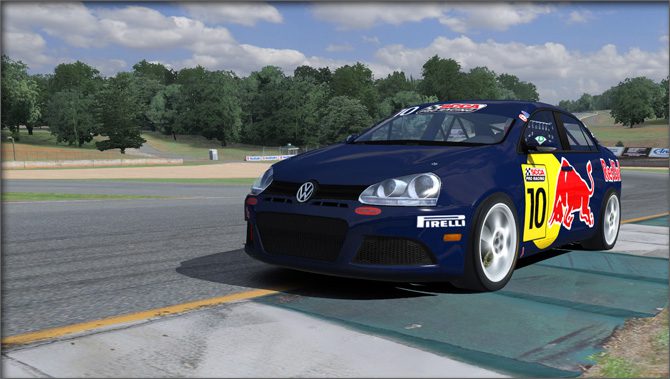
The Volkswagen Jetta TDI iRacing launch in May 2011 brought a fresh, torque-heavy flavor to the road racing community. As the Season 2 update went live, the Jetta immediately carved out a niche as the “torque monster” of the lower-class tiers. The reception was overwhelmingly positive, with drivers noting the car’s stability and its unique power delivery. The launch proved that diesel racing had a home in the digital world, offering a driving experience that prioritized precision and smooth inputs over high-RPM aggression. From the turbo whistle to the DSG “pop,” the Jetta TDI delivered.
The Torque-Pull Sensation
On the Volkswagen Jetta TDI iRacing launch day, the discussion was dominated by the engine’s power band. Drivers quickly realized that the Jetta doesn’t like to be “rung out” to the redline; instead, it finds its speed in the mid-range. The launch showcased a car that is incredibly stable under braking but requires a delicate touch on corner exit to prevent “front-end plow.” The audio was a particular highlight, capturing the distinctive “clatter” of the diesel engine and the high-pitched whistle of the turbocharger, providing an immersion level that felt truly distinct from anything else on the service.
Impact on the Global Challenge
The Volkswagen Jetta TDI iRacing launch saw the car immediately integrated into the Global Challenge multi-class series. During its debut week, the Jetta proved to be an excellent sparring partner for the Kia Optima, often excelling on tighter tracks where its low-end torque allowed it to “jump” out of corners. Drivers praised the car’s “honest” handling, noting that while it was easy to drive, it was difficult to master the efficiency needed for top-split times. The Jetta TDI wasn’t just a new car; it was a new way to race. The diesel revolution had officially arrived.