Every sim racing league admin knows the same story. It starts with a Google Sheet, a Discord server, a Venmo request, and good intentions. A few seasons later that Sheet has fourteen tabs and half the formulas are broken. Results go up two days after the race, protests get argued in DMs, and half the drivers are quietly wondering if anyone is actually tracking anything.
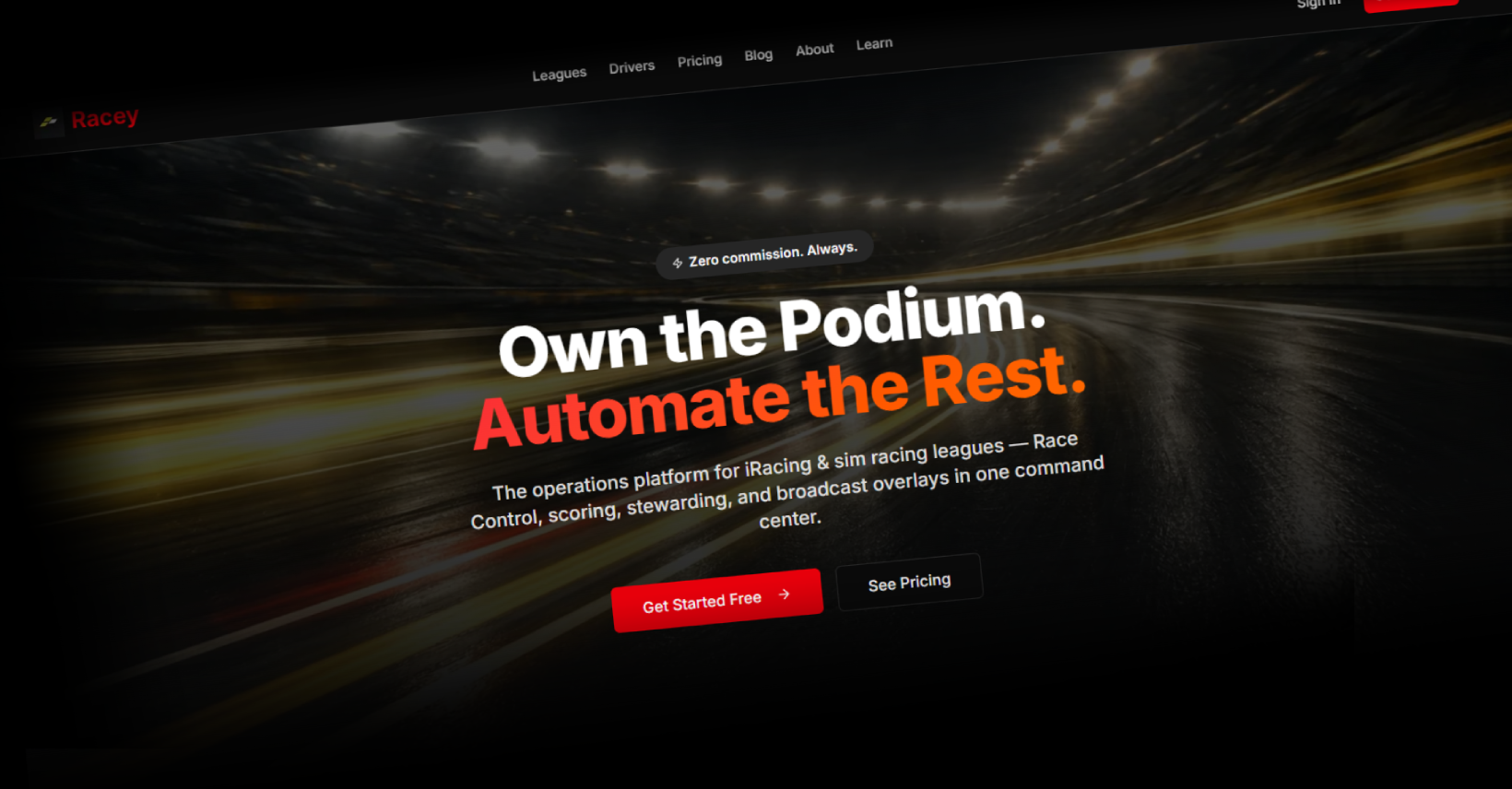
In short, Racey (racey.gg) is a new platform built to end that cycle. It pitches itself as a full race operations tool for iRacing and multi-sim leagues. The platform combines Race Control, scoring, stewarding, driver registration, Stripe entry-fee collection, and OBS broadcast overlays in one command center. Founder Marwan reached out to iRacerHub in June asking to be included in the Apps & Software coverage. After a full walk of the product, it belongs there. Racey is one of the most complete league platforms available right now for iRacing organizers who want to run a real operation.
Also See
➡️ RaceJoin Review: Build Your Driver Profile and Get Discovered by Sim Racing Teams
🎮 Racey on racey.gg
What Racey Actually Is
Racey is not a marketplace, a Discord bot, or a scoring calculator you download and run on your PC. Instead, it is a hosted web platform where a league admin creates a league, sets up seasons and events, and imports iRacing results. Drivers, stewards, race directors, broadcasters, and team captains each get their own role-based logins into the same workspace.
For example, the list of things that ship in the box is genuinely long. Season and event scheduling. A scoring engine with F1, NASCAR, IndyCar, IMSA/WEC, GT3, and weekly oval/road presets, plus fully custom point systems on Pro. A self-serve driver registration portal with approvals, capacity limits, and waitlists. Standings and driver profiles that update the moment results are imported. A stewarding pipeline with blind review, independent voting, appeals, and searchable precedent. Six OBS broadcast overlays covering timing tower, standings strip, driver cards, battle tracker, fastest lap, and incident ticker. Discord webhook integration for results, registrations, and announcements. CSV and JSON import for iRacing, plus CSV import for ACC, rFactor 2, AMS2, and other sims. Data export on every plan, including Free.
In short, the philosophy is simple. If a piece of your race weekend usually lives in a spreadsheet, a Discord thread, or a private admin DM, Racey pulls it into one auditable workspace instead.
Race Control: The Feature Most League Tools Skip
In particular, the headline feature is the Race Control panel. This is the operator screen a race director uses during a live session, and almost nothing else in this category has anything like it.
Specifically, on one screen the race director gets the session state (formation, green, yellow, safety car, VSC, red, suspended, finished) and the full live driver grid. Stewards can pick up an incident queue mid-session, and the race director has in-session penalty tools covering drive-through, stop-and-go, time penalty, and grid drop. A broadcast messaging tool handles communication to one driver, one team, or the entire field. The state machine enforces valid transitions, so nobody accidentally jumps from red to green without a proper restart.
Additionally, everything that happens gets written to an immutable event log. Every flag deployed, every penalty issued, every message sent, every state change. When a protest gets filed on Monday, the steward is not rebuilding the race from memory and three Twitch VODs. They are opening the exact sequence of events with timestamps.
For any league running a broadcast, Race Control is a Pro feature. For any league that runs an actual broadcast or has more than one race night going per week, it is the reason to upgrade on its own.
Stewarding That Removes the Reputation Problem
In addition, the second standout is the stewarding pipeline. Most sim racing protests get handled the wrong way, and everyone racing in a league already knows it. Discord thread, admin DM, community vote, popular driver gets a lighter penalty, controversial incidents turn into flame wars, and identical incidents in different weeks get wildly different outcomes.
Specifically, Racey’s answer is a structured six-step pipeline. A driver files a protest with video, lap, and a written description through a real form. Stewards receive the case with driver names hidden, so the judgment is on the incident and not the reputation. Each steward votes independently before seeing how the others voted. This stops the first voter from anchoring the panel. The majority ruling issues a penalty from a toolkit of twelve types: time penalties, grid penalties, points deductions, warnings, and disqualifications. Drivers can file a structured appeal with new evidence. Every ruling is recorded as searchable precedent that stewards can reference in future seasons.
However, there is an AI-assisted summary layer that generates a neutral facts-only writeup of each incident. It helps stewards ramp on a case faster, but the AI does not vote and does not issue penalties. Stewards do, and Racey is up front about that distinction.
In terms of tier access, basic protests, rulings, and penalties are available on the Free plan. Blind review, appeals, and penalty-points tracking are Pro.
Scoring, Registration, and Season Management
In practice, scoring is where most homegrown league tools quietly fall apart. Racey ships with the major real-world formats as presets. It also adds stage scoring, heat racing, multi-class, team scoring, and drop-week logic on top. Custom scoring systems are a Pro feature for leagues that want to run a bespoke ladder. Furthermore, every point that lands in the standings carries an audit trail back to the race and the rule that put it there.
Similarly, driver registration is a real workflow instead of a Google Form dumped into a Discord pin. Drivers browse a public league page, read the rules and format, and apply directly. The admin approves or waitlists them from inside the same console that runs the season. Capacity limits and content requirements are built in.
Additionally, season cloning quietly wins converts. Once a league admin has a working season configured, the next one is just a few tweaks away. Staff permissions cover seven distinct roles: platform admin, league admin, race director, steward, broadcaster, team captain, and driver. Granular, and appropriate for anyone running a real operation with delegated responsibility.
Broadcast Overlays That Actually Look Like Broadcast
Specifically, the six OBS overlays drop into a stream as a browser source: timing tower, standings strip, driver cards, battle tracker, fastest lap, and incident ticker. All are fed live by the same data driving Race Control. What viewers see on stream matches exactly what the race director sees on the operator screen. For a full picture of what else is available in the iRacing streaming stack, see the rundown of the best OBS overlays for iRacing streams.
For many leagues, this is one of the harder problems in the category to solve well, and it is a big part of what puts Racey ahead of the older iRacing league tools. Indeed, most self-host projects either skip broadcast entirely or leave the streamer to build overlays from scratch.
Zero-Commission Entry Fees
Specifically, the zero-commission model is the founder’s actual pitch line and it is worth taking seriously. Entry-fee collection on Racey rolls out through Stripe Connect, which routes payments directly to the league’s own Stripe account. Racey never touches the money. The only fees are the standard Stripe processing fees, roughly 2.9% plus 30 cents per transaction.
In contrast, most league marketplaces collect entry fees on your behalf and take a cut before paying you out. Racey does not, and has publicly committed that it never will. For a league running a paid championship, this is a real number over a season. Coupons and discount codes are included on Pro so admins can run early-bird pricing without extra tooling.
Drivers Race for Free, Forever
Importantly, the driver-side app is genuinely free with no asterisk. Drivers get a personal dashboard with a next-race countdown, live championship position, and recent results. For instance, they get performance analytics covering win rate, podium rate, consistency index, and rating trends. A public career profile aggregates results across every league they race in. In-app protest filing and appeal tracking come standard, along with a unified profile across every Racey league.
As a result, only the league admin ever pays. This is the correct model for the category and one of the clearer signs that Racey was built by someone who has actually run a league.
How Racey Compares
For reference, Racey publishes its own comparison page and, refreshingly, it is fairly honest.
In contrast to SimGrid, the pitch is different products. SimGrid is a large multi-sim marketplace where drivers join events hosted on SimGrid’s own infrastructure. In short, Racey is software for running your own branded league on your own pages. If a league wants to plug into an existing driver pool, SimGrid is strong. If a league wants to own the operation end to end, Racey is the better fit.
In comparison to Xtreme Scoring, Racey is the closest direct analog. Racey goes further on blind stewarding, native OBS overlays, zero-commission Stripe entry fees, and CSV import for non-iRacing sims.
Meanwhile, the trade-off against iRLeagueManager is hosted versus self-hosted. iRLeagueManager is free and open source, covering schedule planning, results, standings, and stewarding. The key difference is that the league admin runs the server. Racey is hosted and adds AI-assisted stewarding, OBS overlays, integrated payments, and multi-sim CSV import.
Similarly, the trade-off against SimRacing.GP puts the strengths in different places. SimRacing.GP is free and shines for dedicated-server titles like ACC and AMS2. Racey is stronger for iRacing-first leagues that want stewarding, overlays, and integrated payments on top of scoring.
Finally, against a Google Sheet, the comparison speaks for itself.
Pricing, Plain and Simple
Specifically, the Free plan covers one league with unlimited drivers, seasons, and events. It includes all preset scoring systems, full standings and analytics, basic stewarding, Discord webhooks, CSV import, data export, and a league directory listing. Indeed, this is a serious free tier and it is enough to run a full season without paying anything.
In addition, Pro is $4.99 per month ($49.90 per year). It unlocks unlimited leagues, teams, staff, and stewards. Pro also adds entry-fee collection with zero commission, blind stewarding and appeals, custom scoring, drop-week scoring, OBS overlays, Race Control, API access, and priority support.
Finally, Enterprise pricing is custom, covering migration support, custom integrations, and dedicated support for large multi-league organizations and broadcast groups.
In short, at $4.99 a month, Pro costs less than most leagues pay to stitch together the same feature set elsewhere.
Who It’s For (and Who It Isn’t)
In short, Racey is for the league admin who is tired of duct tape. If a league still runs on spreadsheets and Discord bots, Racey replaces that entire stack in one move. It is also built for stewarding-serious leagues that need a real protest system and for broadcast-focused leagues that want live OBS overlays.
However, Racey is probably not the right first move for a driver looking for a place to jump into random public races. That is what SimGrid and the official iRacing hosted system are for. Racey is what the league that hosts those drivers uses to run the season around them.
The Bottom Line
Overall, Racey is one solo developer’s answer to a problem every league admin already recognizes. The scope is bigger than most solo projects in this space. The philosophy is clearly right: drivers race for free, admins pay a fair price, and nobody skims the entry fees. Race Control and blind stewarding, the two features that actually move the needle, are shipping today.
As a result, the Free tier is generous enough to run a full season without spending a dollar. Pro at $4.99 a month unlocks the bits that make Racey feel like a professional broadcast-ready operation.
If you run an iRacing league, this is worth an afternoon of your time. Import a past season, wire up Discord, and see how much of your current setup Racey quietly replaces.
Racey is currently in an early-adopter phase, with five Founding Leagues on the platform. Specifically, founder Marwan offered iRacerHub a Pro seat for a hands-on review. A Part 2 covering custom scoring and broadcast overlays will follow once a complete season has been run through the platform.