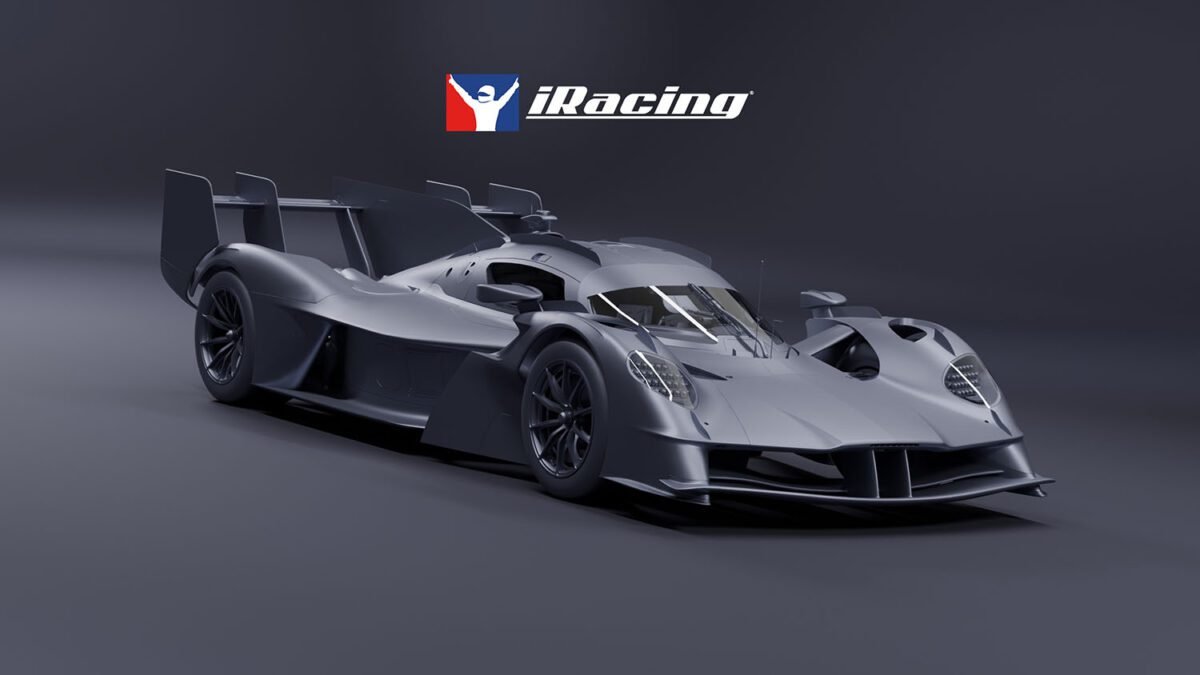
The Aston Martin Valkyrie AMR-LMH is coming to iRacing in Season 4 2026. iRacing spent over a year working directly with Aston Martin’s racing engineers, pulling real-world telemetry, chassis data, and performance documentation to build the car. That level of source material is not standard for every new addition. The result is a hypercar built from the same engineering that campaigns in the FIA World Endurance Championship.
Also See
➡️ iRacing Season 4 Confirmed: Track Reverb, New Gear, and Oval Physics
🎮 Official iRacing August 2026 Development Update
What Makes the Valkyrie AMR-LMH Different
The Aston Martin Valkyrie AMR-LMH iRacing build competes under LMH hypercar regulations. That distinction matters for sim racers accustomed to LMDh machinery. Unlike the BMW M Hybrid V8, the Acura ARX-06, or the Porsche 963, the Valkyrie runs without a hybrid energy recovery system. Its performance comes entirely from a naturally aspirated V12 engine paired with an extreme aerodynamic package and a chassis built to pure LMH specifications.
The V12 configuration puts the Valkyrie in a class of its own within the current LMH/LMDh field. At Le Mans and in WEC endurance racing, the car carries a unique acoustic and mechanical character compared to its hybrid competitors. iRacing is working to translate that character into the sim, backed by the engineering data rather than approximations.
A Year of Engineering Work
iRacing’s development partnership with Aston Martin for the Valkyrie AMR-LMH involved real-world telemetry data and direct access to chassis engineering documentation. That is a more thorough development process than cars built from public technical regulations alone. The collaboration produced a model that reflects the actual performance envelope and handling balance the real car exhibits in LMH competition.
For iRacing, this follows a pattern established with other high-profile cars where manufacturer involvement drives the accuracy of the finished model. The Valkyrie’s intricate downforce management, weight distribution, and braking behavior under heavy aero load are areas where telemetry access matters most.
Le Mans and WEC Campaign
The Valkyrie AMR-LMH made its racing debut in the FIA World Endurance Championship in 2024 and has competed at Le Mans under the Aston Martin factory program. In WEC competition, the car runs alongside the LMDh field in the Hypercar class, where LMH and LMDh regulations converge on a performance equivalency framework. The real-world Valkyrie has campaigned at Spa, Le Mans, Fuji, and the full WEC calendar, giving iRacing substantial race data beyond the engineering documentation alone.
At Le Mans specifically, the Valkyrie’s aerodynamic package performs on the long Mulsanne straight and its mechanical balance through Porsche Curves. The naturally aspirated V12 performs best in high-RPM conditions that Le Mans provides on the long flat-out sections where turbocharged LMDh powertrains manage boost.
LMH vs LMDh: What Changes Behind the Wheel
The technical distinction between LMH and LMDh regulations has on-track consequences for iRacers running IMSA or WEC series. LMDh cars use a shared hybrid system with a spec motor-generator unit at the rear axle, giving them hybrid torque on corner exit that fills in before the combustion engine reaches its power band. LMH cars are individually engineered. The Valkyrie has no hybrid component.
Managing the V12 is different from a BMW M Hybrid V8 or Porsche 963. There is no electric torque cushion out of slow corners. Traction management at medium-speed corner exits is more mechanical, more dependent on throttle application relative to steering angle. Drivers transitioning from LMDh time in the GTP class will need to recalibrate that exit technique. The Valkyrie rewards a different approach to power management, and whether that suits a given driver’s style will only be clear once the car is in hand at the start of Season 4.
What to Expect Behind the Wheel
Driving character for the Valkyrie AMR-LMH will differ from what most iRacers know from LMDh prototypes. Without hybrid torque fill, the power delivery is purely mechanical and rev-dependent, which changes how you manage traction out of slow corners and at circuit entry points. The aerodynamic package is extreme by LMH standards, so the car will reward smooth high-speed inputs and penalize mid-corner instability.
For endurance racing on iRacing’s IMSA and WEC-style series, the Valkyrie adds a genuinely different option to the top prototype class. Whether it runs as an LMH against LMDh competition or in class-specific events, the driving approach will be its own thing. That is the point of running real engineering data through the build process.
Series and Availability
The Aston Martin Valkyrie AMR-LMH arrives with the Season 4 2026 build in September. iRacing has not specified which official series will run the car at launch. Given its LMH classification, IMSA and WEC-adjacent series are the natural home, though fixed-class series placement will be confirmed closer to the build date. The car will be purchasable individually or as part of content packages.
If you currently race LMDh or GTP prototypes and want a car with a different technical identity, the Valkyrie is worth tracking. The combination of manufacturer data, V12 power, and non-hybrid LMH regulations makes it one of the more technically interesting additions iRacing has added to the top prototype class.