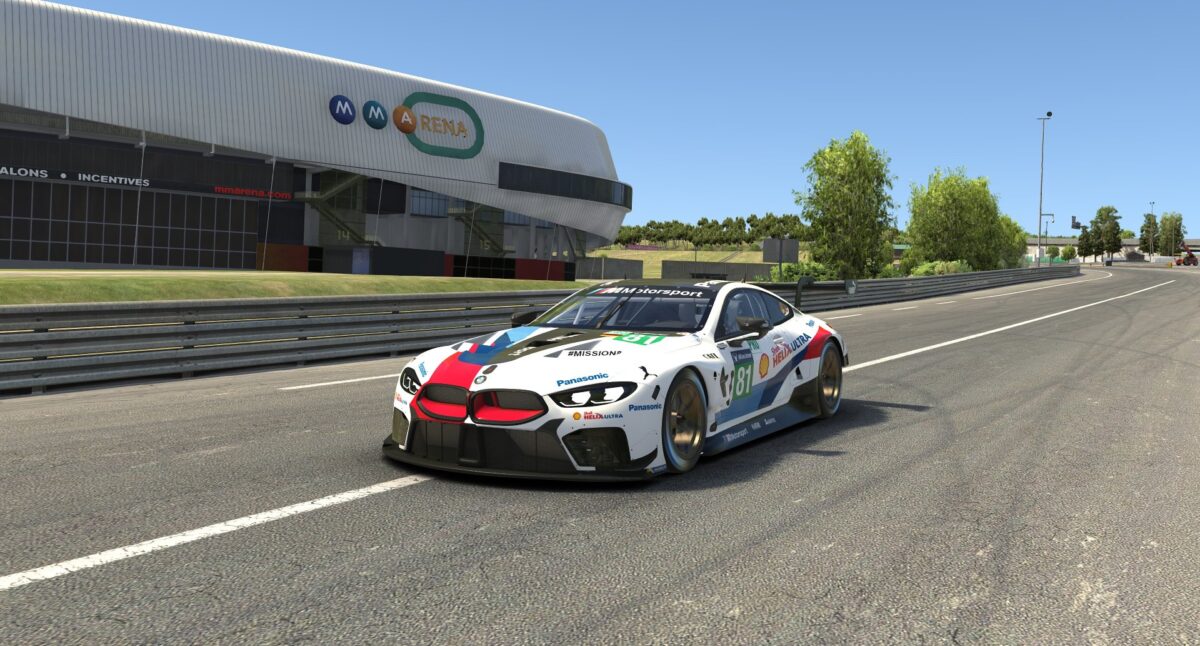
Mastering the BMW M8 GTE iRacing requires a shift in mentality from “finesse” to “discipline.” Because the M8 is a front-engine, high-torque machine, it does not respond well to aggressive, “pointy” steering inputs. Instead, it rewards a driver who understands the fundamental relationship between weight transfer and aerodynamic seal. To find the podium in top-tier GTE splits, you must learn to manage the “Big M8’s” mass through a combination of threshold braking, calculated trail braking, and surgical throttle modulation.
Braking: The Secret to Rotation
The most important skill for a BMW M8 GTE iRacing pilot is mastering the brake pedal. Unlike GT3 cars, GTEs do not have ABS. With the M8’s engine sitting over the front wheels, the car is naturally prone to understeer on entry. To fix this, you must utilize “aggressive trail braking.” You should do 90% of your braking in a straight line, but as you begin to turn the wheel, you must bleed off the brake pressure slowly, keeping about 5-8% pressure until you hit the apex. This keeps the nose pinned and forces the car to rotate. If you release the brakes too quickly, the weight shifts back, the front tires lose their bite, and you will find yourself plowing wide into the grass.
Throttle Discipline and Turbo Management
The twin-turbo V8 in the BMW M8 GTE iRacing is a double-edged sword. While it provides a massive torque curve (700 Nm), it can easily overwhelm the rear Michelin tires if you “mash” the pedal on exit. The fastest M8 drivers use a “progressive roll” on the throttle. You should feel for the point where the turbos spool up and the rear of the car “squats” into the asphalt. If you get on the power too early or too abruptly, you will induce micro-wheelspin that overheats the tires over the course of a 60-minute stint. Slow in, fast out is the golden rule here—sacrifice a tiny bit of entry speed to ensure the “Big M8” is straight enough to unleash all 590 horsepower onto the following straightaway.