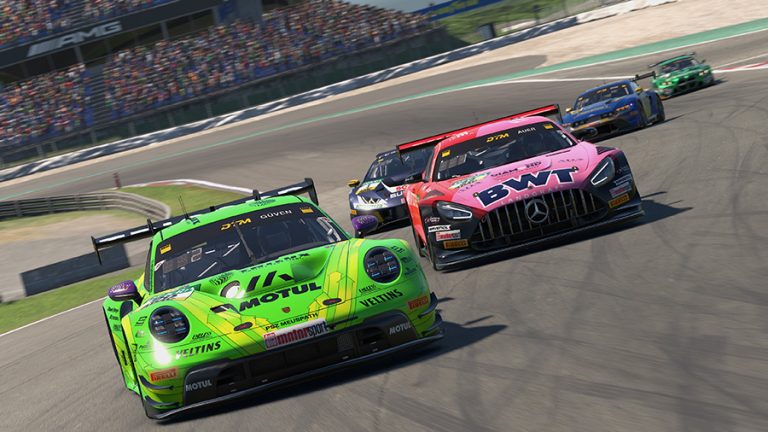
Defending the inside line in iRacing is one of those racecraft skills that separates drivers who race wheel to wheel cleanly from drivers who create incidents. Get it right and you hold position while keeping your pace intact. Get it wrong and you either hand the place over anyway or trash your own corner exit trying to hold on. The goal is to defend without turning a manageable battle into a corner disaster.
Also See
➡️ Speed & Strategy Guides
🎮 iRacing Competition Center
Position Yourself Before the Braking Zone
The most important part of any defense happens before the braking zone. If you wait until your braking marker to react to a car coming alongside, you are already late. The defending driver needs to claim the inside line earlier, ideally on the straight approaching the corner, before the attacker has a run established.
One move is the standard. Make a single, definitive move to the inside while you are still on the straight. An early, clean move communicates clearly that the line is taken. Late moves or multiple changes of direction under braking are dangerous, against the rules in most iRacing series, and give the attacker more information to exploit.
Your Braking Reference Points Change
Your standard braking marker is calibrated for clean air and the normal racing line. When defending on the inside, those reference points shift. You are entering from a tighter position, which means you are approaching a different part of the track. If you hit your normal braking marker from the inside line, you can overshoot or run wide on exit.
Practice your inside-line braking separately. Most drivers have only ever braked from their standard line and do not know what the track feels like from a different entry point. Knowing your inside-line brake marker before a battle happens means you are not learning it under pressure with a car alongside you.
Reading Car Position at the Braking Zone
The question of whether to defend or yield is partly a position calculation. If a car has its front axle level with your rear axle at your braking point and you have the inside line, you have the right to the corner. Hold your line and brake. A car that is only alongside at the front wing has not made the move.
The overlap at turn-in is the key reference. If the attacking car is significantly alongside, consider whether aggressively tightening your line is worth the contact risk. One position gained is rarely worth damage or a DNF. In wheel-to-wheel racing, especially in longer races, protecting your car matters as much as protecting your position.
Exit Speed Is Part of the Defense
A good inside-line defense does not just hold position through the corner. It also sets up a clean exit so the car behind cannot immediately re-attack on the next straight. If you defend well on entry but exit slowly and drift wide, the driver behind gets a run and you are back in the same battle within 200 meters.
Focus on rotating the car early when entering from the inside. You are giving up the standard apex, so you need the car to rotate tighter to rejoin the racing line by mid-corner. A late, sloppy exit on the inside is a common mistake from drivers who nail the entry defense but do not think about what comes after the corner.
Corner Type Matters
Not all corners are equally good for inside-line defense. Slow hairpins at the end of long straights are the highest-percentage places to defend. The braking zone is long, the speed differential on entry is large, and the inside line gives you a clear advantage even if your exit is not perfect.
Fast corners are higher risk. Defending the inside at a high-speed corner means you are entering on a slower, tighter line, and exit speed matters considerably more than at a hairpin. The attacker can re-pass you on exit even if the defense held on entry. Choose your defense moments based on corner type, not just the situation in the moment.
Complex sections and chicanes require reading the full sequence. Yielding the first element of a chicane to maintain a better line through the second can be smarter than defending aggressively at the first corner and coming out of the sequence slow and vulnerable on the second.
When to Let the Corner Go
Sometimes the defensive move does not hold. The attacking car is fully alongside, you have defended cleanly, but they have earned the corner. The worst outcome in wheel-to-wheel racing is a collision that takes both cars out. If the defense is lost, accept it, let the car through cleanly, and focus on the next opportunity.
Drivers who contest every corner in every situation pick up contact, damage, and a poor reputation in online racing. Choosing your battles, defending when you have the right to and conceding when the corner is gone, is what builds a sustainable race record over a full season.
Practice the Defense, Not Just the Attack
Most sim racers spend their practice time on overtaking. Few specifically practice defending. Set up a solo session on your target circuit and spend an entire session entering every corner from the inside line. Find your brake markers from that position. Note which corners work well and which are difficult to exit from the inside.
When a real defense situation happens in a race, you will be drawing on data from dozens of practice repetitions rather than improvising with a car alongside you. That preparation is what separates a controlled defense from a panicked one, and it is what keeps you out of the barriers when the pressure is on.
Recording your defending sessions adds another layer of value. Watching the replay gives you a clear picture of where your inside line was, where the car alongside entered relative to you, and whether your exit was actually clean. A ten-minute replay review after a focused practice session often reveals more than another hour of lapping without it.