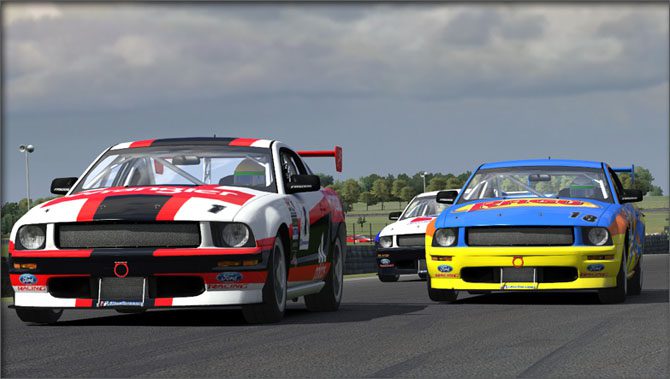
The Ford Mustang FR500S iRacing setup screen is where you confront the unique mechanical character of an “old school” pony car. Unlike modern GT machinery with independent rear suspension, the FR500S utilizes a classic live-axle rear end. This means that adjustments to one side of the rear suspension often affect the other, and your primary goal is to keep that solid axle from “hopping” while managing the 3,160lb mass of the car. Success in the Mustang Challenge comes down to finding a balance between front-end bite and rear-end stability over bumps and curbs.
Taming the Live-Axle: Springs and Panhard Rod
The most distinctive part of the Ford Mustang FR500S iRacing chassis is the rear suspension. Because it’s a live axle, the car is highly sensitive to mid-corner bumps which can cause the rear to “bounce” and lose traction. Stiffening the rear springs can help the car feel more responsive, but it often makes the car skittish on rougher tracks like Sebring. A key adjustment is the Panhard rod height; lowering the roll center via the Panhard rod generally increases rear grip and stability, making the car less prone to snap-oversteer when you’re wrestling the 325hp V8 out of a tight corner.
Managing the Heavy Nose: Front ARB and Alignment
With its iron-block V8 sitting over the front wheels, the Ford Mustang FR500S iRacing model is naturally prone to understeer. To get the “pony” to rotate, you’ll need to focus on your front anti-roll bar (ARB) and camber settings. Softening the front ARB allows for more front-end roll, which can provide that extra bit of “bite” needed for turn-in. Complement this with aggressive negative camber (typically around -3.0 to -3.5 degrees) to maximize the contact patch when the car is leaning into a high-load sweep. If the car feels too “lazy,” increasing the front toe-out can sharpen your initial steering response, though it may increase tire wear over a long stint.
Mustang Setup Quick-Tips:
- Brake Bias: The FR500S lacks ABS, making brake bias your best friend. A front-leaning bias (55-57%) is safer for beginners to prevent rear-locking spins, but moving it rearward can help the car rotate if you are smooth with your threshold braking.
- Differential: The car features a limited-slip differential that is vital for putting power down. If you find yourself spinning the inside rear tire on exit, ensure your clutch preload is sufficient to keep both wheels driving the car forward.
- Tire Pressures: Aim for “hot” pressures in the 28-30 psi range. Because the Mustang is heavy, pressures that are too low will cause the car to feel “floaty,” while pressures that are too high will reduce your already precious mechanical grip.
Gearing for the Torque Curve
The 4.6L V8 in the Ford Mustang FR500S iRacing version is all about torque. While the six-speed Tremec gearbox offers plenty of options, you don’t always need to chase the redline. In fact, many tracks reward “short-shifting” to keep the car in the meat of the torque curve and to help stabilize the rear end on exit. When setting your individual gear ratios (on tracks where permitted), focus on ensuring that your 3rd and 4th gears are optimized for the most critical exit speeds on the circuit. If you’re constantly hitting the limiter just before a braking zone, a slightly taller final drive might be the secret to a smoother lap.
The Search for Mechanical Sympathy
Ultimately, a winning Ford Mustang FR500S iRacing setup is about compromise. You have to accept that the car will never be as surgical as a formula car; instead, you are building a platform that is predictable and robust. Focus on making the car stable over the curbs and compliant under braking. Once you have a Mustang that doesn’t try to switch ends every time you hit a bump, you can start aggressive tuning to find those final tenths of a second. Respect the live axle, trust the V8, and you’ll find the FR500S to be one of the most rewarding drives on the service.