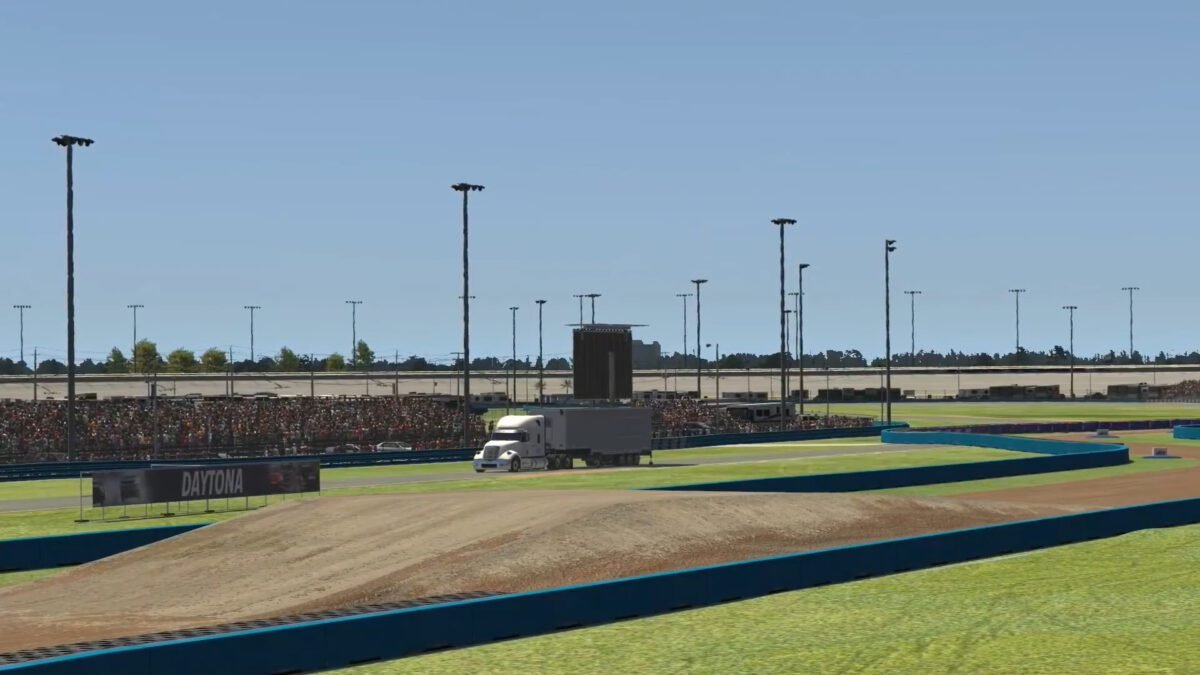
The question of whether iRacing’s rallycross content deserves more investment has come up in the community with some regularity. The discipline has a distinct character, a dedicated following, and a history of producing some of the most chaotic, entertaining racing in the sim. Because it also has smaller field sizes than oval, road, or dirt oval, the argument around whether rallycross is punching its weight as a platform discipline keeps resurfacing. With the FIA Cross Car now in the rotation, there is more reason than ever to take a hard look at where rallycross stands and whether it is worth your time.
Also See
➡️ Daytona Rallycross and Dirt Road Overview and Guide
What Makes Rallycross Different in iRacing
Rallycross runs on mixed-surface layouts, switching between asphalt and dirt multiple times per lap. That alone separates it from everything else in iRacing. The handling transitions mid-lap, the contact rules are more permissive than road racing, and races are short enough that there is rarely a pace management phase to work through. You are racing hard from the opening lap, and the format rewards reflexes and positioning as much as setup knowledge. For drivers who feel like iRacing’s precision-racing disciplines leave little room to actually race, rallycross is often a revelation.
The car lineup reflects the discipline’s range. At the entry level, the RX Lite and the newer FIA Cross Car give accessible, forgiving machinery that suits beginners and those who want competitive racing without a large content investment. At the top end, the Rallycross Supercars rank among the fastest-accelerating vehicles in iRacing. The distance between the two ends of the content lineup is considerable, and drivers who start at the bottom of the ladder and work up often find that the discipline rewards sustained investment more than it looks like from the outside.
The Player Base Question
The honest critique of rallycross in iRacing is that field sizes are inconsistent. There are time zones and split patterns where a race fills out competitively, and there are others where you are waiting longer than expected for a field to build or racing against fewer people than the format deserves. For sim racers who evaluate a series by what they can get on a given Tuesday evening, that inconsistency matters.
The counterargument is that inconsistent field sizes understate actual interest. Rallycross is concentrated in fewer series and time slots than oval or road, which means the active population is spread thinner than the absolute number of interested drivers would suggest. When iRacing has put rallycross in front of a wider audience through special events or challenges, participation tends to spike. The limiting factor is not always demand; sometimes it is visibility and series structure.
Some drivers who race both road and rallycross also note that the contact culture creates a real adjustment period. Drivers who come from strict corner-exit etiquette sometimes struggle with the first-corner chaos and write off the discipline earlier than they should. The learning curve is less about car control and more about recalibrating what clean racing looks like in a format where contact at certain points is expected and accepted by the field.
The FIA Cross Car and What It Changes
The FIA Cross Car arrived in the Season 1 2026 build as a purpose-built entry point for the rallycross ladder. It is a short-wheelbase, approachable car designed to bring new drivers in at the ground level and give the discipline a proper beginner pathway. iRacing framed it as the dirt-road equivalent of the lower NASCAR classes or the Skip Barber in road racing: a place to develop discipline-specific habits before stepping into faster machinery.
Whether that investment pays off depends on how the series around the car develop over the next few seasons. The history of entry-level content in iRacing is that it needs time and consistent promotional placement to build a reliable population. The first few builds after a car launches tell you little about where things will settle. However, the fact that iRacing committed a full car development cycle to the discipline rather than just updating existing content signals genuine long-term belief in rallycross as a platform discipline.
Several drivers who have been in the discipline for years see the FIA Cross Car as the addition that was always missing. Newcomers previously had no clear first step. The RX Lite requires some dirt-surface comfort that is not obvious if you are coming from road or oval. A purpose-built beginner car with its own series gives the discipline a proper front door, which is what the lobby size problem always needed at its root.
Is iRacing Rallycross Worth Your Time?
If you have any interest in dirt-surface racing and have not tried rallycross, the FIA Cross Car makes this a good moment to start. The car is inexpensive, the format is short and fast, and the population around the entry series is growing. The ceiling, if you build into the Supercars, is legitimately some of the best racing in iRacing.
If you are primarily focused on building iRating efficiently in a single category, rallycross will require more patience finding full fields than road or oval will. That is a real constraint. The racing quality is there; finding it consistently requires more scheduling flexibility than the more heavily populated disciplines.
What the community debate ultimately reflects is that rallycross in iRacing is at a point where the infrastructure is beginning to catch up with the quality of the content. The FIA Cross Car is part of that. More structured beginner pathways and consistent series placement are the other pieces. Whether iRacing rallycross grows into a regular part of the weekly schedule for a larger share of the community is still an open question, but the direction is clearly forward.