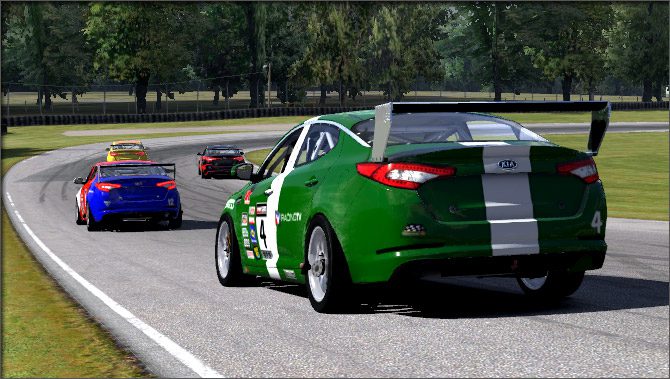
Mastering the Kia Optima GX iRacing is an exercise in unlearning your RWD habits. In a typical racer, you use the throttle to rotate; in the Optima, you use the throttle to stabilize. To find the top step of the podium in the Global Challenge, you must learn the art of “lift-off oversteer,” manage the massive heat buildup in the front tires, and understand how to time the turbocharger’s spool to pull you out of technical chicanes without scrubbing off all your speed.
Lift-Off Oversteer: The FWD Secret
The fastest way to drive the Kia Optima GX iRacing is to get the car rotating early. As you approach a corner, you should brake hard and turn in while slowly releasing the brake. If the car feels like it’s “plowing” wide, you must “lift” off the throttle completely. This sudden weight transfer to the front gives the nose extra bite and causes the rear end to “step out” slightly. Once the car is pointed at the apex, you get back on the gas to pull the car straight. It’s a rhythmic, dance-like style of driving that allows the Optima to keep up with RWD cars through tight hairpins.
Front Tire Management
The Kia Optima GX iRacing is notoriously hard on its front rubber. Because the front tires are doing the steering, the braking, and the accelerating, they can overheat in just a few laps of aggressive driving. If your front tires get too hot, you will experience “plowing” understeer that no amount of lifting can fix. To master the Optima, you must be “smooth with the slip.” Avoid over-driving the front end; if you hear the tires “shrieking,” you are sliding and killing your pace. Focus on “rolling” into the throttle and using as little steering angle as possible on exit.
- Trail Braking: Keep a tiny bit of pressure to the apex to keep the nose pinned.
- Turbo Lag: Anticipate the spool; get on the gas a fraction earlier than you think to have full power at the exit.
- Handbrake Turns: In extremely tight hairpins (like at Long Beach), a split-second “tug” of the handbrake can help the Optima pivot.