Load cell pedals are probably the most-discussed hardware upgrade in iRacing. Ask in any community space what single piece of equipment made the biggest difference, and you will hear the same answer over and over: the brake pedal. Not a new wheel. Not a motion rig. The brake. But the question is not whether load cell pedals are different from potentiometer pedals. It is whether that difference actually shows up in your lap times and your race results.
Also See
➡️ Fanatec Lineup Explained for iRacing
🎲 iRacing on the Pot-to-Cell Upgrade
What Load Cell Pedals Actually Do
Standard potentiometer pedals measure pedal travel: how far you have moved the pedal. Load cell pedals measure force: how hard you are pressing. That distinction matters more in braking than anywhere else. In real racing, drivers do not brake by moving their foot a specific distance. They brake by applying a specific amount of pressure. Load cell pedals bring that mechanic into sim racing, and it changes how your body learns to brake consistently.
Why the Brake Pedal Is Your Most Important iRacing Upgrade
iRacing has no ABS on most cars. That means the moment you push too hard under threshold braking, you are locking wheels and losing time. With a potentiometer pedal, reproducing the exact same pedal position from lap to lap is nearly impossible. Millimeter-level differences in travel create inconsistency you cannot reliably feel or correct. Load cell pedals let you repeat the same pressure application because your muscles are far better calibrated to force than to position.
Trail braking is where load cell pedals prove their value most clearly. Trail braking means gradually reducing brake pressure as you turn in toward the apex. It requires precise, progressive modulation through the braking zone. A potentiometer pedal’s short travel window makes that control difficult. A load cell pedal gives you a consistent, predictable feel across the entire braking zone, which makes feathering off the brakes through a corner far more achievable and repeatable.
What the iRacing Community Actually Says
The iRacing community is almost unanimous on this. Drivers who make the switch report their lap times did not necessarily drop immediately, but their consistency did. Lap-to-lap variation tightens up. Qualifying runs become repeatable. Long stints become more manageable because the mental load of fighting inconsistent braking disappears. Many iRacers describe the transition as clarifying rather than dramatic. The hardware stops being the problem, so the driving becomes the focus.
There is an honest counterpoint worth acknowledging. Some iRacers, particularly those primarily running ovals where trail braking plays a smaller role and throttle-to-brake balance differs significantly, report a less dramatic improvement. The upgrade still helps. However, the day-and-night shift described by road and GT racers may not translate identically on ovals. The benefit is real in both categories. It is just more immediately obvious on road courses where late braking and trail braking define the fast laps.
There is also a hardware dependency that rarely gets mentioned. Load cell pedals only perform well when your rig can support them. A flex-prone pedal plate or an unstable heel rest means inconsistent feel regardless of the technology underneath it. If your setup flexes significantly under hard braking, fix that first. Without a solid mounting point, the load cell cannot do what it is supposed to do.
Load Cell Pedals by Price Point
Entry-level load cell options have improved significantly in recent years. The Fanatec CSL Pedals with the LC add-on module sits around $130 for existing Fanatec users and uses a genuine load cell mechanism, not a stiffened spring. Moza’s SR-P Lite and the Thrustmaster T-LCM sit in the same tier. These are legitimate upgrades from potentiometer pedals and a reasonable starting point for any iRacer who wants to experience the improvement without a major investment.
Mid-range pedal sets are where most serious iRacers settle. The Heusinkveld Sprint (around $700 for the full set), Moza SR-P Pro, and Asetek SimSports Invicta all sit in this tier. Build quality is substantially better, the feel is more consistent, and the brake modulation translates directly to improved driving. Additionally, the jump from entry-level to mid-range is noticeable. Most iRacers who try mid-range pedals after entry-level ones describe it as a meaningful step.
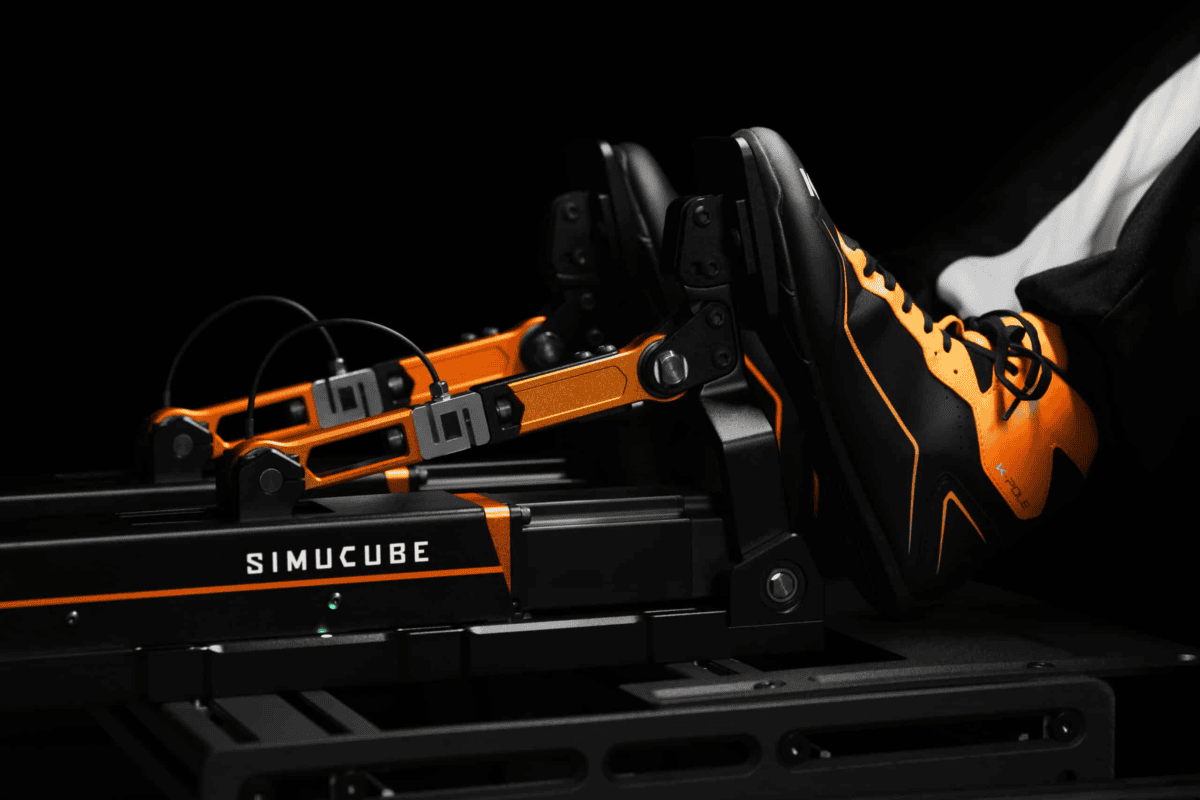
High-end load cell pedals from Simucube, Asetek’s top-tier sets, or the Heusinkveld Ultimate run $1,000 to $3,000 or more. They are exceptional. However, the performance difference over a solid mid-range set in iRacing is largely about refinement and build quality, not lap time. The most significant gains from the load cell upgrade are already captured at the mid-tier level. High-end pedals are worth it for drivers who want the best overall experience. They are not necessary for drivers who simply need a faster lap time.
What Actually Improves When You Switch
Three things improve consistently: braking consistency, trail braking control, and performance across longer stints. Most iRacers who switch report tightening their lap-to-lap variation within a few sessions. The transition period is real, since your brain needs time to calibrate to pressure-based input. However, it typically takes less than a week of regular driving before the benefits become clear and feel natural rather than forced.
What does not automatically improve: your braking reference points. Load cell pedals will not tell you where to begin braking for a corner you have not yet learned. The hardware improvement works within the technique you already have. Consequently, if your reference points are off, the pedals will let you execute those wrong references more consistently. The upgrade rewards good technique more than it compensates for poor technique. That is not a criticism of the hardware. It is simply how the tool works.
Should You Upgrade to Load Cell Pedals for iRacing?
For most iRacers, yes, and sooner rather than later. If you are currently on potentiometer pedals and your braking feels inconsistent, your trail braking feels imprecise, or your long-stint pace drops off relative to practice, load cell pedals are the most direct hardware fix available. They are the single upgrade most likely to show up in your iRacing results without requiring any immediate technique changes to see the benefit.
The priority order matters when you are working within a budget. Entry-level load cell options represent a better investment than upgrading your wheel or adding peripherals such as a button box. However, if your current setup flexes noticeably under hard braking, addressing that flex first will get you more out of the pedal upgrade.
One thing is consistent across the iRacing community: drivers who make the switch to load cell pedals do not go back to potentiometer pedals. That near-universal outcome, across iRacers at every skill level and in every car class, is probably the most compelling argument for the upgrade.