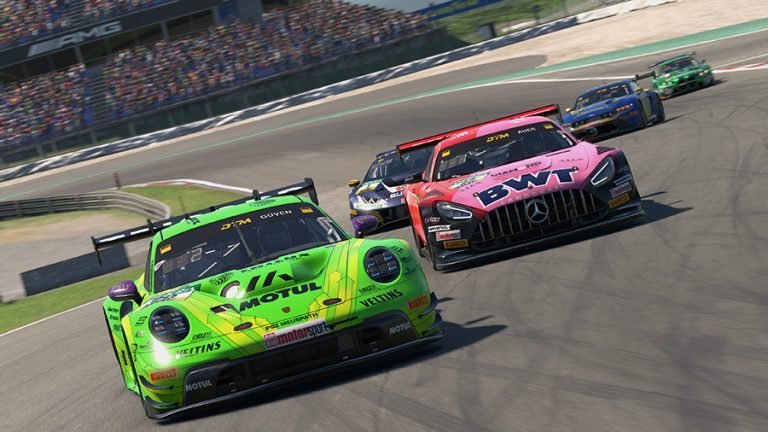
The Porsche 911 GT3 Cup (992) is one of iRacing’s most rewarding, and punishing, cars.
It’s fast, raw, and completely unforgiving under braking. Many drivers join Porsche Cup (PCup) to learn proper trail braking, only to find themselves spinning through Algarve’s uphill braking zones wondering what went wrong.
This iRacing Porsche Cup trail braking guide explains why the car feels so twitchy, how to fine-tune brake bias, and how to stay alive at elevation-heavy circuits like Algarve.
Also See:
➡️iRacing Unleashes the New Porsche 911 GT3 R (992)
Why the Porsche Cup Feels So Difficult
The Cup car has no ABS and very little electronic safety net. It forces you to control weight transfer precisely through your right foot.
Three reasons it punishes small mistakes:
- Rear-engine layout – The weight bias means braking too hard unsettles the rear instantly.
- High downforce sensitivity – Lose speed, lose grip. The car relies on aero stability even under braking.
- Narrow tire window – Cold tires amplify snap oversteer, especially early in races.
In short: the Porsche Cup doesn’t reward aggression, it rewards technique.
Understanding Trail Braking
Trail braking means carrying brake pressure into the corner as you begin to turn the wheel, not releasing completely before turn-in.
In the Cup car, trail braking is the key to controlling rotation without losing the rear. The goal isn’t to brake later; it’s to brake smarter.
Core technique:
- Hit your braking marker firmly.
- Gradually reduce pressure as you turn in.
- Release smoothly by the apex, letting the car settle before applying throttle.
If you dump the brakes too quickly, weight shoots rearward, the front unloads, and the rear steps out.
Brake Bias: The Small Adjustment That Changes Everything
Brake bias controls how much braking force goes to the front vs rear wheels.
In fixed-setup races, you can still adjust it slightly, and those few clicks make a world of difference.
Starting point:
- Default bias: around 52–54% front.
- For more stability: increase front bias (55–56%).
- For more rotation: lower it (52% or below).
Try adjusting one click at a time in practice.
If the rear feels floaty under braking, add front bias.
If it plows through the corner or won’t rotate, take a click out.
Record your preferred settings for each track to track improvement over time.

How to Survive Algarve’s Elevation Changes
Portimão (Algarve) exposes every weakness in your braking technique. The constant crests, dips, and blind entries make trail braking even trickier.
Common mistakes:
- Braking hard uphill, overloading the front tires.
- Accelerating too early over a crest, causing snap oversteer.
- Missing late apexes and understeering into the edge of the track.
Solutions:
- Brake earlier than you think. Use a short, firm initial hit, then ease into trail braking as elevation changes.
- Hold slight brake pressure over crests. Keeps the nose planted and prevents the rear from rising.
- Throttle timing matters. Wait until the car settles over the top before squeezing back on.
Actionable Drills for Porsche Cup Drivers
- Ghost Lap Overlay: Compare your braking trace to a faster driver using telemetry or the iRacing delta bar. Focus on smoother brake release, not later braking.
- Partial Lap Focus: Practice only Turns 1–3 at Algarve repeatedly, perfecting entry balance.
- Bias Testing Laps: Run five laps each at 52%, 54%, and 56% bias. Record corner-exit rotation and braking stability.
Tracking these results week to week helps you see measurable improvement.
When It All Clicks
The first time you nail a braking zone in the Porsche Cup, you’ll feel it, the car will rotate perfectly, stay balanced, and power out without drama.
That’s the reward for patience and feel.
Trail braking mastery doesn’t happen overnight. But once you get it, every car in iRacing feels easier, because the fundamentals of weight transfer and brake modulation never change.
The iRacing Porsche Cup trail braking challenge is a rite of passage. Once you learn to control rotation through brake pressure and bias, you’ll start seeing consistent top-split pace, and more importantly, consistency across every track.
Algarve might break you a few times along the way, but if you stick with it, it’ll also make you a better driver everywhere else.