GT3 is the most active road racing class in iRacing, and the first decision every new driver faces is which rear engine GT3 iRacing car or front-engine alternative to start with. The handling differences between these two types are real and show up in race conditions, not just theory. Understanding them before you spend credits is worth the time.
Also See
➡️ iRacing GT4 Trail Braking Guide: How to Get the Car to Rotate
How Rear Engine GT3 Cars Behave in iRacing
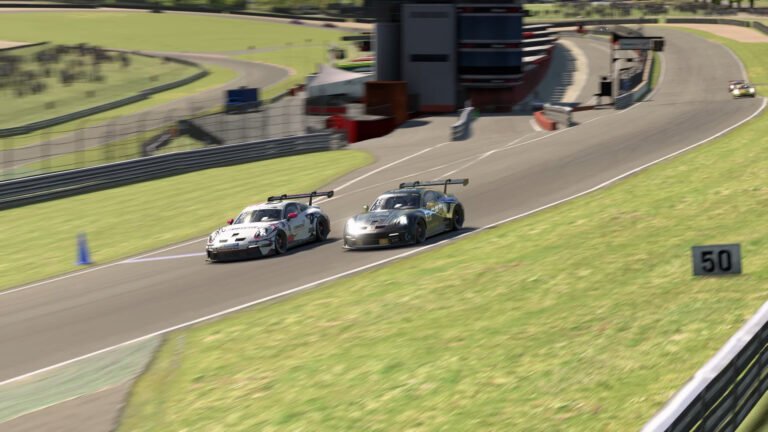
The Porsche 911 GT3 R (992) carries most of its weight over the rear axle. That rear weight bias gives the car a natural tendency to rotate on corner entry, especially when you trail the brakes into the apex. The front end loads up easily, and the car pivots with less steering input than most front-engine alternatives. For drivers who rely on trail braking for rotation, the Porsche rewards the technique in an intuitive way.
The tradeoff is throttle exit behavior. Under hard acceleration out of slow corners, the rear weight distribution can cause the tail to step out if you are too early or too aggressive with the throttle. The snap is quick when it comes. Most drivers learn to manage it, but the sensitivity on exit is a real characteristic that takes a few sessions to calibrate.
How Front-Engine Cars Behave
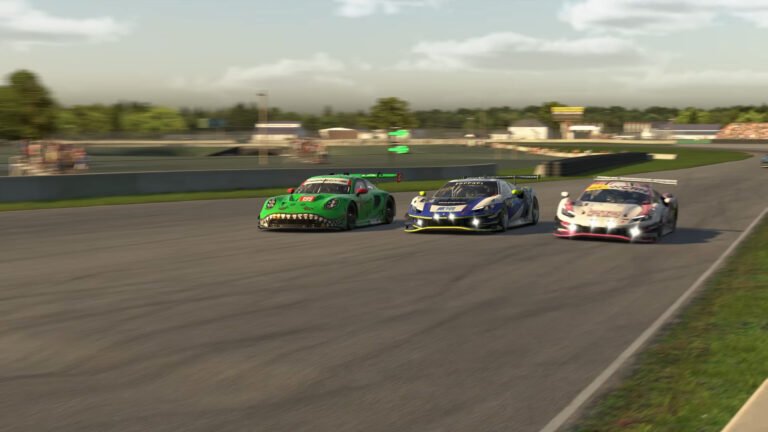
The AMG GT3 Evo, Aston Martin Vantage GT3, BMW M4 GT3, and most other GT3 cars carry the engine forward. Front engine weight pushes load onto the front tires, which gives the cars strong initial turn-in grip and a more stable mid-corner platform. They tend to feel planted and predictable through the middle of a corner.
The challenge with front-engine cars is usually on entry. Without the rear weight bias helping rotation, drivers need to be more deliberate about generating yaw through braking technique and car placement. Drivers who brake in a straight line and turn in late will find understeer. Drivers who carry trail braking further into the corner will find that the car responds well once the technique is there.
Which Should You Pick?
For drivers new to GT3, the rear-engine Porsche is often easier to build confidence in early. The natural rotation means less fighting the car on entry, and the reward for trail braking is immediate and tactile. The throttle sensitivity on exit is a real learning curve, but it comes with time.
For drivers coming from GT4 or other front-engine experience, the transition to a front-engine GT3 tends to be more intuitive. The BMW M4 GT3 is a common first choice because its balance is forgiving mid-corner and the throttle exit behavior is more neutral than some of the other options in the class.
Track type also matters when making this decision. High-speed, flowing circuits like Spa or Suzuka tend to favor front-engine GT3 cars, which offer more predictable balance through fast, committed corners. Shorter, technical layouts with tight hairpins and heavy braking zones — like Sebring or Okayama — often reward the Porsche’s faster rotation on entry, where the rear-biased weight distribution does its best work. If you are starting out in a specific series with a known track rotation, look at the schedule before committing. A few weeks of varied circuits will reveal which weight distribution suits your instincts more naturally.
Sim practice sessions are the most efficient way to test both options before committing credits to a car. Many drivers spend a few laps in the Porsche and a few in a front-engine car during the same session, which gives a direct handling comparison at the same circuit. What feels natural in one driver’s hands often feels unpredictable in another’s, and community recommendations rarely account for that variation. A one-hour practice session comparing both types usually settles the question more reliably than any guide can.
Neither choice is wrong. Both classes run in the same series, both have competitive grids, and both will teach you the same fundamental racecraft. The difference is mostly which bad habits each car forgives and which ones it punishes. Pick the one that matches where your technique needs the most feedback. You can browse the full GT3 lineup on iRacing.com before committing.