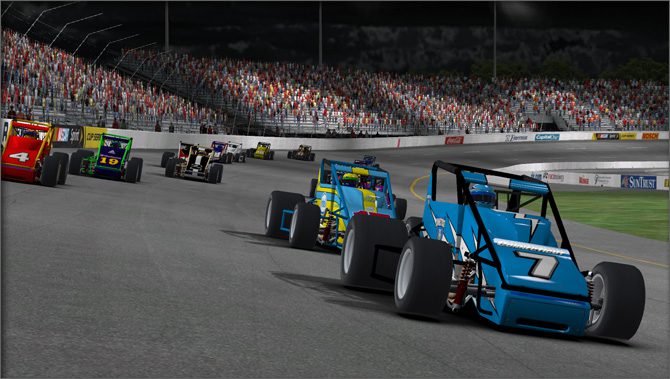
In the iRacing Sprint Car garage, the standard rules of suspension tuning are thrown out the window. This is a car designed to turn left and only left. To achieve this, the car utilizes an almost entirely asymmetrical setup. From the four different tire sizes to the way the torsion bars are loaded, every adjustment is focused on maximizing “side bite” and getting the 800-horsepower beast off the corner without spinning. This setup school article explores the primary mechanical adjustments that will help you tame the most aggressive oval car on the service.
Understanding Tire Stagger: The “Turning” Tool
The most important adjustment in any iRacing Sprint Car setup is tire stagger. Because the rear axle is “locked” (there is no differential), the car naturally wants to drive in a straight line. By using a larger right-rear tire and a smaller left-rear tire, the car effectively becomes a cone. When you roll a cone on a flat surface, it naturally turns toward the smaller end. In a sprint car, the stagger is what allows the car to “hook” into the turn at 140 MPH despite the lack of a differential.
Finding the right stagger is a mathematical challenge. Too little stagger will cause the car to “push” or understeer toward the outside wall. Too much stagger will make the car “loose” and prone to snapping around as soon as you apply the throttle. Most pro setups for the iRacing Sprint Car start with roughly 1.5 to 2.5 inches of stagger depending on the banking and radius of the track. Remember: as the right-rear tire heats up, it grows in size, meaning your stagger increases during a long run. You must account for this “growth” in your initial settings.
Torsion Bars: The Springs of the Bullring
Unlike stock cars that use coil springs, the iRacing Sprint Car utilizes torsion bars. These are solid metal rods that twist to provide spring force. A thicker diameter bar is equivalent to a stiffer spring. In this car, the torsion bars control how the weight “plants” onto the rear tires during acceleration. If the car feels unstable or bottoming out under the 650 lb-ft of torque, you need to increase the diameter of your rear bars.
One of the most powerful tools in the iRacing Sprint Car garage is the “bar stop” adjustment. These stops do not change the stiffness of the bar, but they change the preload or “static weight” on each corner. By adjusting the bar stops, you can change the “cross weight” of the car. Increasing the weight on the left-rear and right-front corners generally “tightens” the car, making it more stable on exit. Conversely, decreasing cross weight will make the car more “free,” allowing for a faster rotation mid-corner at the expense of stability.
Managing Offset and Wheel Spacing
The iRacing Sprint Car also allows for significant adjustments in “wheel spacing” or offset. Moving the right-rear wheel further out from the chassis (increasing the track width) increases the stability of the car but can make it harder to turn. Moving the left-rear wheel closer to the chassis increases the “bite” off the corner. Professional tuners often spend hours find-tuning the millimeter-level spacing of the rear wheels to ensure the 410 engine can put its power down without lighting up the rear tires.
Summary: A Lesson in Asymmetrical Engineering
Mastering the iRacing Sprint Car setup is about finding harmony in asymmetry. You are balancing four different tires, four different torsion bars, and a massive amount of engine torque. Start by finding the right stagger for the track’s radius, then use the torsion bars to stabilize the chassis under acceleration. Small changes go a long way in a car this light and powerful. Once you find a setup that allows you to be aggressive with the throttle without fearing a spin, you’ll truly understand why this car is the king of the American short tracks.