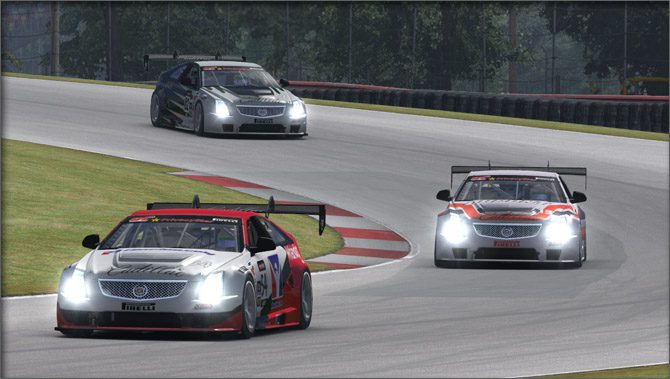
Mastering the Cadillac CTS-V iRacing machine is a lesson in patience and weight management. Unlike the nimble open-wheelers or high-downforce prototypes, the “Caddy” is a 3,200lb heavyweight with a 460-horsepower V8 that loves to overwhelm its rear tires. To find consistent speed in the Global Challenge series, you must move beyond the “maximum attack” mindset and learn the art of smooth weight transfer, disciplined throttle application, and the specific downshifting quirks that define this American GT icon.
The Downshift Snap: Taming the Rear Axle
The most notorious characteristic of the Cadillac CTS-V iRacing physics model is the “downshift snap.” Because the car features a massive V8 with significant engine braking, aggressive downshifting—especially into 2nd or 1st gear—can cause the rear wheels to lock momentarily. In a mid-corner transition, this often results in the back end kicking out and sending you into a spin. The secret to stability is “rev-matching” or waiting until the RPMs have dropped significantly before clicking the paddle. Many top drivers avoid 2nd gear entirely in all but the tightest hairpins, preferring to use the V8’s torque to pull through in 3rd.
Smooth is Fast: Managing Weight Transfer
Because the Cadillac CTS-V iRacing model is a heavy, front-engine car, its handling is dictated by weight transfer. If you “flick” the car into a corner, the momentum of the engine will carry the nose wide, resulting in massive understeer. Successful Caddy drivers use a “lazy” turn-in, allowing the suspension to set and the weight to shift to the outside tires before asking for maximum grip. On exit, the opposite is true; the torque will easily unseat the rear tires if you stab the throttle. Imagine an egg under your gas pedal—roll into the power gradually to ensure the rear end stays planted.
Driving Techniques for Success:
- Threshold Braking: The CTS-V lacks modern ABS, making it very easy to lock the front tires. Focus on a heavy initial hit followed by a smooth bleed-off as you approach the apex to maintain steering authority.
- Trail Braking: Use a tiny amount of brake pressure deep into the corner to keep the nose pinned. This is essential for getting the 3,200lb chassis to rotate in tight technical sections like the “Oak Tree” at VIR.
- Gear Selection: The Katech V8 is all about torque. You don’t need to be at the redline to find speed. Short-shifting can actually help stabilize the car and protect your rear tires over a long race stint.
Tire Management and “Greasy” Handling
In a typical 15-to-20 minute Cadillac CTS-V iRacing sprint, tire heat is your biggest enemy. If you slide the car too much in the opening laps, the rear tires will quickly become “greasy,” leading to a vicious cycle of oversteer and further overheating. Pay close attention to your steering inputs; if you find yourself using a lot of “sawing” at the wheel, you are overheating the surface of the rubber. The most efficient way to drive the CTS-V is to keep the car as straight as possible, using the V8’s grunt on the straights to make up for any time lost by being conservative in the corners.
The Gateway to GT Excellence
To conclude this Cadillac CTS-V iRacing guide, remember that this car is the ultimate training tool for moving into GT3 or GTE categories. It forces you to learn the fundamentals of car control without the safety nets of traction control or advanced aero. By mastering the weight of the chassis and the torque of the engine, you develop the “mechanical sympathy” required for any high-performance series. Respect the Caddy’s bulk, be clinical with your shifts, and you’ll find it’s one of the most rewarding drives on the service.