The Audi R18 iRacing platform serves as a digital museum for what many consider the most sophisticated era of sports car racing. As the automotive world shifted toward gasoline hybrids and eventually full electrification, the R18 e-tron quattro stood as the final, peak evolution of diesel-electric technology. In the simulator, this car represents a moment in time where “Vorsprung durch Technik” meant conquering the 24 Hours of Le Mans with a whisper-quiet V6 TDI engine and a high-speed flywheel. Exploring its legacy reveals why it remains a favorite for prototype purists.
The Final Evolution of TDI Power
For over a decade, Audi used the 24 Hours of Le Mans as a laboratory for diesel innovation, and the Audi R18 iRacing model is the culmination of that research. By the time the e-tron quattro arrived, Audi had shrunk the engine displacement while simultaneously increasing efficiency and integration with the hybrid system. This car proved that a diesel engine could not only compete with gasoline rivals but outperform them through superior fuel economy and relentless low-end torque. In iRacing, this legacy is felt every time you stretch a fuel stint further than your competitors, a hallmark of the Audi endurance strategy.
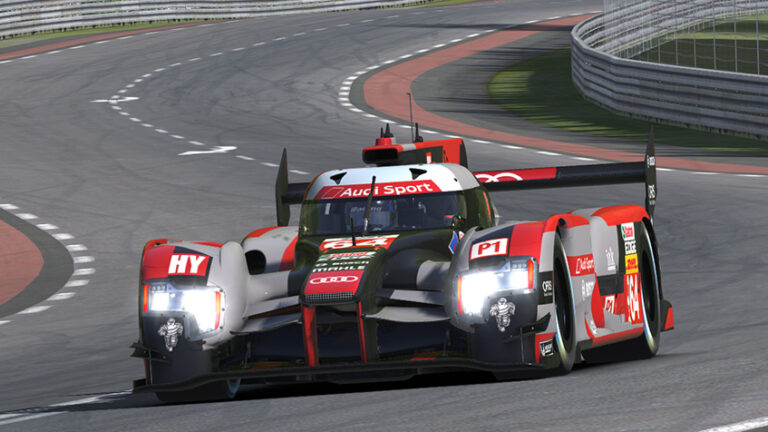
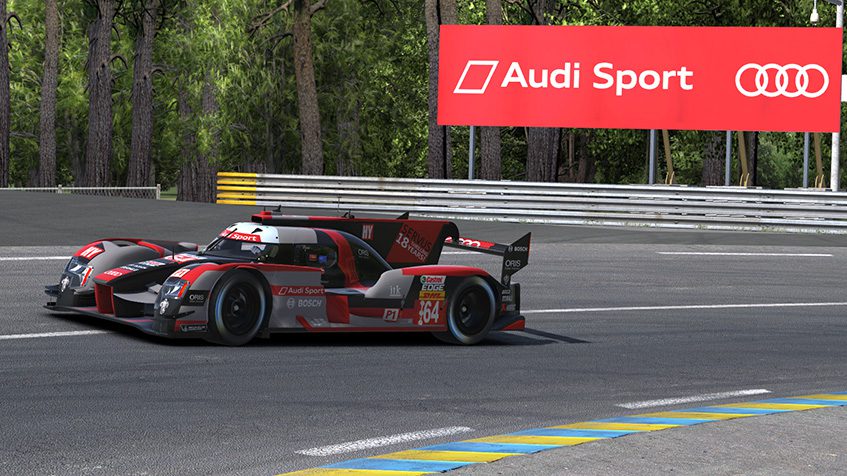
The Audi R18 iRacing prototype also represents the height of the “Aero Wars” in LMP1. Every vent, dive plane, and radiator duct was sculpted to minimize drag while maximizing the cooling required for the dense diesel powerplant. The car’s silhouette is unmistakable, featuring a narrow cockpit and a massive vertical fin designed to prevent the car from flipping during high-speed spins. It remains one of the most aerodynamically efficient vehicles ever added to the service, teaching drivers the importance of “slipping” through the air to achieve record-breaking lap times.
A Bridge to Modern Hybrid Systems
While modern Hypercars use battery-based energy storage, the Audi R18 iRacing machine utilized a mechanical flywheel. This system was capable of absorbing and discharging energy at incredible speeds, providing a violent burst of “Quattro” power that defined the car’s exit speed. This technology was a bridge between the analog racing of the past and the digital, software-defined racing of the future. In the sim, it serves as a reminder of a time when engineers were exploring diverse, creative solutions to the problem of energy recovery before the industry standardized on lithium-ion technology.
The Cultural Impact on Sim Racing
The Audi R18 iRacing addition changed the way the community viewed multi-class racing. It introduced the concept of “Active Energy Management,” where the driver’s role expanded to include monitoring harvest rates and deployment maps. This complexity paved the way for future hybrid additions to the service, setting the standard for how high-fidelity prototypes should be simulated. For many, the R18 is the “final boss” of the prototype ladder—a car that requires total mastery of physics, electronics, and strategy to drive at the limit.
The Benchmark of the LMP1 Era
As we look back at the history of the World Endurance Championship, the Audi R18 e-tron quattro remains the benchmark for diesel-hybrid performance. Its presence in iRacing allows a new generation of drivers to experience the unique hum of the TDI engine and the staggering grip of the e-tron system. It is a tribute to an era of unrestricted engineering ambition, providing a racing experience that is as much about intellectual mastery as it is about raw speed. The R18 didn’t just win races; it defined a decade of innovation that will likely never be repeated in the internal combustion world.