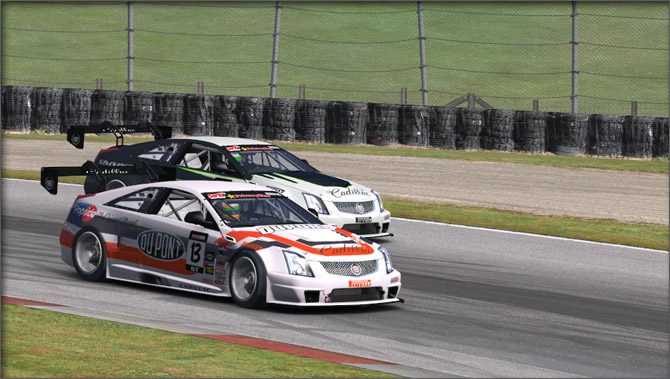
The Cadillac CTS-V iRacing experience reached its competitive peak with the creation of the Global Challenge series. This unique multi-class environment brought together two of the most disparate machines on the service: the thunderous, rear-wheel-drive Cadillac CTS-V and the nimble, front-wheel-drive Kia Optima. The resulting “grid of contrasts” became a staple of the road racing career ladder, offering drivers a masterclass in traffic management and the fundamentally different physics of American V8 power versus turbocharged touring car agility.
A Contrast in Physics: V8 Torque vs. FWD Precision
In the Cadillac CTS-V iRacing Global Challenge, the racing dynamic is dictated by how each car finds its speed. The Cadillac is the heavyweight bruiser, capable of obliterating the Kia on the straightaways thanks to its 460-horsepower Katech V8. However, the Kia Optima, despite its lower power, often proves more efficient in tight technical sections and under heavy braking. This creates a “rubber band” effect during races; the Cadillac pulls away on the straights, only to find the Kia filling its mirrors in the hairpins. For the Cadillac driver, success depends on using that V8 grunt to build enough of a gap to survive the twisty sectors.
The Cadillac CTS-V iRacing drivers must also deal with the unique challenges of multi-class traffic. Because the Cadillac is the faster class, the burden of safe overtaking falls on the CTS-V pilot. Managing the “close rate” when approaching a Kia Optima requires foresight; the Kia can brake much later and carry more mid-corner speed. Over-aggressive Cadillac drivers often find themselves “plowing” into the back of a Kia because they underestimated the braking difference between the two chassis. It is a series that rewards high racing IQ as much as raw lap time.
The Spiritual Home of the Pirelli World Challenge
The Cadillac CTS-V iRacing Global Challenge series was designed to recreate the spirit of the SCCA Pirelli World Challenge. By running on iconic North American circuits like Sonoma, Watkins Glen, and Canadian Tire Motorsport Park (Mosport), the series captured the grit of real-world “sprint” racing. The rivalry between the Cadillac and the Kia became legendary within the community, with “Team Caddy” purists regularly clashing with “Team Kia” enthusiasts. This rivalry helped populate the lower-tier splits, ensuring that there was always a packed grid of V-Series machines ready to do battle.
- Manufacturer Identity: The series allowed fans of the Cadillac V-Series to represent the brand in a highly competitive, official setting.
- Traffic Management: Learning how to overtake slower-class cars safely is a vital skill for moving into IMSA or European Sprint series.
- Fixed vs. Open: The Global Challenge offered both formats, allowing casual racers to jump into the “Fixed” series while setup gurus could tinker in the “Open” sessions.
A Legacy of Close Competition
While newer GT3 and GT4 series have since taken center stage, the Cadillac CTS-V iRacing Global Challenge remains a nostalgic favorite for long-time members. It represents a time when racing was less about electronic aids and more about managing the raw mechanical differences between manufacturers. The Cadillac CTS-V, with its signature silver-and-black livery and earth-shaking exhaust note, remains the undisputed king of this era. Whether you are chasing down a Kia or defending against a fellow V-Series rival, the Global Challenge is where the Caddy truly earned its stripes.