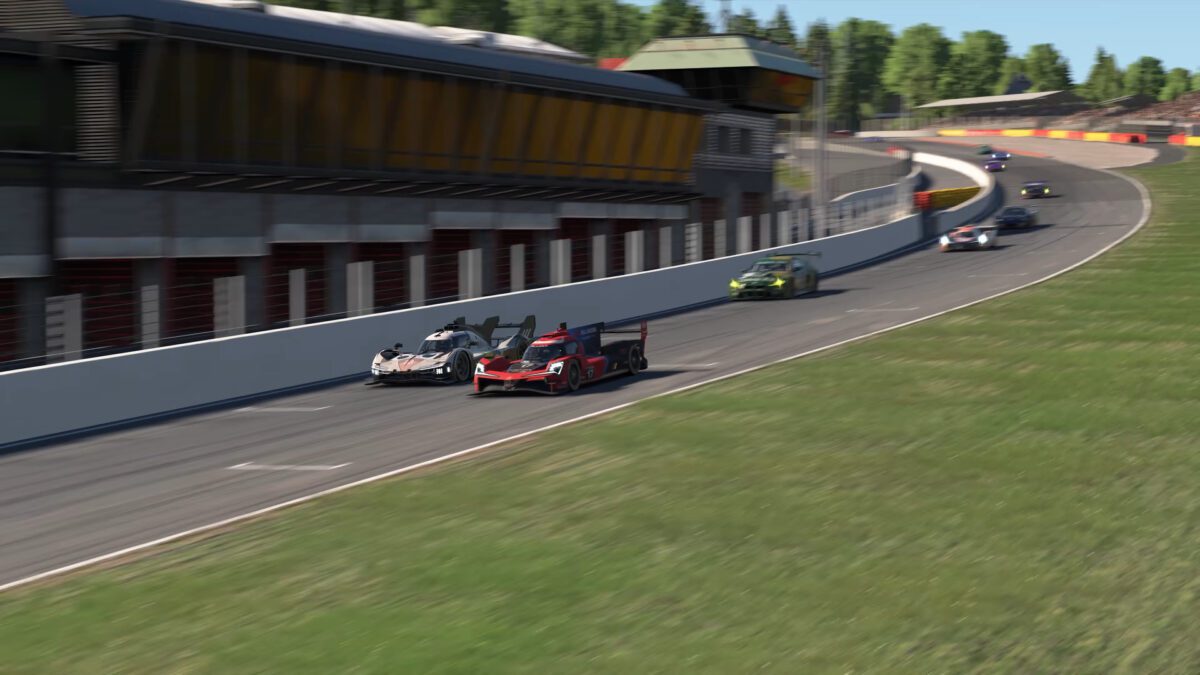
The iRacing GTP BOP system is supposed to be the great equalizer. In GTP racing, where manufacturers bring wildly different aero philosophies, engine layouts, and hybrid systems to the table, Balance of Performance exists to make sure no single car dominates on raw engineering alone. The idea is simple: level the playing field so driver skill decides the race.
In iRacing’s GTP class, that concept gets tested every single week. And if you spend any time in the forums or post-race lobbies, you’ll hear the same question over and over: is the BOP actually fair?
How the iRacing GTP BOP System Works
The iRacing GTP BOP adjustments work through a combination of power output limits, minimum weight requirements, and aero restrictions. These values are tuned independently for each manufacturer, and they’re updated periodically based on internal testing and telemetry data.
The goal isn’t necessarily to replicate real-world IMSA or WEC BOP tables. iRacing builds its own performance targets, then adjusts each car until they converge within an acceptable window. That window is tighter than most people realize, but even small gaps feel massive when you’re racing door-to-door for 45 minutes.
It’s worth noting that iRacing’s BOP process isn’t fully transparent. We don’t get detailed patch notes explaining exactly why the Porsche lost 5 horsepower or the Cadillac gained 10kg. The adjustments happen, and the community reverse-engineers the effects through testing and lap time comparisons.
The Community Perception Problem
At any given point in a season, there’s usually a car that the community considers “the meta.” Sometimes it’s the BMW M Hybrid V8 carrying too much straightline speed. Other times it’s the Porsche 963 feeling untouchable through high-speed corners. The Cadillac V-Series.R tends to draw complaints about its braking stability, and the Acura ARX-06 occasionally flies under the radar as quietly competitive.
These perceptions shift constantly, and they’re not always wrong. But they’re also not always based on clean data. A fast driver in a “weak” car can make it look dominant. A popular setup sheet for one manufacturer can inflate that car’s representation in top splits. What looks like a BOP problem is sometimes a setup distribution problem.
If you’ve noticed the Cadillac behaving differently on certain tracks, you’re not alone. We broke down why the Cadillac GTP loses speed on straights in a separate piece, and it highlights how car-specific characteristics can feel like BOP imbalances even when the overall performance window is tight.
BOP vs. Setup Optimization
This is where the conversation gets nuanced. BOP sets the ceiling for each car’s potential performance. But the gap between a baseline setup and an optimized one can be enormous in GTP cars. We’re talking multiple seconds per lap at some circuits.
When one manufacturer has a widely-shared, highly-refined setup floating around the community and another doesn’t, the results look like a BOP failure. In reality, it’s a setup ecosystem imbalance. The car with better community support looks faster because more drivers can extract its potential.
This is especially visible in lower splits, where drivers are more dependent on downloaded setups. In top split, where drivers build or heavily modify their own setups, the performance gaps between manufacturers tend to shrink significantly.
Is It Actually Broken?
Honestly, it depends on what you mean by “broken.” If you expect every car to lap within a tenth of every other car at every track, then yes, the BOP will always feel flawed. That’s an impossible standard, especially across a calendar that includes everything from Daytona’s high-speed banking to COTA’s technical sectors.
Different cars have different strengths. The BMW might dominate at power tracks while the Porsche excels at flowing circuits. That’s not broken BOP. That’s character. And managing those trade-offs across a full season is part of what makes endurance racing interesting.
Where legitimate concerns arise is when one car is consistently faster across most track types for extended periods without adjustment. That has happened in previous seasons, and when it does, the community frustration is justified. iRacing typically responds with mid-season corrections, but the lag between identifying a problem and deploying a fix can feel painfully slow when you’re on the wrong end of it.
The Data We Don’t Have
Part of the frustration comes from the fact that the community is arguing with incomplete information. We don’t have access to iRacing’s internal telemetry aggregates, their performance targets, or their testing methodology. We’re working with lap times from VRS, setup comparisons, and anecdotal race results.
That’s enough to identify trends, but it’s not enough to make definitive claims about whether the BOP is “rigged” toward any manufacturer. The people making the loudest complaints are often the ones who just got beaten by a car they think shouldn’t be that fast.
The iRacing GTP BOP isn’t perfect, and it probably never will be. But it’s closer than the forums would have you believe. The real performance gaps in most races come from setup quality, driver consistency, and race craft, not from which manufacturer badge is on the nose. If you’re losing races, the BOP probably isn’t why. But if you want to keep debating it, you’ll have plenty of company.