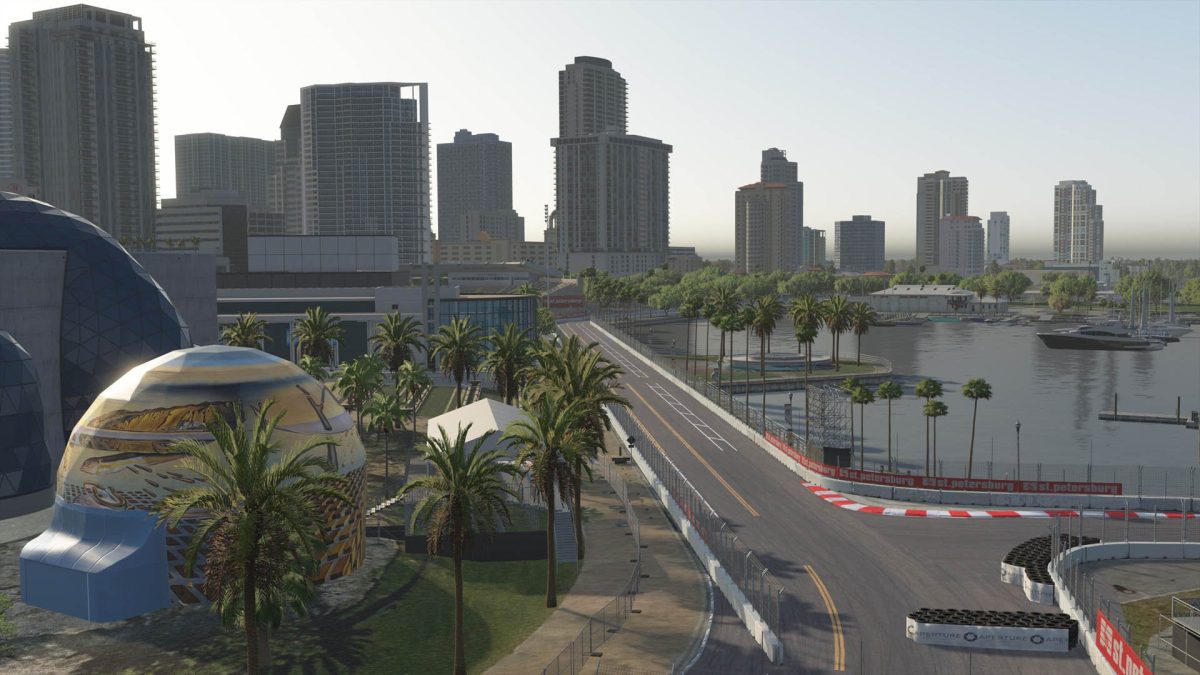
The St. Petersburg Grand Prix is one of the most recognizable street circuits in North American motorsport. It joined iRacing’s track library as part of the 2026 Season 2 build. The 1.808-mile, 14-turn circuit sits in the heart of downtown St. Petersburg, Florida, using the city’s waterfront streets and an airport runway to create a layout that rewards precision over aggression and experience over raw pace. Here’s what you need to know about it.
Real-World History
St. Petersburg’s relationship with motorsport goes back to the mid-1980s, when the city hosted races on temporary circuits through its downtown streets. The sport returned briefly in the mid-1990s before departing again, and when it came back for good in 2003, it was with CART organized a return to the waterfront with a modified version of an earlier layout. The event found its current form in 2005, when INDYCAR took over the Grand Prix of St. Petersburg and it became a fixture of the series calendar, often serving as the official season opener.
For twenty years, St. Pete has provided the first meaningful laps of the INDYCAR season. The chaos of its Turn 1 chicane at race starts has launched more championship campaigns and ended more of them than any other single corner in the series. Notably, the track has a particular reputation for opening-lap drama that follows the series all season long.
In 2026, St. Petersburg made additional motorsport history by hosting the first NASCAR Trucks race on a street circuit, adding another chapter to the venue’s already interesting resume. The combination of 600-horsepower pickup trucks and concrete barriers produced the exact kind of spectacle you’d anticipate.
The Circuit Layout
The lap starts on the main runway of Albert Whitted Airport, which serves as the start-finish straight. It’s a long, flat acceleration zone that gives cars time to build genuine speed before the circuit turns into the city grid. The straight is one of the better overtaking opportunities on the track, and cars arrive at Turn 1 at significant speed.
Turn 1 is a tight chicane that requires cars to drop speed aggressively and thread through a narrow gap before continuing into the circuit proper. At race starts, this corner is where the field compresses and incidents happen. Turn 2 and Turn 3 carry the circuit out of the chicane and into the city streets, connecting to the section of 1st Street SW that forms the first part of the downtown segment.
From Turn 4 through Turn 9, the circuit passes through what INDYCAR regularly describes as the most technically demanding section on its calendar. This complex of medium-speed corners requires a very precise rhythm: each turn feeds directly into the next, and a slightly wrong entry at Turn 4 has consequences that run all the way through to Turn 9. This section rewards drivers who have taken the time to properly learn the reference points and penalizes those who are still estimating. Getting it right is the primary separator between fast drivers and very fast drivers at St. Pete.
After the technical complex, the circuit opens onto Bayshore Drive SE and a sequence of longer straights separated by medium-speed corners. These stretches provide the track’s main overtaking opportunities outside of the airport straight, where a car that has got a tow on a straight can attempt a move into one of the following braking zones. The final section of the lap sweeps through a pair of right-handers that require commitment to drive correctly. The exit of the final corner sets up the run back toward the airport straight, and cars that get it right carry meaningful speed advantage into the following lap.
What Makes St. Pete Challenging
Street circuits share one fundamental characteristic. This makes them different from permanent tracks: the walls don’t move. There’s no gravel trap, no tire wall, no run-off asphalt to give you a moment of deceleration before contact. At St. Pete, the concrete barriers are immediately adjacent to the racing line throughout much of the circuit. The margin for error is small enough that being a foot off your intended line often means contact.
Turn 1 represents the biggest single risk on the circuit, and particularly at the start of a race. Every driver arrives at the end of the airport straight at the same time, in close proximity, all braking and changing direction into the chicane simultaneously. Incidents at Turn 1 expect, not exceptional. The conventional wisdom at St. Petersburg race starts is that surviving Turn 1 intact is worth more than any position gained through an ambitious move into the corner. This applies in iRacing exactly as it does in real life.
The Turns 4-9 complex requires the kind of reference point accumulation that takes multiple sessions to build. Unlike a single hairpin with a clear apex, the sequence has interconnected entries and exits where each corner shapes the next. A driver who has five sessions at St. Pete will be significantly faster through this section than a driver doing their second session, even if raw pace is similar elsewhere on the track.
The walls throughout the downtown section leave very little margin. Particularly in the tighter portions of the circuit, being even a few inches off the ideal line consistently results in contact. The track rewards clean, methodical driving and punishes drivers who rely on aggressive saves and improvised lines.
Series at St. Petersburg in iRacing
St. Petersburg is available for all road racing content in iRacing. In official events, open-wheel cars using the Dallara IR18 and the Dallara IL-15 are the natural fit given the track’s INDYCAR heritage. GT3, GTE, and TCR content also works well at the circuit. The tight barriers and demanding braking zones are a good test of car control across all these classes.
In hosted sessions and leagues, the track is compatible with essentially any road racing car. The track’s character suits lower-powered, lower-downforce cars particularly well. The mechanical grip and braking ability of the car are more prominent factors than outright aerodynamic performance.
Who Should Buy St. Petersburg
If you follow INDYCAR, this is an obvious purchase. St. Petersburg is the series’ spiritual home track and one of the most referenced venues in North American open-wheel racing. Having it in iRacing means you can learn a circuit you’ve watched every spring for years.
If you run GT or touring car content and want a street circuit that genuinely challenges your racecraft, St. Pete delivers. Lapping it cleanly and consistently takes real work. The progress you make at this track translates directly to improved car control on any circuit. The track launched with AI Racing enabled, so practice sessions against AI are available from day one.