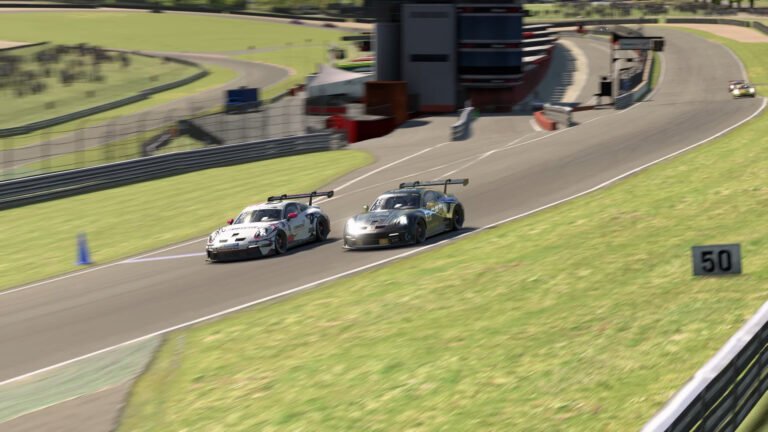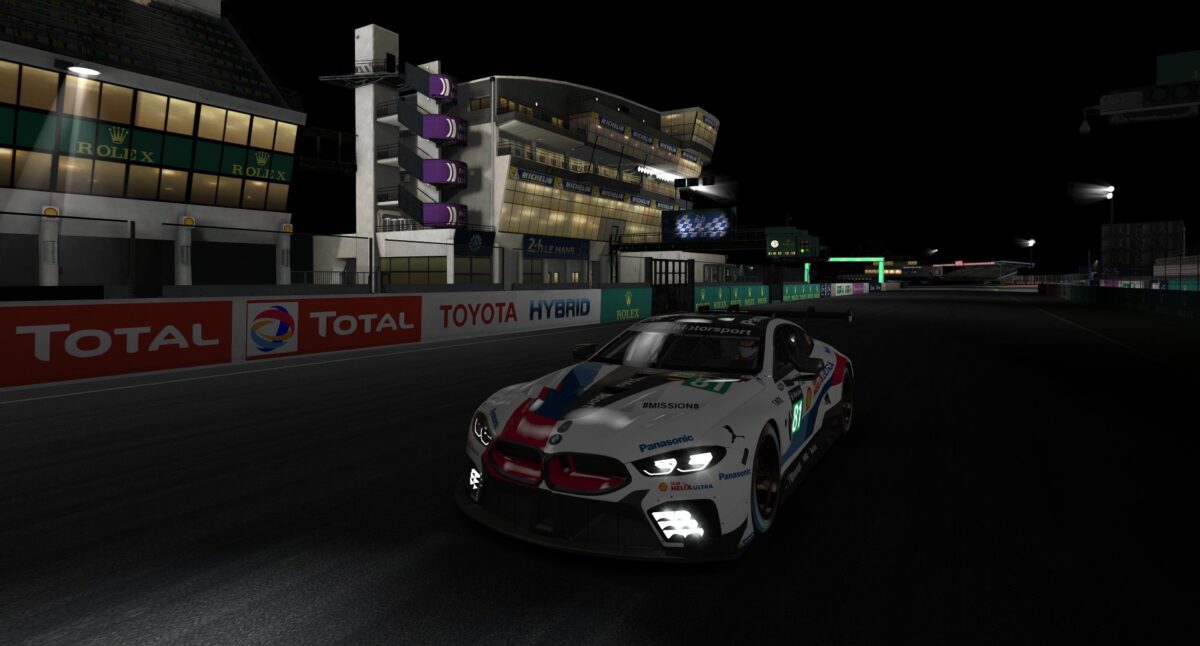
The BMW M8 GTE iRacing setup screen is a playground for those who understand high-downforce suspension geometry. Because the M8 is a front-engine car with a long wheelbase (2880 mm), your setup goal is to minimize “pitch” while maximizing “rotation.” In the GTE class, where every tenth matters, your garage adjustments are the difference between a car that fights you for 30 laps and one that feels like an extension of your hands. The following deep dive outlines the essential adjustments needed to turn the M8 into a race-winning machine.
The Aero Platform: Managing Rake
In the BMW M8 GTE iRacing setup workflow, “rake” (the difference between front and rear ride height) is the single most important adjustment. The M8 loves a “nose-down” attitude. By lowering the front ride height and slightly raising the rear, you force the front splitter to work harder, creating a vacuum effect that kills the car’s natural understeer. However, you must be careful not to over-rake the car; if the rear is too high, the car will become unstable under high-speed braking. Use the in-game Aero Calculator to find a balance where your “Front Downforce” percentage is between 38% and 42% for most tracks.
Mechanical Grip: Springs and Dampers
Because the BMW M8 GTE iRacing is a “heavy” racer (1313 kg dry weight), it requires stiff front springs to prevent the nose from “diving” and stalling the aero during threshold braking. We recommend stiffening the front springs to keep the aero platform stable, while running slightly softer rear springs to help the car “squat” and find traction on corner exit. Additionally, pay close attention to your “low-speed” dampers. Increasing front low-speed compression will make the car feel more direct during the initial turn-in, while softening rear low-speed rebound will help the car stay settled when you’re aggressively jumping the curbs at tracks like Road America.
- Brake Bias: Typically runs best between 51% and 53%. Move it forward if you are locking the rears on entry; move it rearward to help the car rotate.
- Differential Preload: A higher preload (around 150-200 Nm) will make the car more stable on corner exit, while a lower preload will help with mid-corner rotation.
- Tire Pressures: Aim for “hot” pressures around 27-29 PSI. The M8 is hard on its front tires, so monitor your temperatures to ensure you aren’t “cooking” the outer edges.