The GTP class in iRacing is one of the most watched categories on the service. Factory-backed prototypes, varied manufacturers, mixed-class racing alongside LMP2 and LMP3. But one question keeps coming up in the community: why does the Balance of Performance feel off, and why does it seem so hard to fix?
The answer involves how GTP cars work in real life and what iRacing can and cannot simulate accurately. The gap between those two things is where the BOP problem lives.
What Balance of Performance Is Supposed to Do
Balance of Performance is a regulatory tool used in real endurance racing to keep different manufacturer prototypes competitive with each other. The FIA and ACO apply BOP adjustments through weight, fuel capacity, power output, and ride height restrictions to ensure no single manufacturer holds a structural advantage. The goal is close racing between cars that are fundamentally different machines.
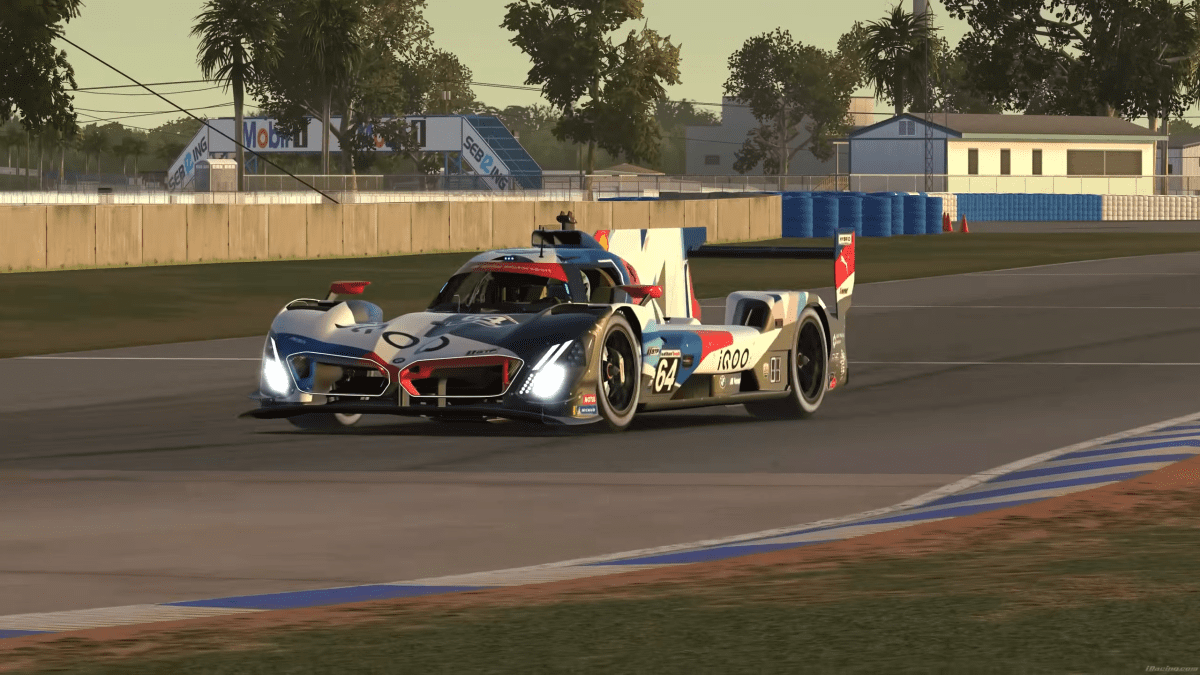
In iRacing, the same concept applies. The GTP class includes the Acura ARX-06, BMW M Hybrid V8, Cadillac V-Series.R, Ferrari 499P, and Porsche 963 among others. These are cars with different aerodynamic philosophies, different power delivery characteristics, and different baseline performance levels. BOP is meant to equalize them so car choice is not the deciding factor in a race result.
The Virtual Energy System Problem
The biggest gap in iRacing’s GTP BOP is the virtual energy system, or VES. In real GTP racing, hybrid systems play a central role in how cars perform. Each manufacturer’s hybrid architecture is different. Some cars deploy hybrid power more aggressively through corners. Others concentrate it at the exit. Some store more energy per lap. Others sacrifice energy recovery for outright aerodynamic efficiency.
The FIA’s BOP for real GTP racing accounts for hybrid deployment patterns as part of the balance calculation. Two cars might produce identical lap times under controlled conditions, but their energy curves across a lap are different, which means BOP adjustments go beyond raw speed into the details of how each car manages its power delivery across a stint.
iRacing’s current GTP model does not fully replicate the hybrid energy systems of each manufacturer. The cars have performance differences baked in through physics modeling, but the detailed deployment and recovery characteristics that distinguish a Porsche 963’s hybrid from a Ferrari 499P’s are not modeled at the level of granularity that real-world BOP accounts for. This creates a situation where iRacing applies a one-dimensional BOP to cars that in reality have multi-dimensional performance characteristics.
Inconsistent Parity Across Track Types
Even setting aside hybrid complexity, GTP cars in iRacing show different relative performance depending on the track layout. A car that feels balanced at Road America may feel dominant at Laguna Seca. A car that seems slightly behind at Daytona Road Course can lead the pack at Sebring.
This is not unique to iRacing. Real GTP racing shows the same behavior. In real racing, however, the FIA can issue mid-season BOP updates targeting specific track-type performance imbalances. iRacing’s BOP updates come seasonally, which means a car that overperforms at specific track types can stay at that level for an entire season before any adjustment arrives.
The community discussion tends to focus on which cars are fastest at specific circuits rather than which car is fastest overall. Some iRacers have noted that the car-choice advantage at individual tracks can reach several tenths per lap, which at GTP speeds translates to significant race-pace gaps regardless of driver ability.
Track-Type BOP: The Aerodynamic Variable
The track-type consistency issue connects directly to each car’s aerodynamic philosophy. High-downforce tracks like Spa and Monza expose aero differences between manufacturers. Low-downforce configurations expose power delivery differences. Street circuits with slow corners put a premium on mechanical grip and low-speed balance.
Real GTP BOP is adjusted for aerodynamic configurations per event. A car that runs a high-downforce package might receive a lower power allowance at Spa to offset its cornering advantage. The same car might receive a higher power allowance at Monza where the low drag setup naturally reduces its advantage elsewhere.
iRacing’s seasonal BOP does not have that per-event specificity. A single BOP value for a car across all track types means a compromise. The car may be correctly balanced at a typical road course but over-performing at tracks that particularly suit its aerodynamic configuration. That is perhaps the clearest explanation for why community members consistently report different car parity at different circuits.
Why Fixing It Is Harder Than It Looks
The obvious response is to update BOP more frequently. The practical problem is that iRacing needs a process to measure and adjust performance without introducing instability. If BOP changes come too often, setups and driving strategies become obsolete mid-season. iRacers who invest time learning a specific car’s strengths find those strengths changed before they can use them in competition.
The deeper challenge is that without a full virtual energy system model, iRacing is balancing cars based on lap time data rather than on the full performance envelope that real BOP accounts for. Two cars that produce similar lap times in testing can behave very differently under race conditions, in traffic, under tire degradation, and across stints of different lengths. A BOP based on testing laps does not capture those differences.
Some iRacers in the community have argued that the answer is building more detailed hybrid modeling into the cars over time. That would allow iRacing to balance the class the way real BOP does, accounting for energy deployment and recovery as part of the package rather than just lap time as a single number.
What It Means for Drivers in the Class
For most iRacers in the GTP class, the BOP situation means car choice matters more at some tracks than others. At the highest levels of the class, the car you run at Laguna Seca may not be the optimal choice at Silverstone.
The community consensus is that all the GTP cars are fun to drive and broadly competitive. The BOP issue becomes most visible in close championships and endurance events where small consistent gaps accumulate into meaningful margins. In casual racing, the differences are real but not race-deciding for most drivers.
If you are new to the GTP class and choosing a car, pick the one whose characteristics suit your driving style. Lap time data from specific events will tell you which car the leaderboard favors at a given circuit if that matters to you. Otherwise, drive the one that feels right and adjust if you find yourself consistently off the pace at specific tracks.
The BOP discussion in the GTP community is a sign of how seriously iRacers take the class. You do not spend time debating the details of a category you are not invested in.